
French Revolution
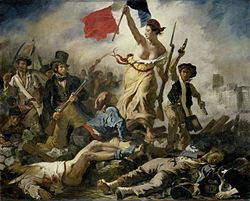
The French Revolution is recognized as the most violent and the most universally significant of late 18th-century Western revolutions. During the period in France, an increasingly prosperous bourgeoisie class aspired to political power, and land-owning peasants hoped to remove the last vestiges of feudalism to acquire full landowner rights. Growing population density, crop failures, economic crises, and heavy governmental expenditures served as catalysts. Enlightenment thinkers such as Montesquieu, Voltaire, and Rousseau provided theoretical foundation for the French Revolution.
The Estates-General met in 1789, with the Third Estate (the non-clerical, non-aristocratic class) demanding vote by head rather than estate. The political unrest led to the gathering of troops around Paris, resulting in the Parisian crowd’s seizure of the Bastille. The National Constituent Assembly issued the Declaration of the Rights of Man and of the Citizen. In subsequent years, the National Constituent Assembly enacted a series of reforms, including abolishing feudalism, expanding suffrage, and nationalizing the land of the Church. After the war with counterrevolutionaries in 1792-1794 and the Reign of Terror in 1793-1794, Napoleon Bonaparte seized power in 1795 and proclaimed the end of the Revolution.
The French Revolution was a rich theoretical resource for J. S. Mill. Reading the history of the Revolution for the first time, Mill was astonished that the principle of democracy, then insignificant in most parts of Europe, had held sway in France. Later, he wrote in defense of early French Revolutionists against the Tory misrepresentation, and pondered writing a history on the Revolution. Even in launching the Westminster Review and forming a circle around radicalism, Mill aimed to imitate the French philosophes.
Sources:
“French Revolution”. Encyclopedia Britannica. https://www.britannica.com/event/French-Revolution
Mill, John Stuart. Autobiography.