
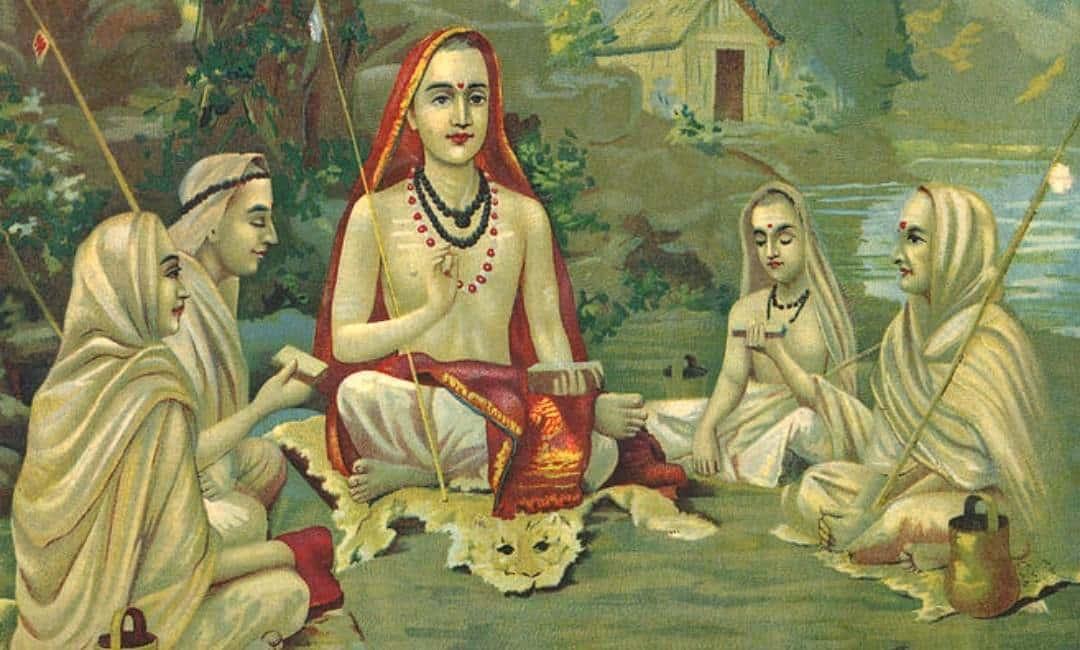
Advaita means “non-duality,” and Advaita Vedanta is a school of Indian philosophy that adheres to monism. It argues that there is no distinction between Brahman, the immanent god of Hinduism, and the world, and that the appearance of multiplicity is an illusion. This means that there is no distinction between the soul and God. Based on interpretations of the Upanishads, Advaita Vedanta is an ancient tradition but is now most associated with Shankara, a teacher and philosopher, who lived in the eighth century CE and advanced the school. In the nineteenth century, a lawyer named Vivekananda who belonged to the Brahmo Samaj propagated a version of Advaita Vedanta that became known as Neo-Vedanta. This movement claimed to be representative of Hinduism as a whole and held that advaita was the essence of all religions. With its emphasis on universalism, Neo-Vedanta was well received by western audiences and shaped the West’s understanding of Hinduism.
Sen references “advaita” once in her autobiography. She recounts how she went to see a sage who gave her an overview of the concept of advaita. He says “Because most human beings do not have an awareness of advaita, non-duality of the Creator and creation, we worship God as something separate.” (70) Sen seems sympathetic to this philosophy, describing the ascetic holy man with reverence. Though she is often accused of being a Christian, Sen’s monotheism leans towards monism, as evidenced by her visit to the holy man, and so has deep roots in traditional Indian philosophy.
Menon, Sangeetha. “Advaita Vedanta.” Internet Encyclopedia of Philosophy, iep.utm.edu/advaita-vedanta/#H1. Accessed 25 May 2024.
Johnson, W. (2009). Vivekānanda, Svāmī. In A Dictionary of Hinduism. : Oxford University Press. Retrieved 25 May. 2024, from https://www.oxfordreference.com/view/10.1093/acref/9780198610250.001.00….