

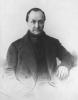
Auguste Comte (1798-1857) was a French philosopher and the founder of positivism. In his youth, he worked as secretary for St. Simon who would remain an enduring influence despite their early break. Comte’s first major philosophical work Course on Positive Philosophy was published in six volumes between 1830 and 1842 and outlined many of the ideas now associated with positivism. In Course on Positive Philosophy, Comte attempts to classify and develop a philosophy for each of the physical sciences (math, astronomy, physics, chemistry, and biology). Furthermore, he seeks to integrate social science or sociology into this system, arguing that this forms the sixth and most complex science. The desires to relate and systematize disparate fields of human knowledge and, in particular, to theorize sociology as a science were key features of positivism. Another significant feature was Comte’s theory of the stages of history, also developed in Course on Positive Philosophy. Strongly influenced by St. Simon, this theory divides history into theological, metaphysical, and positive stages.
While Course on Positive Philosophy was highly influential, Comte’s other important work System of Positive Polity, or Treatise on Sociology, Instituting the Religion of Humanity (1851-1854) in which he more fully developed the political implications of positivism met with controversy, earning him the scorn of former supporters, such as John Stuart Mill. In the System of Positive Polity, Comte advocates for a strong spiritual power distinct from a temporal one. This spiritual power, whose centralized and universal nature was modeled on the papacy, would be composed of scientists. Additionally, Comte proposed a Religion of Humanity, which denied the existence of any supernatural beings and worshiped human society and the great men of history instead. With its strong emphasis on worship and ritual, Comte’s new religion was accused of being a secular form of Catholicism.
In his autobiography, John Stuart Mill praises Comte’s early philosophical work while condemning his later social and religious theories, calling them “The completest system of spiritual and temporal despotism which ever yet emanated from a human brain, unless possibly that of Ignatius Loyola.” (Mill 120) Mill’s reflections on Comte and his philosophical influence accord with the autobiography’s general tendency to acknowledge Mill’s intellectual debts to other thinkers. However, this section is unusual in its departure from Mill’s typical position of neutrality. Though he maintains the appearance of evenhandedness by acknowledging both the good and bad aspects of Comte’s work, such scathing phrases as the above suggest a depth of animosity that is almost unique in the autobiography.
Citations:
Bourdeau, Michel, “Auguste Comte”, The Stanford Encyclopedia of Philosophy (Spring 2023 Edition), Edward N. Zalta & Uri Nodelman (eds.), https://plato.stanford.edu/archives/spr2023/entries/comte/. Accessed 18 May 2024.