
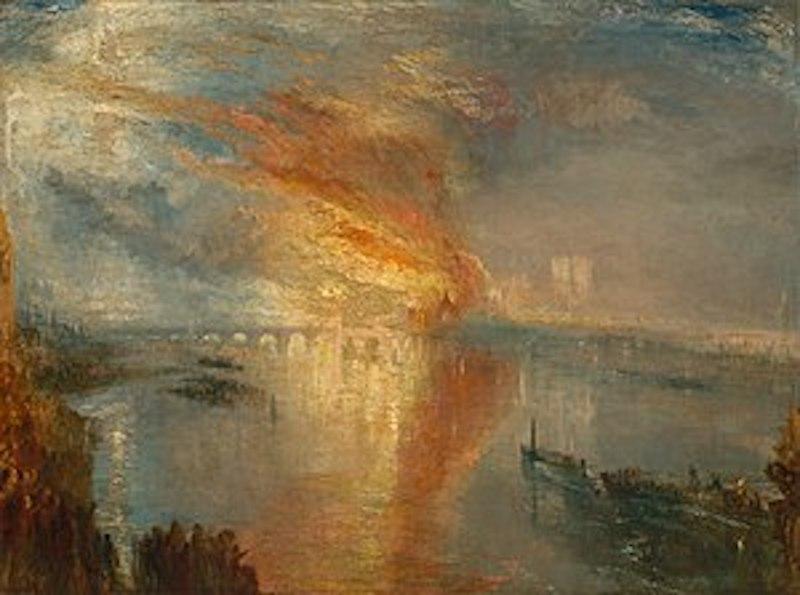

J.M.W Turner’s watercolor painting The Burning of the Houses of Parliament depicts the 1834 fire which destroyed a large portion of the Palace of Westminster – along with the Houses of Lords and Commons. On the 16th of October, along the Thames riverbank, Londoners were enraptured by the blaze which consumed Westminster. One such onlooker happened to be renowned Victorian painter, J.M.W Turner who claimed to have quickly executed the painting on the spot. Scholars still debate whether The Burning of the Houses of Parliament was made from preliminary sketches or en plein air. The public was craving images and renditions of the fire – Turner filled the demand.
Turner was known for his fascination with conflagrations – large fires which are particularly destructive to communities. Art historians note that the immense fire as seen in The Burning of the Houses of Parliament was influenced by his earlier painting The Pantheon, the Morning after the Fire. Much like the theme of ecology in Gaskell’s North and South some scholars have interpreted Turner’s nebulous conflagration as a statement about the overwhelming polluted air which affected London.
In 1835 the Royal Commission held a contest about which style the new parliament should be built-in: Gothic or Elizabethan. August Pugin – who we discussed in class as being responsible for the rebirth of the Gothic style and used the example of a poor house to argue one of his many points – sought to submit his Gothic designs. Due to converting to the Roman Catholic church his work had to be submitted through the names of other architects. Much like Mr. Hale in North and South Pugin was unable to operate in English society after his conversion due to the supremacy of the Anglican church. In fact, the designs sent in with his true name were rejected outrightly due to religious reasons.
The Burning of the Houses of Parliament was not only a work done by a seminal Victorian artist but also trace the history of the Palace of Westminster as the world knows it today.
Works Cited
Boase, T. S. R. “The Decoration of the New Palace of Westminster, 1841-1863.” Journal of the Warburg and Courtauld Institutes, vol. 17, no. 3/4, Warburg Institute, 1954, pp. 319–58, https://doi.org/10.2307/750325.
Eigen, Edward. “On the Record: J. M. W. Turner’s Studies for the ‘Burning of the Houses of Parliament’ and Other Uncertain Bequests to History.” Grey Room, no. 31, The MIT Press, 2008, pp. 68–89, http://www.jstor.org/stable/20442792.
Matthew Imms, ‘The Burning of the Houses of Parliament c.1834–5 by Joseph Mallord William Turner’, catalogue entry, May 2014, in David Blayney Brown (ed.), J.M.W. Turner: Sketchbooks, Drawings and Watercolours, Tate Research Publication, February 2017, https://www.tate.org.uk/art/research-publications/jmw-turner/joseph-mal…, accessed 26 October 2021.