
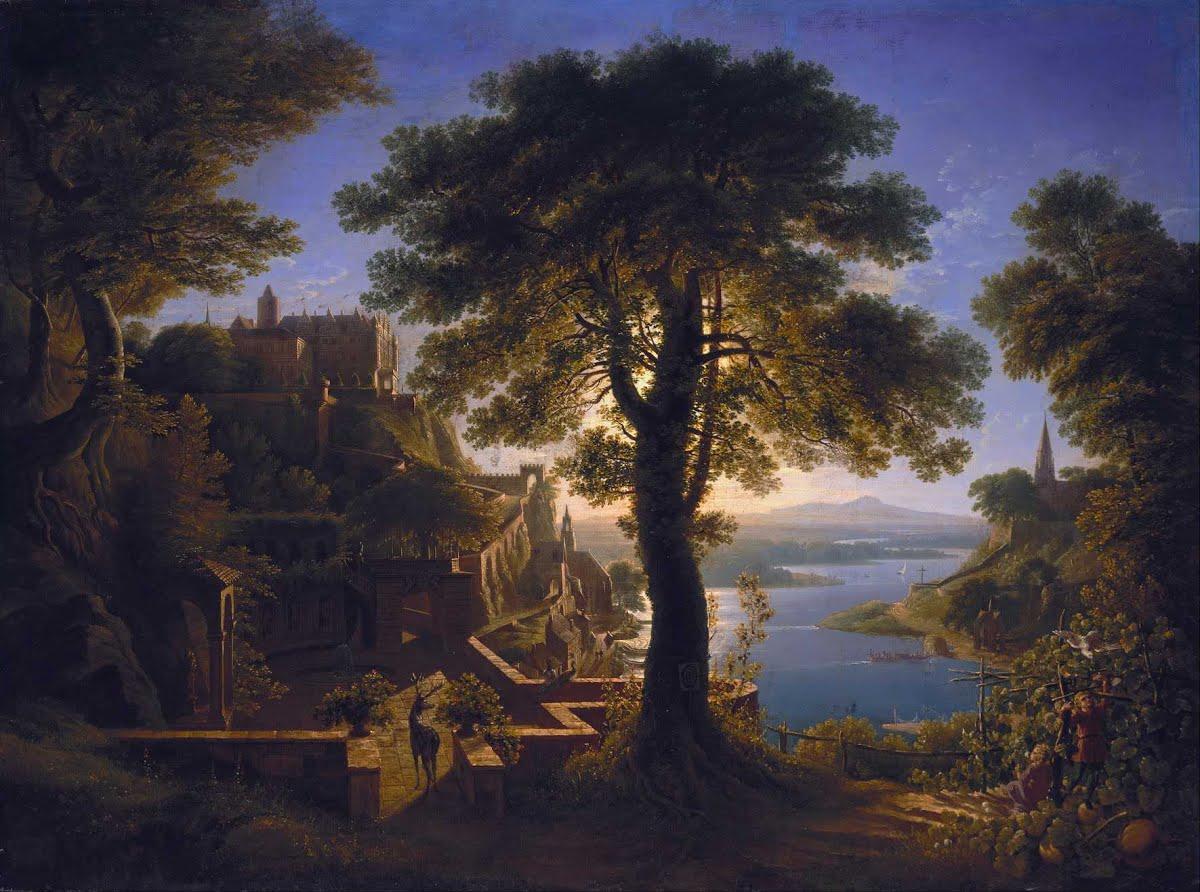
Karl Schinkel’s painting Castle by the River (1820) offers a glimpse of what was once a man-made architecture entirely absorbed by nature. The background of the artwork involved two artists, Schinkel had created this oil painting based on the narrative of a poet, Clemens Brentano. There are several elements of verism as Schinkel provided a detailed and realistic approach to the abandoned structure by overlaying it with vegetation and wildlife. Although realism was introduced in the 1850s, Brentano’s narrative rendered a subtle introduction while honouring the deserted castle's nature. With that said, Schinkel conclusively paid tribute to Romanticism as the aesthetics of nature and the sublime were emphasized as one. Schinkel had brought a combination of realism and Romanticism to the oil painting by saturating the colours and maintaining the earthy tones. The sober colours illustrated by Schinkel represent nature’s time as the Sun remains in the center impersonating a transient from day to nightfall. Despite the combination of the polar opposite movements, there remains a balance of colours that exhibits a peaceful atmosphere surrounding the piece. With Brentano’s narrative including the basis of life and death, Schinkel disregards the aspect of human life and presents classicism in his painting by not exhibiting passionate depictions. While preserving the order of nature at its most authentic state, Schinkel shared a sense of serenity as he brushed enough colours to convey life into the art piece. The transcience and clarity in Castle by the River, showcased Schinkel's take on classicism and Romanticism as he paid no heed to humankind and became inclined to visualize Earth's mystery without it.
Keywords: Oil Painting, Nature, Architecture, Germany
Location: Alte Nationalgalerie, Staatliche Museen zu Berlin (Berlin, Germany)