
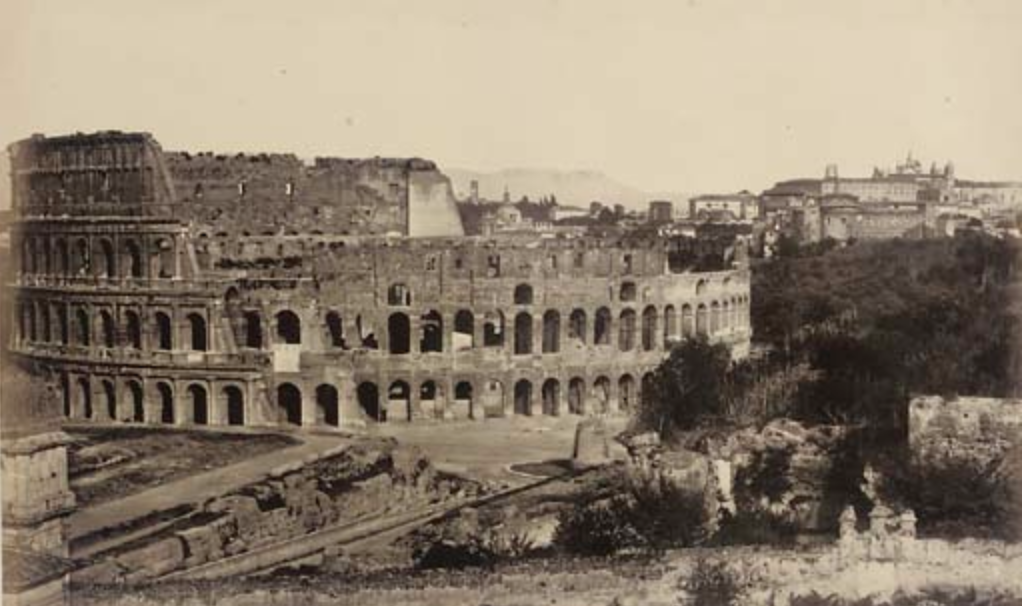
Having served a multitude of unrelated functions—from a bullring to a wool factory, and having suffered the effects of both fires and earthquakes, in 1749 Pope Benedict XIV declared the Colosseum a sacred site based on the likely erroneous belief that Christian martyrs had been sacrificed to the lions in the arena. He subsequently banned the pillaging of its stones for use in the construction and restoration of other buildings, and the ruin became less of a tourist destination and more of a stop on a religious pilgrimage. By the 19th century, botanists were flocking to the building to catalog the flora grown unchecked, and artistic renderings of the site—such as J. M. W. Turner’s 1819 The Colosseum, Rome, by Moonlight—depicted the monument and its environs more as a landscape painting than an architectural study. In 1818, Percy Bysshe Shelley wrote that it had, “been changed by time into the image of an amphitheater of rocky hills overgrown by the wild olive, the myrtle, and the fig tree.” Byron in the fourth canto of his Childe Harold’s Pilgrimage writes of its “splendor” as “The garland-forest, which the gray walls wear, / Like laurels on the bald first Caesar’s head.” Byron’s perspective echoes that of botanist Richard Deakin—who wrote in the Preface of his 1855 publication Flora of the Colosseum of Rome that the plant-life growing in the Colosseum, "flourish[es] in triumph" and "form[s] a link in the memory, and teach[es] us hopeful and soothing lessons, amid the sadness of by-gone ages" (vi).