
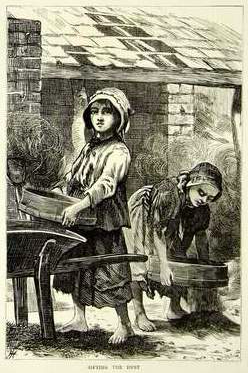
The Factory Act of 1844 was passed after the Factory Act of 1833 flopped. The 1833 act limited the working day for 13-17 year old children to twelve hours and eight hours for 9-12 year old children. However, businesses found loop holes, so the Factory Act of 1844 was an attempt to reinforce children's rights. The Factory Act of 1844 was passed on June 15, 1844. It limited the hours children could work even more and applied some of these rules to women. With the newer act, children ages 9 to 12 were limited to work for six and a half hours. Children ages 13 to 18 and women were limited to twelve hour days. The Act also enforced a minimum of three hours of schooling each day for the younger children. Because of the ineffective 1833 act, additional rules and stricter punishment were also put in place. Dangerous machinery, which children had previously been forced to clean and operate, had to be fenced off in a way that prevented children from working on it or going near it. Additionally, children were no longer permitted to clean other machines while they were in operation or in motion. It also became a criminal offence to dismiss the 1844 act. In fact, this proved to be the most effective difference between the acts of 1833 and 1844. People were now allowed to be charged with the same charge multiple times, with different individuals, and in different locations.
The Factory Act of 1844, as well as the acts passed later in an effort to preserve the rights of children, had a tight knit relationship with literature. Many writers boldly addressed child labor in their work which lead to more discussion around it and served as vocal support for acts like the Factory Act. Charles Dickens was one of these well-known writers who refused to shy away from child labor—which hit so close to home for him. Some of his most notable stories that address child labor are A Christmas Carol, Oliver Twist, and David Copperfield. Dickens wasn't alone in this fight. Writers like Charles Kingsley, Frances Trollope, and Charlotte Elizabeth all made it a point to write about the horrors of child labor. "The Chimney Sweeper" by William Blake and "The Cry of the Children" by Elizabeth Barett Browning are two poems that joined ranks with the previously mentioned stories in the fight for children's rights. This vocalization for child rights by influential writers of the time served as an important step towards the passing of the Factory Act of 1844 and the subsequent child labor acts.
Sources
Education in Victorian Britain
"The Successful Prosecution of the Factory Acts, 1833-55"