
Journal Entry:
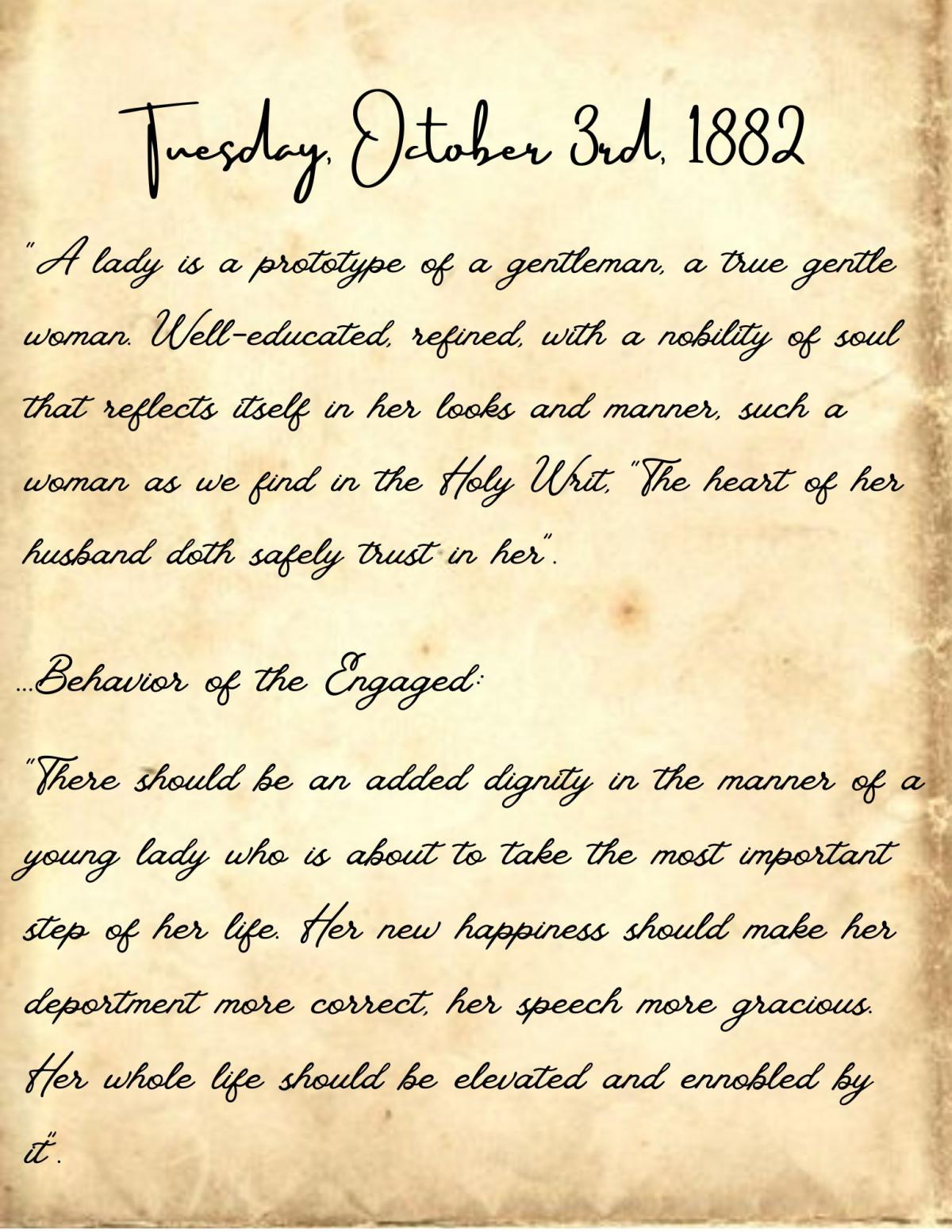
I stumbled upon this book a few weeks ago and I haven’t put it down since. It has great advice for how a woman like me should act. I still keep coming back to this specific line. Well… I am having trouble figuring out how to step into this new chapter of being a bride. I cannot believe I am getting married after all these years to Edward Marsh. Just a few years ago he was struggling to pay rent. I was in love with him before, but now it is so much more than that. I was so jealous of my sister's youth that I deemed the possibility impossible. I felt like my time was past, and that it would never come, but here we are. I am definitely excited to be a bride, but I am nervous at the same time. How do I act after all of these years? I don’t want to leave my sisters behind but I need to walk into this new chapter with gratitude and an open mindset. It has been my dream to be married, and although I love the photography studio, I believe I will flourish as Edward’s wife. Edward has always been so lovely to me. He is definitely the gentleman that this book describes. How did I get so lucky? I hope my sisters get married too. Although, I am not sure if all of them want to. They are too focused on the studio, which I understand, but how can you miss out on love? It is my turn to be the lovely bride, the gentle wife, and the homemaker. I can finally rest in the stability of this new role.
Editorial Commentary:
Individualistic feminist attitudes do not seem to take a toll on “young” Frances Lorimer. Through her writings, the perspective of the "New Woman" seems to daunt her. Fanny appears to be a woman of mere tradition, lacking nothing, except for the reassurance of how to be a gentle wife. In this time period, women began to explore their opportunities. One modern women's suffragist Millicent Garrett Fawcett argued, "Womanliness grows and thrives on whatever strengthens the spontaneity and independence of the character of women" (Fawcett). It seemed as though women in the Victorian time period were unsettled, unsatisfied, and searching for something new. This something new may not have brought in the big dollars, but Fanny is rest assured that her life will be stable after she conjoins with Edward’s financial prospects. One can conclude that Fanny may agree with some of the New Woman ideals, but partially cannot align out of fear. Fanny’s perspective overall contributes to the changing gender roles within the nineteenth century. At first, women in the nineteenth century were "evaluated by four virtues of piety, chastity, submission, and domestic life" (Borumand). Consequently, this "restriction" of women led to the "New Woman" outbreaks, where those eager enough stepped out of their traditional feminine roles and formed new standards of living. Women were determined to make a change and they didn't care what the world thought. One trend that changed was that women started to be more interested in romantic love and not just arranged love. Here, the reader is incapable of determining if Fanny is actually in love with Edward, or if marriage was just her ideal livelihood. Fanny resorts to the title of the “Old Woman”, while still supporting her sisters that take on the “New Woman” title. Fanny is hopeful, full of dignity, and ready to take on the duties of the homemaker, a name that has been pushed for centuries.
Borumand, Safura. “The Issue of Self and Other: The Identity Challenge of Victorian Women: (Case Study: CMS Women’s Interaction with Women of Qajar Era).” International Journal of Humanities, vol. 29, no. 3, 2022.
Fawcett, Millicent Garret. “The Appeal Against Female Suffrage: A Reply. I.”, 1889.
Rayne, M. L. (1882). Gems of deportment and hints of etiquette: The ceremonials of good society, including valuable moral, mental, and physical knowledge. Tyler & Co. and R.D.S.