
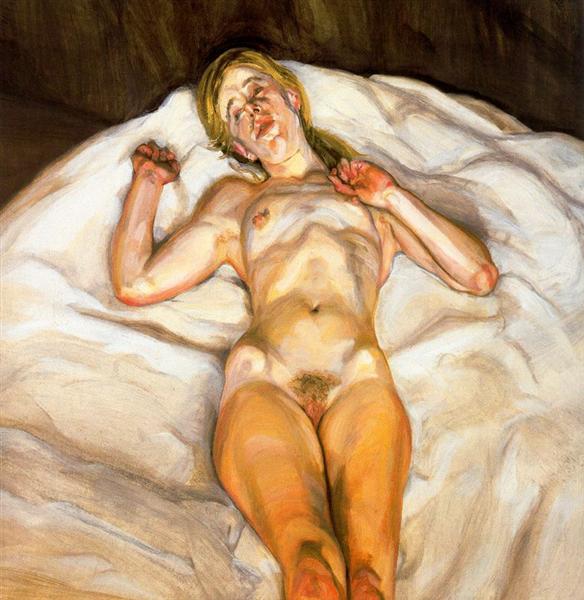
This timeline provides a sociohistorical context for Lucian Freud's 1966 Naked Girl.
Timeline
Table of Events
| Date | Event | Created by |
|---|---|---|
| Sep 1939 to Sep 1945 | World War Two and the HolocaustIn 1933, the Nazi regime rose to power in Germany, eventually sparking the beginning of World War two September of 1939. This was the most violent and deadly war to have occurred. In total, around 85 million people died including civilians and military deaths. The world was forever changed by this death toll. One of the most horrific causes of deaths during this time were from the Holocaust. 6 million Jews were murdered, along with millions of other “enemies” to the Nazi regime, such as 1.8 polish civilians (not including the Jewish population), 70,000 criminals, 312,000 Serb civilians, and many more. Lucian Freud was one of the lucky few who fled to Britain in 1933 before the carnage began. All of these deaths had severe, lasting impacts on people around the world. Three percent of the total population had vanished in only six years. Those that made it home from war were severely scared and traumatized by what they had seen. Many were disabled. It changed the public’s view on war and on death. In America, war had for so long been something we were proud of participating in and an event that showed our glory and power. But after World War Two, while the Allies had “won”, the resulting deaths and damage partly tore away this notion and reminded everyone how deadly and horrible war really was. It helped everyone value peace times and led to many war protests later on in History. It also amplified the importance of individual life, when such a bulk had been lost to one cause.
|
Kierra Weyandt |
| circa. Summer 1945 | Lucien Freud meets Francis BaconIn 1945, Graham Sutherland introduced Francis Bacon, a rising expressionist painter, to Lucian Freud. Apparently, the two became instant friends and met often at night, drinking, and gambling together. They were also reported to have lunch every day. While there was a thirteen-year age-gap, the two were very close in experience in art, which helped them grow together. They both painted portraits in surrealism and expressionism, but with marginally different methods. Freud was famous for taking particularly long with painting portraits, having his models pose for several months before a painting was completed. Bacon, on the other hand, painted very quickly. Mentioned in the article “Lucian Freud’s first drawings of Francis Bacon”, Freud had said, “He talked about packing a lot of things into a single brushstroke, which amused and excited me, and I realized that it was a million miles away from anything I could ever do.” Their friendship unfortunately fell off and they both publicly denounced each other’s art in 1982. However, the two artists painted each other several times throughout their friendship. One of these paintings, Three Studies of Lucian Freud, painted by Bacon in 1969, was sold in 2013 for 142 million dollars in New York, cementing their friendship in history.
|
Kierra Weyandt |
| Jul 1963 to Oct 1966 | The Moor's MurdersFrom July 1963 to October 1965, a violent string of murders terrorized Britain. Myra Hindley and Ian Brady kidnapped and murdered 5 children. The first was Pauline Reade, 16, who went missing on July 12, 1963, on her way to a dance. They took her to the Moors outside of Manchester, raped, and then murdered her. That same year on November 23 they kidnapped 12-year-old John Kilbride. The following year on June 16th they kidnapped 12-year-old Keith Bennet, and then 10-year-old Lesley Downey on December 26. All murdered, raped and then left on the Moors. Their final victim was 17-year-old Edward Evans, on October 6th, 1965. Ian and Myra had moved in with Ian’s brother-in-law that year, who assisted in hiding the body of Edward and then immediately told police that night. Ian and Myra were both arrested October 7th. Throughout the investigation, they discovered John Kilbride and Lesley Downey’s body, as well as documentation of her torture. In 1966, they were most found guilty. Ian Brady was given life and Myra Hindley also received life in prison, and seven additional years. They were only charged with three of the five murders, since only three bodies had been discovered. The Moors Murders quickly rose into notoriety in Britain. What was especially alarming to the public was the involvement of Myra Hindley in the abduction, rape, and murder of the children. While Myra insisted that Ian was forcing her to help him, it was undeniable that she helped with all parts of the crimes, and never stopped helping. The ideal of a woman being mothering and caring towards children was shattered when she was arrested and convicted.
This delve into the History before Lucian Freud painted Naked Girl in 1966, helps me explain the implications behind his painting. Naked Girl depicts a woman lying on her back on white fabric, not covering herself, but looking away from the observer with an uncomfortable expression. Her upper body and face is highlighted, while her lower body is darker, drawing your eyes from the center to lead to her face. Freud is particularly known for creating an empathetic bond between the subject and the observer. In this case, the subject is not called a woman, but a girl. While she has pubic hair, her body-type is thin and her breasts are not well-developed, causing the observer to associate her with youth. With the background of the Moors Murders, it is possible to link this disgusting assault on children with Freud’s depiction of this woman. Those murderers stripped away the lives and innocence of those children, regardless of their gender. The horror and fear that echoed in the public can be seen echoed here. This woman lies on a white background, a color associated with innocence, and the highlight on her body draws your eyes to the parts of her that appear young and helpless. Her expression causes you to feel uniquely uneasy for her. This interpretation can also be linked with the influence of the casualties from World War Two. Freud sought for the observer to empathize with the subject. He also tried to make the subject feel as real as possible. During World War Two, the focus was on the protection of the nation, not the people, and after, once the death tolls came in, the shock rebounded in people everywhere. With his paintings, Freud brings the attention back to the individual. His exaggeration of flesh colors and the subject’s vivid expressions draws the observer to connect with the subject as though it is a real person – because it is. Lastly, the residual effects of Freud’s relationship with Francis Bacon can be found in this art piece. Freud loved the way Francis Bacon slathered paint onto the canvas and used colors to express emotions. The ominous coloring of the background behind the white cloth in contrast to the warm-toned colors that make up her body hint to the darker undertones of the painting. Her expression, again, is particularly vivid, similar to Bacon’s Head VI, which is another painting expressing the complicated post-war emotions surrounding the number of deaths. "Francis Bacon and Lucian Freud". https://www.francis-bacon.com/news/francis-bacon-and-lucian-freud. Accessed Mar 27 2022. "Lucian Freud's First drawings of Francis Bacon". September 2018. https://www.christies.com/features/Lucian-Freud-1951-drawings-of-Franci…. Accessed Mar 27 2022. "Research Starters: Worldwide Deaths in World War II". https://www.nationalww2museum.org/students-teachers/student-resources/r…. Acessed Mar 27 2022. "Timetable of Moors Murders Case".https://www.theguardian.com/uk/2002/nov/15/ukcrime. Accessed Mar 27 2022. Rothman, Joshua. "A New History of the Second World War", 23 December 2017.https://www.newyorker.com/books/page-turner/a-new-history-of-the-second…. Accessed Mar 27 2022. Sherman, Elisabeth. "The Strange Story of Myra Hindley and The Moors Murders".https://allthatsinteresting.com/myra-hindley-moors-murders. Accessed Mar 27 2022. United States Holocause Memorial Museum. "Documenting Numbers of Victims of the Holocaust and Nazi Persecution". https://encyclopedia.ushmm.org/content/en/article/documenting-numbers-of-victims-of-the-holocaust-and-nazi-persecution. Accessed Mar 27 2022.
|
Kierra Weyandt |