
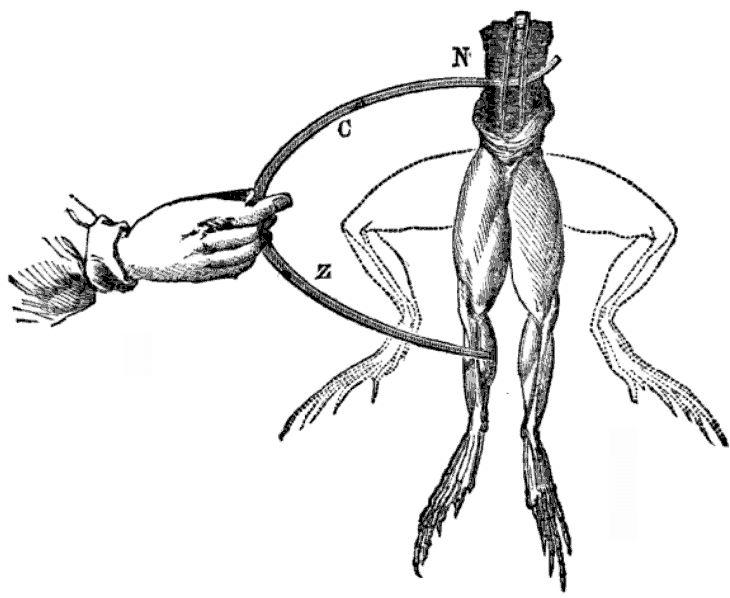
Shelley’s main character, Victor, uses the theory of Galvanism to give life to his creature. Galvanism involves the application of electrical current to body tissue which leads to muscle contraction. In the article “Galvanism and Scientific Discovery” the birth of Galvanism is explained:
Late in the 18th century, Scientist Luigi Galvani, who was experimenting on dissected frogs, mistakenly touched a brass rod to a steel scalpel making a clear contraction of muscle in an otherwise dead frog. He believed that this form of electricity, which he called “animal electricity”, was a form of energy that was still being held in the animal’s tissue. Today, it is referred to as Electrophysiology, and scientists are aware that it is not in fact electrical fluid streaming from the brain that makes the animal twitch but instead just the effect of the joining of two metals and their electrical charges.
Victor’s creature is brought to life by a spark of electricity. He is surprised that no one else has made this simple discovery. He soon finds out that he has made a horrible mistake by putting his discovery to work.
“Galvanism and Scientific Discovery.” Mary Shelley’s FRANKENSTEIN, 16 Apr. 2012, frankensteinproject.wordpress.com/2012/04/16/galvanism-and-scientific-discovery-5.