
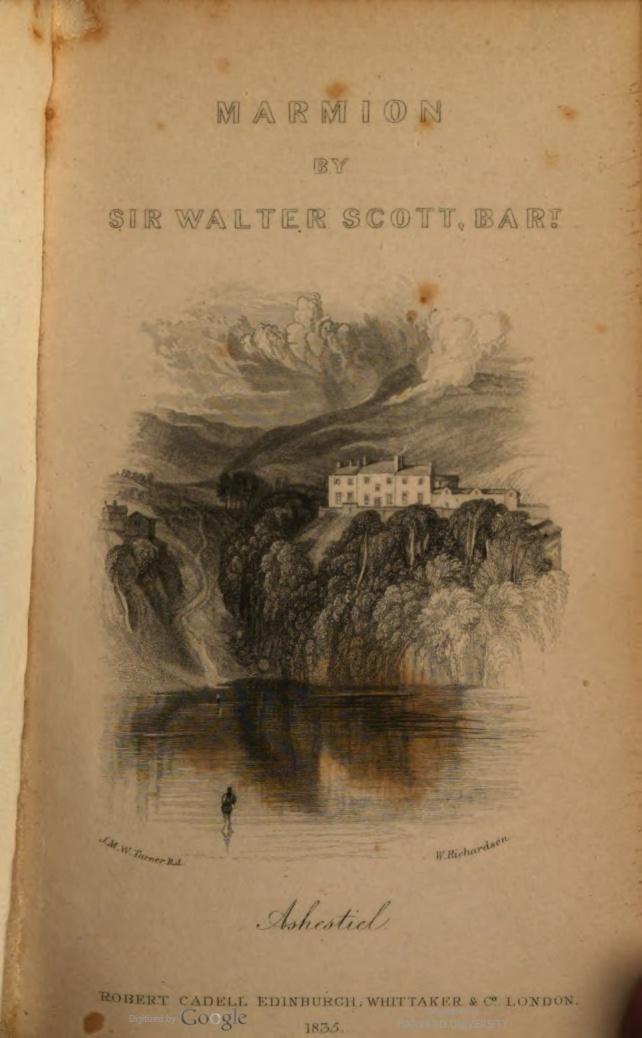
This photo is of a reprinted edition of Walter Scott's poem Marmion, originally published February 22, 1808. This poem is one of many examples of poems and other literature being reprinted and repackaged in a more decorated fashion during the Victorian stage of the Industrial Revolution, as well as being scaled down to be more affordable to lower classes. This became a common practice as technology during this time was advancing, allowing flashier prints, engraving, and illustrations to become more common for publishers to invest in, as it was both easier to manufacture books with these characteristics, and easier to sell these books and recoup the costs. The growing middle-class and the rising literacy rates also contributed to the easier sale of these books and the higher demand for them. Even though these prints were cheaper to manufacture, they were still expensive to buy, and people of modest means would have to carefully select which books they would want to invest in. There were “pocket” editions of some of these stories however, and even though they were more affordable, it was still not an expenditure to be taken lightly. Scott’s publisher decided to capitalize on this in 1825, printing these “pocket” editions to sell more of his popular stories to lower-income readers. Despite the cheaper price, this edition gets added steel engravings, and some editions get illustrations done by Joseph Mallord William Turner, a famous artist with high fees, showing that it was becoming much easier to manufacture books with these characteristics during this time. One of these editions is mentioned in The Tenant of Wildfell Hall, which takes place in 1827, as Gilbert gifts one of these to Helen as a gesture of affection and a way for them to continue bonding over their shared love of literature. Anne Brontë uses descriptions of Gilbert’s workday to illustrate how being a gentleman farmer was a well-paying job at the time, but not to the point of being able to afford luxurious manufactured books without a second thought. Gilbert’s gifting of it, as well as Helen’s reaction, being surprised and attempting to reimburse him, showed how much of an expenditure this would have been, and how this kind of gift was usually reserved for special occasions with loved ones. The Tenant of Wildfell Hall incorporates many elements regarding Victorian Era readers and their reading habits, and this scene is a comment on how the middle-class, which the Brontë sisters grew up in, interacted with the printing and publishing of books at the time. Practices such as printing cheaper and shorter editions of books to sell to lower classes or to put in libraries were used by authors and publishers to make more money and allow more people to engage with their stories, and the Brontës engaged with this in their real lives growing up.