
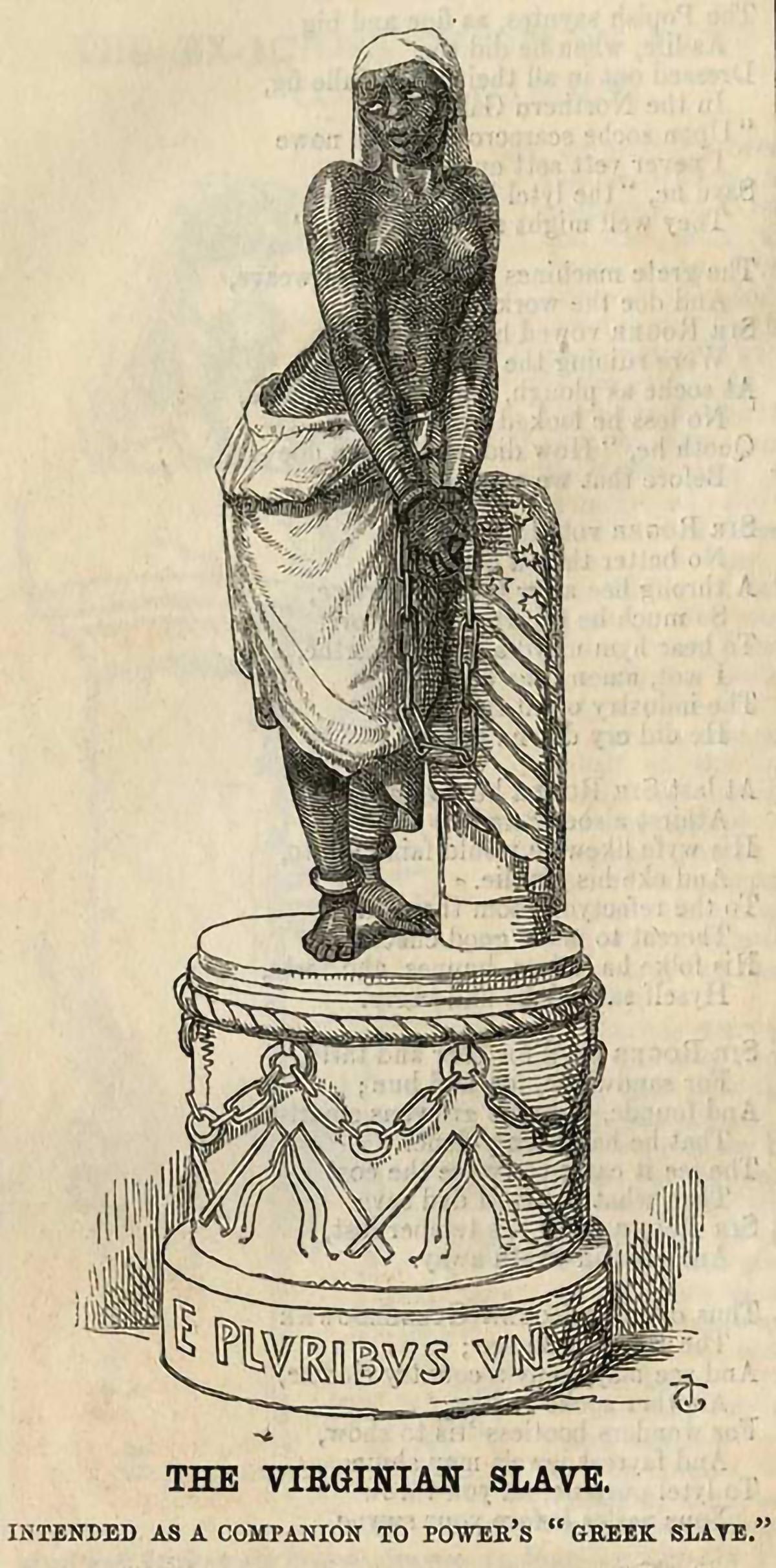
On June 7, 1851, Punch, a satirical London-based magazine, published a series of critiques of the Great Exhibition of 1851. Though these various cartoons and written criticisms ranged from class disparities to the exportation of cultural and economic production, this image by John Tenniel, titled The Virgininian Slave, Intended as a Companion to Hiram Power's [sic] Greek Slave, was unaccompanied by any additional commentary. By this time, Powers's work was well-known in both London and abroad in the United States, and readers of the magazine would have understood Tenniel's work as a direct parody of Powers's original statue.
Tenniel's cartoon was not the first critical reaction to the relationship between the Greek Slave and the depiction (or lack thereof) of race in the context of enslavement. When the first model of the Greek Slave went on an exhibitionary tour around the eastern United States in the decade before the American Civil War, the statue was met with varied praise and critique. While some American reviewers, like newspaper editor and publisher Horace Greeley, lauded the statue for its beauty, other newspapers, including satirical journal Yankee Doodle, were more critical:
"If the object of Mr. Greeley's peculiar admiration had happened to be some poor negress from the rice fields of the South, we should no doubt have heard of great doings among the abolitionists, and read some fearful denunciations in the Tribune about the cruelty and the hard-heartedness of slave owners. But no sooner is a beautiful Greek slave announced, than, Presto!—the sympathy of Mr. Greeley takes another direction, his admiration is excited, and we find him perfectly willing that she should be continued in bondage. We ask Mr. Greeley if this is consistent? Whether he ought not in justice to his avowed principles, exert all his influence to liberate this slave of Mr. HIRAM POWERS...
We understand that the Greek Slave is pinioned very tight, with no possibility of escaping with her life, and that [the] many rabid abolitionists have seen her, are loud in their demonstrations of delight; none of them manifesting the remotest desire to free her from her present confinement. She seems quite resigned and has never been heard to murmur in the least at her cruel fortune, although she always appears to be on the point of speaking." (Yankee Doodle, 28 Aug. 1847, 201)
Scholars have previously pointed out that "Prior to the Civil War, the sculptor diplomatically refused to admit that the Greek Slave might be a commentary on the American slave system, although after emancipation he freely took credit for the progressive abolitionism of his earlier works, including the Greek Slave" (Miller 648).
Image Source: Punch 20, June 7, 1851: 236.