



Introduction
Virginia Woolf’s “The Lady in the Looking-Glass: A Reflection” features the theme of the materialism of fashion and the oppression of women. Throughout the reflection, we see descriptive imagery that focuses on the furnishings of Isabella Tyson’s room and attire questioning the oppression of women through the materialism of fashion. Woolf describes Isabella as having the “qualities one had discovered into this visible body. There were her grey-green dress, and her long shoes, her basket, and something sparkling at her throat” (Woolf). These lines emphasize what Isabella’s status is as a woman. This imagery of fashion materialism causes a conflict of reality and self.
The inspiration behind Woolf’s writing of this specific piece involves the oppression of women through status seen through the materialism of fashion. It’s important to note that Isabella towards the end of the reflection faces a mirror and is described as “naked in the pitiless light”(Woolf). All the wealth and materialism has taken a toll on her. Materialistic things throughout the centuries symbolize wealth and status, but can you separate the two to see who's behind it or do we get lost in it? For example, the picture of Madonna in the music video “Material Girl” shows a woman enjoying the wealth and the fashion. It shows men admiring her for all the lavish things. However, it goes deeper into materialistic gain rather than oppression seen in the Victorian image of a woman dressed nicely, but the look on her face says more. Even though Woolf’s reflection comes from the 19th century, we still see how fashion plays off itself especially in different eras.
From the Victorian era following up to today, fashion has changed drastically. In the Victorain era women wore “dresses covering their entire body” (Victorian Era). However, they were “prohibited from even showing their ankles” (Victorian Era). Fashion became more risky as it evolved from women wearing corsets because it was a social standard to fashion evolving into this rebellious phase of showing skin. Each image explores the materialism of fashion and what it means for each era.
Mahabal, P. Victorian Era Women's Fashion. Dresses, Clothing and Gowns. Victorian Era.
http://victorian-era.org/victorian-era-womens-fashion.html.
Woolf, V. The Lady in the Looking-Glass: A Reflection. Studio.covecollective.org.
Fig.1 Sire,. “Material Girl”. WordPress, 23 Jan. 1985, https://davidsshelf.wordpress.com/2020/04/09/hidden-meanings-in-materia….
In Madonna’s “Material Girl” we see a woman enjoying the attention of men and what she is wearing. Her dress would have been considered revealing. This is the 80’s era where fashion was bold and meant to test fashion standards. In Woolf’s reflection she says, “ One must put oneself in her shoes. If one took the phrase literally, it was easy to see the shoes in which she stood” (Woolf). Isabella did not wish to be known as the rich spinstress because she is more than that as an individual. This relates back to the photo of Madonna because she is the opposite of Isabella. She is taking the attention and wealth and boosting herself up hence ‘Material Girl.’ We are left with our imagination as she is wearing something revealing and is covered in shiny jewelry. Is she rich? Is she doing it for the money or attention? Isabella is oppressed by her materialism while Madonna here in this photo seems to be enjoying herself.
Fig. 2 Marks, G. “Mirror Fasts”. New York Times, 2015, http://www.nytimes.com/2012/08/16/fashion/mirror-fasts-help-take-the-fo….
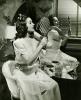
The photo of a woman from the 60’s reveals that fashion was still conservative. Not as revealing, but a woman kept herself neat and clean to be presentable. The mirror in her hand is symbolic to how much a woman had to keep herself presentable. Woold wrote that, “People should not leave looking-glasses hanging in their rooms any more than they should leave open cheque books or letters confessing some hideous crime” (Woolf). The symbol of a mirror in the reflection presents a conflict of individuality vs reality. Isabella seemd to struggle with how she was veiwed by others and how she was unable to come to terms with who she was when she looked at herself in the mirror with all the fine things she had. Fashion materialism conceals who a person is and can make one get lost in it. The woman is looking at herself, and is lost in her reflection of what society wants to see.
Fig. 3 West, R. Victorian Beauty. 2021, https://www.vintag.es/2021/08/victorian-ladies.html.
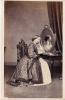
The Victorain era for fashion was very conservative. Women were seen wearing full on dresses that covered the arms, legs, and shoulders. Women of considerable status had elaborate fabrics and stylish homes. As seen in Robin West's “Victorian Beauty,” we see a woman wearing the traditional fabrics surrounded by a vanity in an open room. Her expression is solmn as she does not appear to be looking in the mirror. “Look, as she stood there, old and angular, veined and lined, with her high nose and her wrinkled neck, she did not even trouble to open them” (Woolf). This represents the end of Woolf’s reflection well because in the end we see a separation between woman and fashion. Woolf describes seeing the truth in the mirror which symbolizes what society sees (recognized by Isabella) and without the mirror symbolizes one's indivduality. The Victorian era's oppressive view of women through fashion materialism was caused by the domestic sphere such as women with clean looks and homes. So in this picture do you see the woman or the domestic influence on fashion materialism?
Fig.4 Zahradka, J. French Women. 29 Sept. 2016, https://www.insider.com/style-mistakes-american-women-make-2018-7.
In modern fashion, we see relaxed and bold intentions unlike the Victorian era and Woolf reflection. This picture is from Paris Fashion Week in 2016. This is significant because people come to view and dress the way the trends are for the season. As Woolf said “people should not leave looking glasses hanging in their rooms,” (Woolf), modern fashion is advertised by the media. The media becomes the mirror of Woolf’s reflection, which can be oppressive because it influences compulsive buying. It’s similar to Woolfs reflection because society still plays a part in oppressing women through fashion materialism. Back then if you did not follow the standards you were excluded while today's fashion is constantly in your face by the media so it can be seen as more difficult to separate oneself from materialism, one can start making comparisons about themselves. Fashion materialism, according to a research project, manages identity and the ability to maintain self-awareness (Liu). As you look at this gallery, do you think fashion materialism affects you too?
Fu, Shuxiang, and Yaozhong Liu. "Research Progress on the Influence of Materialism and Its Interventions." Psychology, vol. 10, no. 03, 2019, pp. 358– 70, https://doi.org/10.4236/psych.2019.103025.