
Lucy Lorimar Commentary:
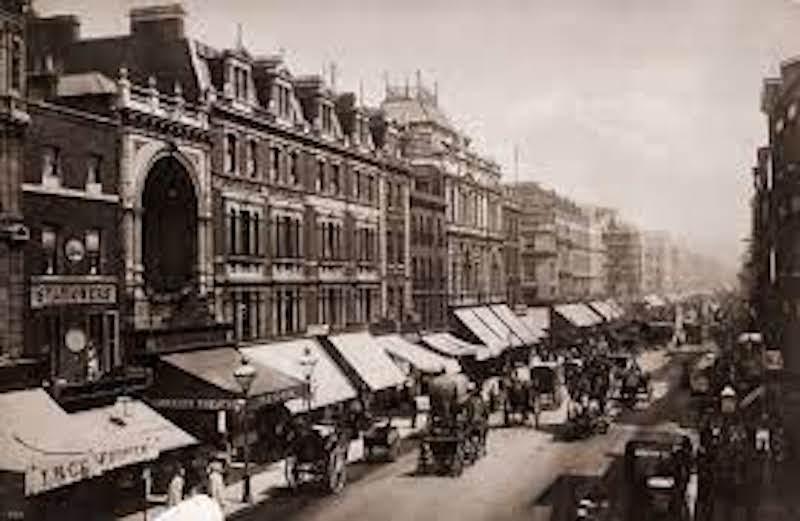
I saw this picture in the newspaper today. The busy streets of London remind me of so many details, the sounds of people and horse and buggies, the smell of bakeries, the sight of busy people rushing from job to job. The picture is quite simple though as it is only a picture of a street of London; however, it brings up so many memories. This picture reminds me of my father who recently passed away. The busy street reminds me of how he would rush out the door to head to work and walk along this same street. It also reminds me of when he would take my sisters and I to eat at restaurants on the weekends and we would walk along this same street. I wish I was able to spend more time with him before he passed. After my father’s passing, my sisters and I have had to start working to pay for our necessities in life. For example, we need to pay for housing and food to keep on living. We had to take over his role as the supplier of necessities and now we are the ones rushing out the door every morning to head to work. To successfully take over as working women to supply for the household, we have decided to continue further with our collective passion of photography. By helping each other succeed, we hope to open a photography studio soon to continue paying for our necessities. I soon will leave for an apprenticeship at a nearby photography studio run by a family acquaintance. While I am nervous to leave my sisters, I know that it is my duty to help and provide for my sisters. After my apprenticeship, we will be able to open our very own photography studio run by only women. I am so proud of all my sisters and what we plan to achieve.
Editorial Commentary:
The photograph depicts a busy street of 19th century London with horse and buggy and many businesses alongside the road. London played a key role in the 19th century as being a center for trade and politics. Because of this, London became the capital of the British Empire in the 19th century. The reason London became a center for growth and the capital of the great British Empire was because of major streams of migrants flowing to the city prior to the nineteenth century (Mcquillan 51). The migrants came from all over the world to participate and help grow the amazing city of London. However, because so many migrants decided to move to London, the city ended up with many flaws. While London was known for being a center for trade and politics, the city was filled with impoverished people looking for any kind of work and large amounts of sickness being spread extremely quickly in such close quarters. In the photograph depicted above, the streets of London look clean and swept and the air looks mostly clean. However, the reality of 19thcentury London was dirty streets from horse manure, dust from horses and walking, and smog from factories covering everything. The busy work environment and capital of the British Empire seemed like an amazing idea as it would stimulate economic and political growth. However, London ended up not being an amazing place to grow up or live in despite the detailed writings of Lucy Lorimer in her description and commentary of the picture posted above.
Works Cited:
McQUILLAN, KEVIN. “Moving to the City: Migration to London and Paris in the Nineteenth Century.” Sociological Focus, vol. 16, no. 1, 1983, pp. 49–64. JSTOR, http://www.jstor.org/stable/20831270. Accessed 11 Oct. 2023.
“‘Dirty Old London’: A History of the Victorians’ Infamous Filth.” NPR, NPR, 12 Mar. 2015, www.npr.org/2015/03/12/392332431/dirty-old-london-a-history-of-the-vict….