
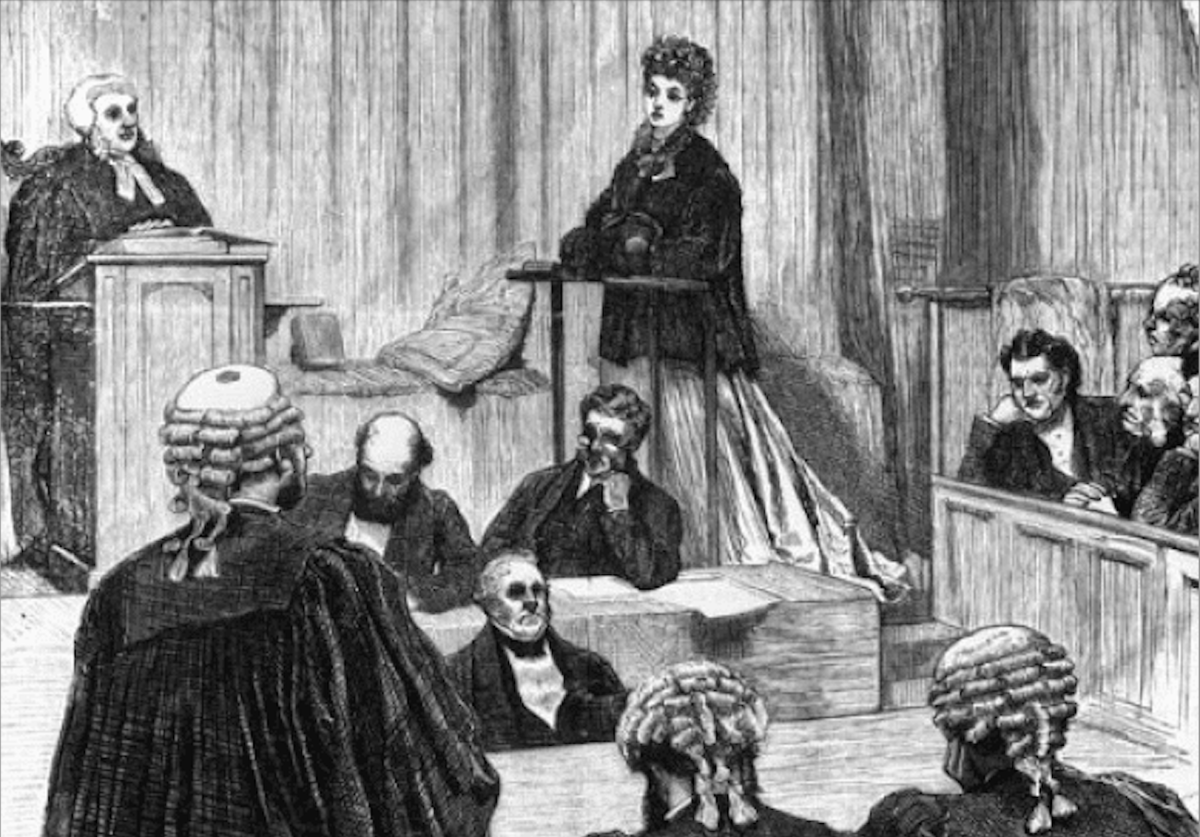
Prior to the Married Women’s Property Bill of 1870, married women in England were required to cede all personal property, belongings, and money to their husbands upon marriage. Any subsequent income was also legally owned by their husband. While women could own property, they were not allowed to rent or sell it without their husband’s consent. The Married Women’s Property Committee advocated for reform by organizing petitions to be presented to Parliament. The group collected over 33,000 signatures in 29 separate petitions and submitted them to Parliament in 1868. The bill was presented to the House of Commons in 1868 by George Shaw-Lefevre and passed in 1870. It allowed married women to directly control their earnings without their husband’s interference, inherit small amounts of money, own property inherited from family, and made both men and women liable for the care of their children.
Mill does not directly discuss the Married Women’s Property Bill in his autobiography. However, his ardent support of women’s suffrage arose from his acknowledgment of women’s plights in England at the time. Mill writes, “I saw no more reason why women should be held in legal subjection to other people, than why men should. I was certain that their interests required fully as much protection as those of men, and were quite as little likely to obtain it without an equal voice in making the laws by which they were bound.” Thus, equal voting rights for women was the manner in which Mill believed equality between women and men could be achieved. In Mill’s essay, The Subjection of Women, Mill frequently uses master and slave terminology to describe the married relationship between men and women. As a supportive, yet also cautious, supporter of democracy, Mill’s advocacy for women’s suffrage may imply a tacit approval for other women’s causes, such as the Married Women’s Property Bill.
Citations:
Loudermelk, Shana. “Married Women’s Property Act, 1870 and 1882 | towards Emancipation?” Hist259.Web.unc.edu, 2019, hist259.web.unc.edu/marriedwomenspropertyact/.
Combs, Mary Beth. “‘A Measure of Legal Independence’: The 1870 Married Women’s Property Act and the Portfolio Allocations of British Wives.” The Journal of Economic History, vol. 65, no. 4, 2005, pp. 1028–57. JSTOR, http://www.jstor.org/stable/3874913.
Shanley, Mary Lyndon. “Marital Slavery and Friendship: John Stuart Mill’s The Subjection of Women.” Political Theory, vol. 9, no. 2, 1981, pp. 229–47. JSTOR, http://www.jstor.org/stable/190714.
Kha, Henry. “John Stuart Mill on Matrimonial Property and Divorce Law Reform.” Fundamina, vol. 24, no. 2, 2018, https://doi.org/10.17159/2411-7870/2018/v24n2a3. Accessed 2 Jan. 2020.