A timeline of events for the modern and postmodern in literature
Timeline
Table of Events
| Date | Event | Created by |
|---|---|---|
| 14 Oct 1897 | Founding of the National Union of Women's Suffrage SocietiesOn October 16, 1896, approximately twenty leaders of women’s suffrage organizations in Britain gathered together at the Birmingham Conference to discuss the possibility of merging their individual societies into one joint organization. Because each society was fighting for the same overall goal-- women’s suffrage-- they decided that uniting their organizations would be a beneficial and powerful strategy (Hume 4, Vellacott 1). Thus, one year later, on October 14, 1897, the National Union of Women’s Suffrage Societies, commonly acronymized as NUWSS, was founded. At its founding, the NUWSS had seventeen member societies, including many of the largest and most influential women’s suffrage organizations in Britain at the time (Hume 4). The seventeen member societies branded themselves-- and the NUWSS as a whole-- as a non-militant, constitutional, and non-party-affiliated organization united to achieve women’s suffrage (Holton 1, Hume 5, Vellacott 1). In the early years, the role of the NUWSS was limited. Because each member society still functioned independently in its designated location and the NUWSS had no funds to support its members, the organization had little control over how the individual societies functioned. Instead of managing its members, the main duty of the NUWSS was to communicate with the Committee of Parliamentary Supporters of Women’s Suffrage (Hume 6, Vellacott 2). Direct communication with Members of Parliament was the first step in getting the government to hear and consider the idea of women’s suffrage (Hume 6). Spearheading the NUWSS after its founding was Millicent Garrett Fawcett who served as the president of the organization from 1898-1919 (Holton 1, Hume 7-8). Fawcett had experience with women’s rights, as she grew up with a father who was a strong believer in feminism and a sister who helped to pave the way for women in the medical field (Holton 1). Fawcett and many other members of NUWSS were described as women whose personalities closely resembled that of a typical Victorian woman. They were kind wives and mothers and gentle, loving figures all around (Hume 13). While this helped create a sense of camaraderie among the societies in the NUWSS, it was not helpful in their quest to have their issues heard or considered by the government. In general, 1897-1903 were building years for the NUWSS and were not as successful as perhaps the organization had hoped. The NUWSS tried to advocate for their cause, but they were often too gentle and did not fight to break the sex barriers to have their voices heard by Members of Parliament (Hume 9-11). After years of not having a single concern of theirs talked about in the House of Commons, the Committee of Parliamentary Supporters of Women’s Suffrage suggested that the individual member societies of the NUWSS directly approach Members of Parliament who lived in their area to communicate to them the importance of women’s suffrage (14). If Members of Parliament could be convinced women’s suffrage was an important cause, perhaps the entire Parliament would listen to the issue. In 1903, after the Boer War was over and a General Election was approaching, the NUWSS had a change in strategy. In late 1903, two-hundred women from the NUWSS and other women’s rights societies met for a convention in London (Holton 1, Hume 20-21). What is argued to be the most important aspect of the 1903 convention was the idea that going forward, the NUWSS would establish new committees in every county in Britain and Ireland (Hume 21). These new committees would commit themselves to consistently speaking with Members of Parliament and electoral candidates about the women’s suffrage issue as well as informing the general public about the importance of women’s suffrage and encouraging them to only support candidates who supported the cause (Hume 21, Vellacott 2). These actions helped to establish the NUWSS as a united, governing body rather than a collection of individual societies (Hume 21-22). After the 1906 election where the Liberal party secured its place in office, the NUWSS was hopeful that its campaigning efforts would lead the House of Commons to discuss women’s suffrage, but they were, once again, overly optimistic (Hume 23). After having no success in having their concerns heard, in July 1906, the NUWSS started a movement to speak to individuals in Parliament who were against women’s suffrage to try to convince them to rethink their position. Then, in October of the same year, the NUWSS announced it would sponsor a candidate who supported women’s suffrage (26). While all of these efforts were steps in the right direction in the overall goal of achieving women’s suffrage, the NUWSS was still a fairly new and growing society. In the following years, the organization had its share of ups and downs. It organized public events to further campaign for this cause, and it was eventually renamed the National Union of Societies for Equal Citizenship (Holton 4). The fight for equal voting rights for women continued into 1928 when it was finally achieved thanks, in part, to the work of the National Union of Women’s Suffrage Societies. Works Cited Holton, Sandra Stanley. “National Union of Women's Suffrage Societies (Act. 1896–1918).” Oxford Dictionary of National Biography, 24 May 2008, doi:10.1093/ref:odnb/96378. Hume, Leslie Parker. The National Union of Women's Suffrage Societies 1897-1914. Vol. 3, Routledge, 2016. Vellacott, Jo. Pacifists, Patriots and the Vote: The Erosion of Democratic Suffragism in Britain During the First World War. Palgrave Macmillan, 2014. |
Gracie Hart |
| 1905 | Formation of the Bloomsbury GroupThe Bloomsbury Group, started by Virginia Woolf and Vanessa Bell, was a group of writers dedicated to bringing literature out of Victorian styles and forms and into the modern era. The Bloomsbury Group emphasized the creation of avant-garde writing styles, most notably stream-of-consciousness writing coined by Virginia Woolf. This group gave way to newer styles such as imagism, the style used by Ezra Pound. Works Cited
Author Unknown, “A Group at Garsington Manor.” Wikimedia Commons, July 1915, https://commons.wikimedia.org/wiki/File:SomeBloomsburymembers.jpg. “Bloomsbury.” Tate, https://www.tate.org.uk/art/art-terms/b/bloomsbury. |
Jared Rhone |
| 1907 to 1914 | The Creation of CubismThe art style Cubism, created between 1907 and 1914 by Pablo Picasso and Georges Braque, focused on a rejection of traditional form and structure. Instead of following in the footsteps of classical painters with paintings imitating nature and landscapes, Cubist’s opted to emphasize the two dimensional nature of a canvas with bold, straight lines and strict shapes arranged to make up an object, much like the imagists opted for clear cut details in their description of objects in writing. In both Cubism and Imagism, every subject is broken down to its most basic elements in its description. Works Cited Gris, Juan. “Portrait of Pablo Picasso.” Wikimedia Commons, January - February 1912, https://commons.wikimedia.org/wiki/File:Juan_Gris_-_Portrait_of_Pablo_Picasso_-_Google_Art_Project.jpg.
|
Jared Rhone |
| 1914 | Beginning of World War I - Ezra Pound and FascismThe beginning of WWI very notably marked the rise of Fascism, a term coined by Italian Dictator Benito Mussolini to describe a type of authoritarian dictatorship that spread throughout Europe during this time. Ezra Pound was known to be a Fascist, as he often expressed admiration for Mussolini and his politics, and was later arrested on treason charges for broadcasting messages of Fascism on American radio stations during WWII. Works Cited “Ezra Pound.” Poetry Foundation, https://www.poetryfoundation.org/poets/ezra-pound. Coburn, Alvin Langdon. “Ezra Pound.” Wikimedia Commons, 1913, https://en.wikipedia.org/wiki/File:Ezra_Pound_by_Alvin_Langdon_Coburn,_1913.jpg. Author Unknown. “Русский.” Wikimedia Commons, Between 1937 and 1940, https://en.wikipedia.org/wiki/File:Duce_Benito_Mussolini.jpg. |
Jared Rhone |
| 28 Jun 1914 | The Assassination of Archduke Franz Ferdinand
On the twenty-eighth of June, 1914, a young man toppled the fragile structure of world order with two bullets—one for Archduke Franz Ferdinand of Austria-Hungary, the other for the Archduke’s wife, Sophie. The royal couple were invited to the Bosnian capital of Saravejo, which was annexed by the Austrian empire in 1908, by General Oskar Potoirek to attend a speech in the city hall and inspect imperial military personnel. The shooting occurred just hours after a botched bombing attempt, about which the Archduke is recorded to have said to the military governor, “What is the good of your speeches? I come to Sarajevo on a visit, and I get bombs thrown in my face. It is outrageous” (The Times). After the failed bombing, the speech and the inspection of Sarajevo’s military parade, riding in the back of a roofless motor-car—as was common for the time—through the streets of Sarajevo among a crowd of thousands gathered to see the royal couple, they were shot dead (The Times). After the two shots were fired, the young gunman swallowed a cyanide pill but somehow survived (Jay 19). He was promptly pointed out by the crowd and arrested by Bosnian officials. That young gunman was nineteen-year-old Gavrilo Princip, misidentified by The Times in London as Nadjeliko Cabrinovitch just a day after it happened. Gavrilo Princip was one of three men involved in the assassination plot directly, and a member of the Black Hand, a group of Serbian nationalist extremists (Jay 19). He was too young to be executed by Austria-Hungarian law, so he was instead sentenced to life in prison in Theresienstadt, where he wasted away in solitary confinement (Jay 19). The Black Hand’s actions, carried out by Gavrilo Princip’s hand, is often considered to be the straw that broke the camels back with regards to stoking the flame of the first world war (Schmitt 70). This event is important to highlight when exploring historical examples of “toxic patriotism”, as Gavrilo Princip’s nationalistic mindset is ultimately what led to his involvement with the Black Hand and eventually to his shooting of the Archduke. Moreover, although Princip ultimately died for his actions, he was hailed as a martyr by many who viewed the annexation of Sarajevo and Bosnia as a bad thing, thus further stoking a ravenous nationalistic mindest which spiraled into WW1 (Jay 20). Similarly, this sentiment was mirrored in the attitudes of many of the nations which then involved themselves in the war—this idea of the romanticisation or the idealization of one’s homeland. To Princip, his homeland was under siege by a foreign power, infected and otherwise beautiful, and that is a state of mind which mirrors many contemporary examples of toxic patriotism—namely the January 6th insurrection at the United States capitol building. In both this event and the insurrection of the U.S. capital building, the party responsible for the violence believed they were engaging in a fight to rid their homeland from an occupying force which tainted its natural goodness. Primary Source: "Austrian Heir and his Wife Murdered." The Times, 29 June 1914, p. 8. Gale Primary Sources, https://go-gale-com. Other Works Cited: Jay, Martin. "The Manacles of Gavrilo Princip." Salmagundi, no. 106/107, 1995, pp. 14-21. JSTOR, https://www.jstor.org/stable/40548800. Schmitt, Bernadotte E. "The Origins of the War of 1914." The Journal of Modern History, vol. 24, no. 1, March 1952. JSTOR, https://www.jstor.org/stable/1871982.
|
Samuel Pickett |
| 28 Jul 1914 to 11 Nov 1918 | Start of World War IA month after the assassination of Archduke Francis Ferdinand, Austria-Hungary declares war on Serbia beginning World War 1. This war involved countries across Europe, the central powers (Germany, Austria-Hungary, Bulgaria, and the Ottoman Empire) against the allied powers (Great Britain, France, Russia, Italy, Japan, Romania, and the United States). WW1 caused a huge shift in society as it meant almost all capable men were sent off to fight in the war and the women were left at home to pick up the factory jobs and labor the men had left behind. This was the first great war and it brought destruction, carnage, and mass loss of life to everyone involved, it is estimated over 16 million soldiers and civilians lost their lives in World War 1. This bloodshed on the battlefield inspired the work of soldiers such as Wilfred Owen who fought on the frontlines to create such historic poetry and works of art. |
Charlie Elliott |
| The end of the month Spring 1916 | The Easter Rising in DublinThe Easter Rising in Dublin occurred on Easter Monday: April 24, 1916. The Easter Rising was an insurrection against the British government that wished for independence from Britain, and causally, to cut ties from obligations to serve Britain. By the end of the day important civic and private property, including the city’s post office, was seized by the rebel army of the Irish Republic. The Irish Republic consisted of three main factions: “the revolutionary fraternity of the Irish Republican Brotherhood, the Irish volunteers who opposed Ireland’s participation in Britain's imperial war, and the Irish Citizens Army (992). One of the leaders of the insurrection, Patrick Pearse, came down the post office steps after it had been seized in the early afternoon and proclaimed Ireland to be an independent republic. The Irish Citizens army was a worker’s militia formed in retaliation to the police brutality that had occured against striking unions three years prior on the infamous Bloody Sunday. Within the week the insurrection was suppressed and resulted in the death and injury of thousands. The leaders of the revolt were then executed—swaying public opinion towards the side of the rebellion as the leaders and their causes became martyred. Although the rebellion was initially unsuccessful in securing independence for Ireland, it’s resulting shift in public opinion against Britain marshal law and their rushed executions of suspected allies to the rebellion led to parliament members being elected who wished to establish a free republic. Eventually, a treaty was signed amongst Britain and Ireland that created the Irish Free State. Works Cited Arrington, Lauren. “Socialist Republican Discourse and the 1916 Easter Rising: The Occupation of Jacob's Biscuit Factory and the South Dublin Union Explained.” Journal of British Studies, vol. 53, no. 4, 2014, pp. 992–1010. JSTOR, www.jstor.org/stable/24701520. Accessed 6 Dec. 2020. History.com Editors. “Easter Rising.” History.com, A&E Television Networks, 9 Nov. 2009, www.history.com/topics/british-history/easter-rising.
|
Madison Rheinheimer |
| 1917 to 1922 | The Russian Civil WarFrom the wake of World War I, Russia was divided. Lenin and the Bolsheviks seized power in the October Revolution. It is important to add that Lenin believed the only way to bring change was through violent uprising and not peaceful change. Once in power, Lenin had pulled Russia out of the war so the nation could focus on rebuilding, specifically by using Marxism to help build the communist state. This revolution and Lenin’s rise to power threw Russia into conflict quickly. Many different people rose up to push back against these Bolshevik ideals. There were two main groups that were opposing Lenin: the non-Bolshevik left, who had been finally alienated from Lenin by his dissolution of the Constituent Assembly and the rightist Whites, whose main asset was the Volunteer Army in the Kuban steppes. This “White Army” as they called themselves was the biggest opposition to Lenin. It was composed of many different groups but all to go against the Bolshevik Red Army. Multiple battles erupted all throughout Russia. While many of the smaller armies/movements struggled, The White Army held strong and was holding their own against the Bolsheviks. In late 1918, the Bolsheviks only really held power in the western industrial cities because of Allied Germany, treaties, and the White Army’s advances. Then in November 1918, World War I officially came to an end and the line of Eastern Europe were redrawn. Other countries pulled their troops out and the Bolsheviks saw their chance to push. The Bolsheviks sought dominance over the East and West. Their push east was not too successful, but into the east they spread quickly. With this push the Bolsheviks took dominance fast. This is largely due to the fact that the Bolsheviks had a singular, united goal and a strong leader behind it, while the White Army was more disjointed with many goals throughout the leaders. In 1919, the White Army was making progress towards Moscow but the Bolsheviks then made an alliance with the Black Army in Ukraine and stopped their advancement and pushed them back. By 1920, the White Army was all but destroyed in the East. The Whites could no longer effectively fight the Black and Red Army. Late 1920 saw Poland and Ukraine form an alliance and launch an offensive against the Bolsheviks in hopes to reunite the Ukrainian State. While they captured Kyiv they were met by a numerically superior Red Army. The Red Army then kept advancing farther into Poland but were halted and the Bolsheviks made a treaty with Poland. This guaranteed Polish independence but left Ukraine under Bolshevik control. With this, the remnants of the White Army fled. Even in this, Lenin saw more opportunity for power and control. With the White Army fleeing, this allowed Lenin to break his alliance with the Black Army and turn on them. They would eventually surrender in 1921. The Bolsheviks would then take over Georgia and Romania to finish off the White Army. The Bolsheviks annexation of the Far Eastern Republic in 1922 effectively ended the war and created the Soviet Union. The revolution and war displayed the ruthless power-grabbing mindset under Lenin and the Bolsheviks that has led to so much of what modern Russia has become. Lenin’s ideals and effect on history still have weight and repercussions in the present. Russia and Ukraine are still dealing with the trickle-down effect of this complex history. The grasping for power at the expense of others is still something that weighs on these countries as we can see in Ukraine today.
Works Cited Britannica, The Editors of Encyclopaedia. "Russian Civil War". Encyclopedia Britannica, 19 Nov. 2020, https://www.britannica.com/event/Russian-Civil-War. Accessed 26 April 2022.
Raleigh, Donald. “The Russian Civil War, 1917–1922.” The Cambridge History of Russia, edited by Ronald Grigor Suny, vol. 3, Cambridge University Press, Cambridge, 2006, pp. 140–167. The Cambridge History of Russia.
Reiman, Michael. “About the Russian Revolution of 1917.” About Russia, Its Revolutions, Its Development and Its Present, Peter Lang AG, 2016, pp. 13–24, http://www.jstor.org/stable/j.ctv2t4dn7.4. Accessed 26 Apr. 2022 |
Truitt Anweiler |
| 18 Jul 1918 | Romanov Family ExecutedThe Romanov family ruled over Russia from 1613 until 1917. During the last leader, Nicholas II’s, rule Russia was involved in a time of near constant war, between the Russo-Japanese war and World War I. This led to economic unrest in the country, with food scarcity and extreme discontent from soldiers and civilians. Nicholas abdicated the throne in 1917 in the face of revolution and a civil war. The Bolsheviks, led by Vladimir Lenin, assumed power soon after (History). On July 16th, 1918, during a clash between forces in Yekaterinburg, it was decided by the Bolsheviks that the entire Romanov family would be executed. The family and their servants were lined up and posed for a family photo by force. Then, the family was executed by firing squad, with any survivors searched out stabbed to death after the smoke from the guns had cleared (History). Erin Blakemore describes this as a carefully planned attack, saying, “For days, the Romanovs’ Bolshevik captors had been preparing the house for the murder, including stocking up on benzene with which to burn the corpses and sulfuric acid with which to maim them beyond recognition” (Blakemore). Rumors circulated afterward of members of the family having escaped the attack. According to the History.com Editors, “The Crown Prince Alexei and one Romanov daughter were not accounted for, fueling the persistent legend that Anastasia, the youngest Romanov daughter, had survived the execution of her family” (History). There were also similar suspicions of the only son of Nicholas II, Alexis, surviving the execution. However, tangible proof to suggest there were any survivors has yet to be discovered. From the very beginning of Jasper Fforde’s, The Eyre Affair, the audience is thrust into a world both unfamiliar and absurd. We are introduced to science-fiction levels of weird, with Chrono-Guards, feuding timelines, and a father with, “a face that could stop a clock” literally (Fforde 3). With little to hang onto to center us in this novel, Fforde provides a few timeline revisions that attempts to help the reader become situated to the difference of this world. The most obvious and helpful, perhaps, was the inclusion of “Czar Romanov Alexei IV” (Fforde 9). As this novel takes place in the 1980s, it is likely that this refers to the last son of Nicholas II, who was 13 at the time of the execution (Encyclopedia Britannica). This could imply that either the son actually did manage to escape the murders, or that they never happened in the first place. Regardless, this significant revision in the real world timeline helps the audience become acclimated to the weird, fictional world Thursday operates in. Looking into the history of the Romanov family, it is also interesting to consider the amount of war connected to Nicholas II and the PTSD Thursday deals with as a veteran of the Crimean war. While not directly connected, there seems to be a theme in Thursday’s world of war and bloodshed, like that tied to the Romanov family and Nicholas II’s rule. This may be worthwhile to keep in mind throughout the reminder of the novel. Works Cited: Blakemore, Erin. “Why Czar Nicholas II and the Romanovs Were Murdered” History.com. 29 March 2019. https://www.history.com/news/romanov-family-murder-execution-reasons. Accessed 10 April 2022. Britannica, The Editors of Encyclopedia. "Alexis Prince of Russia" Encyclopedia Britannica. 21 August 2021. https://www.britannica.com/biography/Alexis-prince-of-Russia-1904-1918. Accessed 10 April 2022. Family Nicholas II of Russia ca. 1914. Wikimedia Commons. https://commons.wikimedia.org/wiki/File:Family_Nicholas_II_of_Russia_ca._1914.jpg. Accessed 10 April 2022. Fforde, Jasper. The Eyre Affair. Penguin Books, 2001. History.com Editors. “Romanov Family Executed, Ending A 300-Year Imperial Dynasty” History.com. 13 January 2021. https://www.history.com/this-day-in-history/romanov-family-executed. Accessed 10 April 2022.
|
Lilith Yurkin |
| 1930 to 1939 | "The Slump" - The Great Depression in the United KingdomFrom 1930 to 1939 and forward, the United Kingdom, as did most of the world, faced economic downfall and affected every class in some way. It began when the stock market on Wall Street in New York crashed. Although this depression began in the United States, it was not long until it took over Europe and the rest of the world. The crash subsequently created a domino effect of events; decreased consumerism, low demand for exports out of Europe, and an incredibly high unemployment rate. This time was extremely challenging and terrifying and no one knew what to do next and how to get out of the global panic that took over most of the world. Unemployment rates had increased by 150% while the number of exports had fallen by 50%. From the time of the Great Depression to when this photo of the pub was taken, the world was being rebuilt both from the Depression and then the effects of the Second World War. It was a time of hard work, but also of hope and finally being able to see a chance at a better future.
Brain, Jessica. The Great Depression. Historic UK. https://www.historic-uk.com/HistoryUK/HistoryofBritain/Great-Depression/ Accessed 29 Mar. 2022. |
Marianna Balsamo |
| 1 Sep 1939 to 3 Sep 1939 | The Start of World War IIOn the first of September in 1939, Nazi Germany invaded the Poland capital, Warsaw. This would be known as the attack that ignited World War II. Earlier in the year, around March 1939, British government formed an agreement that stated they would be allies to Poland in this very event. Meanwhile, France had already been in a prior alliance with Poland. Not long after the British formed their treaty, Germany and Italy had formed an agreement to be allies. On the second of September in 1939, Italy proposed a peace conference that would be held between Italy, Germany, Britain, France, and Poland. Unfortunately, the efforts made for peace were not successful. French Prime Minister, Édouard Daladier, spoke and conformed France involvement. The Prime Minister of the United Kingdom, Neville Chamberlain, stated that it would be impossible to discuss peace while Poland’s cities were under invasion. In this same statement, he confirmed that if German forces would not withdraw from Poland, their involvement would be certain. On the third of September in 1939, Britain made an announcement at 0900 that stated, if Germany does not announce withdraw from Polish territory by 1100, they will declare a state of war with Germany. Later that day, France allowed Germany until 1700 to withdraw their forces. After Germany did not respond to either of these deadlines and all peace attempts were made, Allies to Poland had no choice but to engage in war against Germany. These events would be precursors to many other countries, including the United States, involvement in World War II. |
Katey Powell |
| Sep 1939 to Aug 1945 | World War IIWorld War II was fought from 1939 to 1945, with the United States fighting with the Allied powers, Italy with the Axis powers under Benito Mussolini. |
Lorenzo Allen-Felluga |
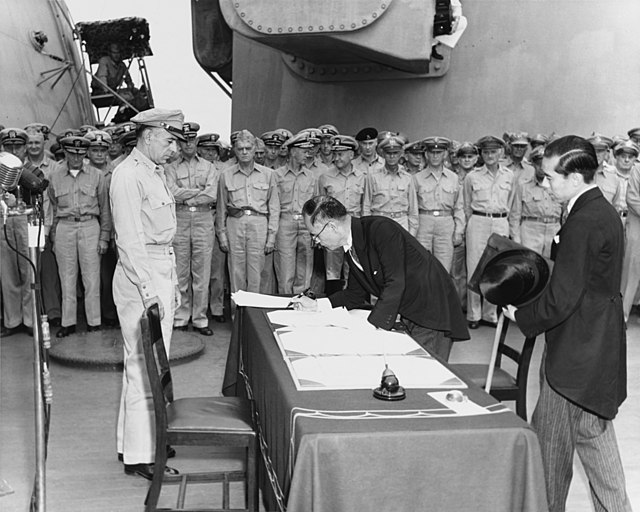
| 2 Sep 1945 | End of World War IIOn April 27, 1945, Benito Mussolini was captured and executed the following day. On April 30, 1945, Adolf Hitler committed suicide, setting into motion once and for all, the collapse of the Nazi regime. On May 8th, 1945, Wilhelm Keitel along with several other German representatives surrendered to the Soviet forces shortly before midnight as witnessed by Georgi Zhukov officially ending World War II. This day was declared V-E Day (Victory in Europe Day) and is recognized as the true end of World War II. On September 2, 1945, Japan also signs documents of surrender (pictured). President Harry Truman made a speech saying, “This is the day we have been waiting for since Pearl Harbor. This is the day when Fascism finally dies.” Celebrations broke out in the streets all over the world, one of which was caught on camera creating the iconic “Kissing the War Goodbye” photograph.
Works Cited “Victory and Peace.” National Museum of American History, 8 Oct. 2021, americanhistory.si.edu/price-of-freedom/world-war-ii/victory-and-peace. Accessed 26 Apr. 2023. |
Dylan Cuffari |
| 15 Aug 1947 | India Gains IndependenceOn August 15, 1947, India gained independence from Imperial Britain. The Indian Independence movement represented very modernist ideas as it was always evolving ideologically and was anti-colonialst in nature. The partition caused the split and subsequent creation of India and Pakistan as individual nations. Both nations remained under Crown Dominion until India's constitution was established forming the Republic of India in 1950. Pakistan's constitution was established in 1971.Independence was however overshadowed by the violence and confusion this split created in the people. This split began the decolonization of India from Imperial Britain. India saw a rise in Hindu nationalism from parties such as Modi’s Bharatiya Janata Party (BJP). Pradip Jain, a spokesman for the RSS (a subset of the BJP) said, “Just like every family has a head, every society has a head, and religion is its head.” This Hindu nationalism fought against modernism by attempting to institutionalize a traditional religion. Works Cited “Indian Independence and the Question of Partition - the Choices Program.” The Choices Program, 2018, www.choices.edu/curriculum-unit/indian-independence-question-partition/. George, Cherian. “The Rise of Hindu Nationalism.” The MIT Press Reader, 28 Feb. 2022, thereader.mitpress.mit.edu/the-rise-of-hindu-nationalism/. |
Jaden Massaro |
| 1950 | Korean War 1950The Korean War is seen as one of the most significant impacts of the containment policy of the U.S. government, aimed at preventing the spread of communism, and was one of the major proxy wars of the Cold War. After five years of simmering tensions on the Korean peninsula, the Korean War began on June 25, 1950, when the Northern Korean People's Army invaded South Korea in a coordinated general attack at several strategic points along the 38th parallel, the line dividing communist North Korea from the non-communist Republic. |
Dylan Cuffari |
| 1957 | Soviets Launch Sputnik 1957The Sputnik crisis was a period of public fear and anxiety in Western nations about the perceived technological gap between the United States and Soviet Union caused by the Soviets' launch of Sputnik, the world's first artificial satellite. It was a joyous occasion for supporters of the Soviet Union and an equally frightening one for those in the United States. The successful launch of Sputnik was a major victory for the Soviet Union, for they had become the first nation to send an object into orbit. |
Dylan Cuffari |
| 1958 | C.W. Mills uses the term “post-modern” 1958Over 30 years ago, C. Wright Mills described the post-modern period as one in which the economy would shift employment from heavy industry to non-unionized clerical, service, and new industrial sectors. He foresaw the rise of multinational corporations, trouble in the social welfare system, and decline in human freedom and choice. At that time he wondered how the human family would respond to and adjust to this new period in world history. The term was applied to a whole host of movements, many in art, music, and literature, that reacted against modernism, and are typically marked by revival of traditional elements and techniques. |
Dylan Cuffari |
| 1962 | British Caribbean Islands start gain independence 1962The West Indies Federation fell apart when the largest island Jamaica withdrew from the federation and declared itself independent in August 1962 followed by Trinidad and Tobago in August 1962. By the end of the 1960s, only a few Caribbean islands remained dependent territories. Postmodern theory provided pathways through which the postcolonial world responded to the old empire with a renewed sense of legitimacy. The postmodern and the postcolonial came together irrevocably in resisting imperialist culture and the systems and manifestations of modernism. |
Dylan Cuffari |