
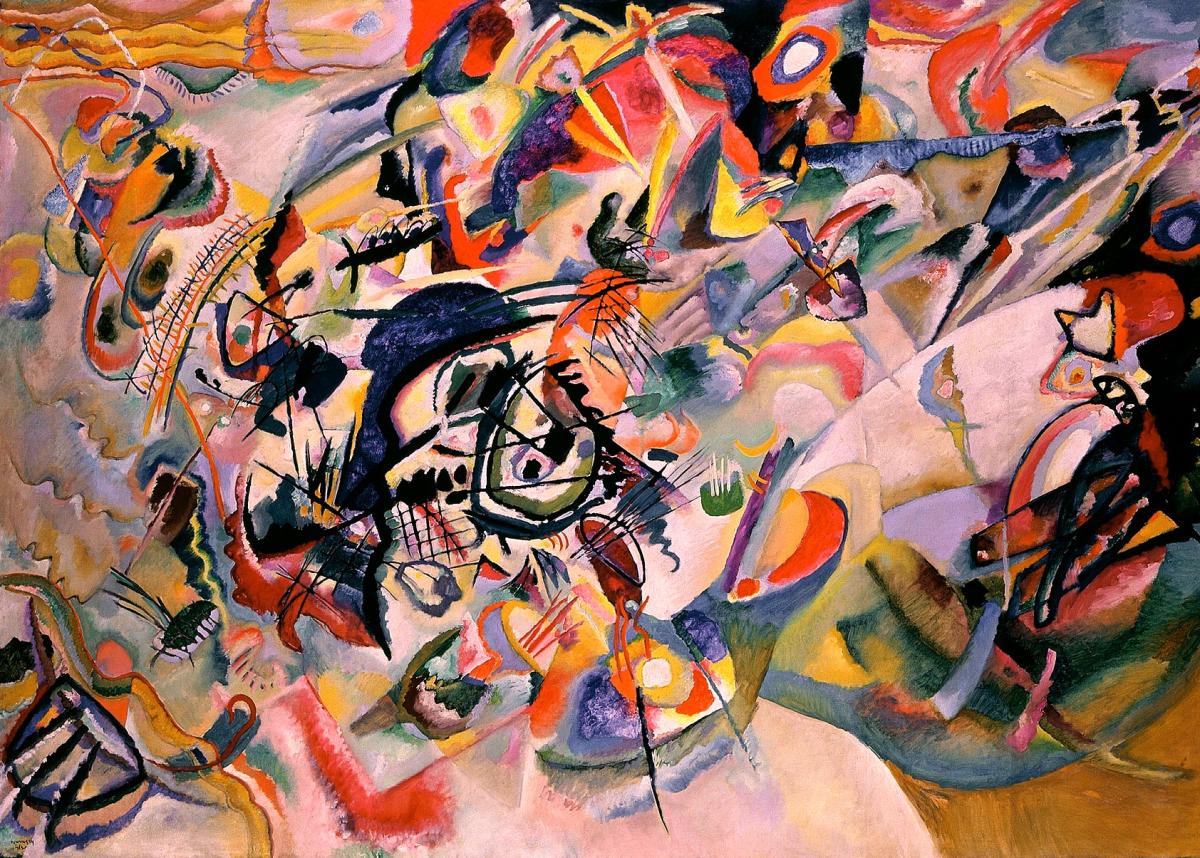

- Title: Composition VII
- Artist: Wassily Kandinsky
- Year: 1913
“Composition VII” is a groundbreaking abstract painting by Wassily Kandinsky, completed in 1913, and is often considered one of his most important and complex works. Though the painting is abstract, Kandinsky associated it with complex themes like Resurrection, Judgment Day, the Flood, and the Garden of Eden.
In Composition IIV, Kandinsky rejects the constraints of traditional art, similar to how Imagists broke from Victorian poetics. Kandinsky wanted to express pure feeling through color, movement, and shape. Composition VII is thus a visual correspondent to Imagist poetry, as both stray from previous structure and tradition, a quality of the Modernist Movement.
Citations:
Brandabur, Edward. Ezra Pound and Wassily Kandinsky: A Language in Form and Color. The Journal of Aesthetic Education, vol. 7, no. 2, 1973, pp. 91–107. JSTOR, https://doi.org/10.2307/3331947.
"Composition VII, 1913 by Wassily Kandinsky." WassilyKandinsky.net, https://www.wassilykandinsky.net/work-36.php.
Scholes, Robert. "Kandinsky, Wassily (1866-1944)." Modernist Journals Project, Brown and Tulsa Universities, https://modjourn.org/biography/kandinsky-wassily-1866-1944/.
Kandinsky, Wassily. Composition VII. 1913