
An exhibition showcasing the inventions of women from a variety of fields, covering everything from computing and domesticity, both on land and under water. The women foregrounded in this exhibition overcame significant difficulties, and the restrictions of a patriarchal society, in their quest to both patent and design their inventions. The mother of modern computing Ada Lovelace showed true force of character to work in a predominantly male sphere, Margaret Knight rose through the ranks from lowly factory work to engineering insight that is still relevant today (although she made little money from her work), and Jeanette Villepreux-Power was so enamoured by deep sea life that she devised her own way of observing it. Just a handful of the women whose work you can discover and enjoy in this exhibition.
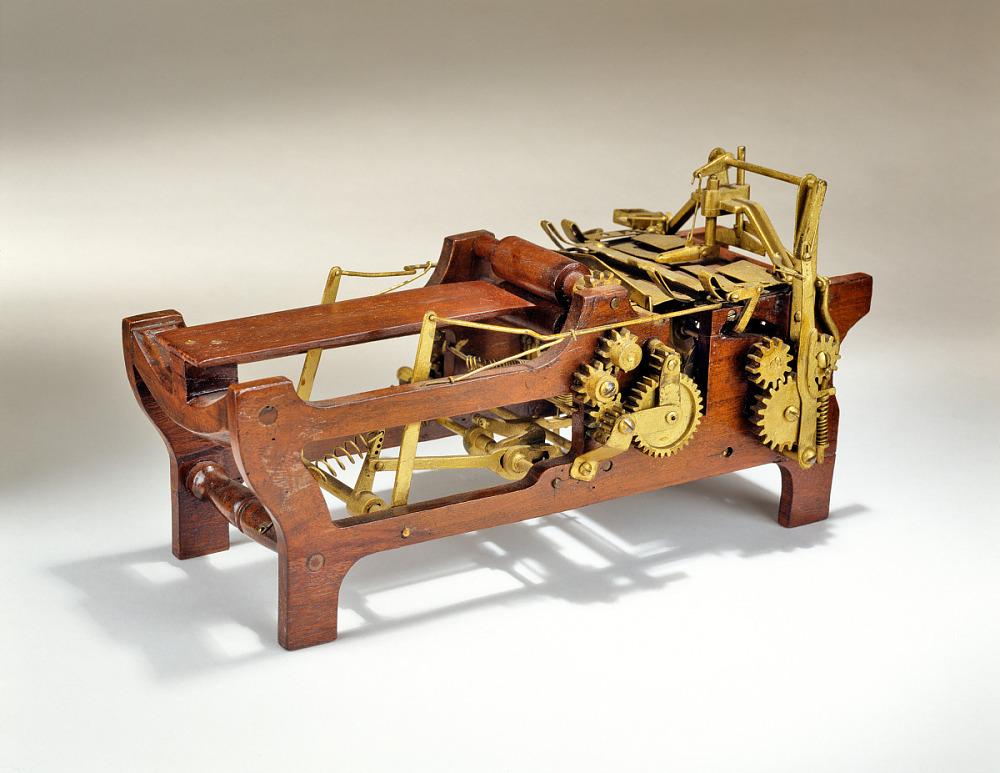
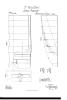
"Patent model for paper bag machine," Margaret E. Knight, c. 1879. National Museum of American History.
A familiar image from American consumer culture, is the flat- bottomed paper carrier bag, which allows groceries to be safely stored and carried. The paper bag machine which allowed the mass production of these bags was developed by Margaret ‘Mattie’ E. Knight, a prolific engineer and inventor. Overcoming adversity was a feature of Smith’s life; even registering the patent for her design involved an expensive legal battle, as her design was stolen and registered in another name. Today, we recognise the damage plastic causes to the environment, therefore Knight’s invention is as relevant as ever.
Trial Model of the Analytical Machine, c. 1871, Victorian Web
The Babbage Analytical Machine (above) was the first computer ever built, and Ada Lovelace was its first programmer. A fantastic mathematician in her own right, Ada Lovelace is best known for her work translating Charles Babbage's notes and positing that the binary code (a language of 1s and 0s based on the punch cards of 19th century weaving machines) the machine used to function could be used beyond numbers before the machine was even built. (This model was finished in 1871 but by this time Lovelace had already succumbed to cancer.) She is also known for being the only daughter of Lord Byron.
Patent for the First Underwater Telescope, c. 1845, Sarah P Mather, National Archives and Record Administration, USA
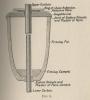
This document is the patent for the Submarine Telescope, as invented by Sarah P. Mather in 1845. It used a camphene lamp in a glass globe at the end of a tube to allow ships to see deeper into the ocean and examine the sea life there. It was also used by those on board to examine the hull from a position above the water and even to inspect wreckages. This invention was later improved upon by Mather’s own daughter. Very little is known about Sarah Mather except that she was American, born in 1796, married, and with at least one daughter.
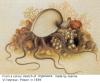
Jeanette Villepreux-Power: A colour sketch of an argonaut shell from ‘Physical Observations and Experiments on Several Marine and Terrestrial Animals’ (1839)
Villepreux-Power is the inventor of the aquarium. In studying the natural life of Sicily she conducted tests and observations on marine life, particularly octopuses and argonauts. A highly significant breakthrough in the study of argonauts was her discovery that they grew their own shells, rather than as previously thought, that they used the shells of other creatures. To pursue her studies, Villepreux-Power developed three distinct aquaria; one made of glass for indoor use; a glass model that could sit in a cage in shallow water; and a cage, for deep water study of molluscs. Villepreux pioneered ideas about marine conservation in Sicily.
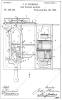
Patent for the Dishwasher, Josephine Cochrane, 1886, United States Patent and Trademark Office
This is an image taken from the patent of the first commercially successful, hand powered dishwasher, as invented by Josephine Garis Cochran. She designed the first model of the dishwasher in the shed behind her house, and patented it in 1886. A wheel was used to turn the dishes while soapy water squirted up from below. It was the first dishwasher that used water pressure to clean the dishes. In order to make the final product, she employed the mechanic George Butters. Cochran was allegedly spurred on to invent the machine when her servants kept chipping her crockery during hand washing. Her invention later inspired the 1950s dishwasher and Whirlpool Corporation regard Cochran as their founder. Cochran was born in 1839, she lived in Illinois and had two daughters.
Henrietta Vansittart (1833-1883) – Propeller
Henrietta Vansittart was born in 1833 in Ewell, Surrey to Marie and James Lowe, an engineer and inventor. After her father’s death she further developed and improved his invention of a type of stern-mounted submerged marine screw propeller, replacing its flat blades with ones in the shape of a compound curve. The propeller she developed was a success, being trialed on HMS Druid in 1869 by the Admiralty, and even winning a prize in 1871 at the Kensington Exhibition. In a touching tribute to her father, she made sure to call her invention the Lowe-Vansittart Propeller. Vansittart impressed her male contemporaries and due to her engineering background, education and work she was possibly the first female engineer and naval architect in Britain. Vansittart held patents for the Lowe-Vansittart propeller both in the UK and the US. Sadly, all did not end well for her — she spent her last days in a lunatic asylum, apparently from acute mania and anthrax.
Alice Bygrave – Cyclewear
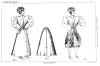
Alice Bygrave, a dressmaker from Brixton, lodged a patent in 1895 for “Improvements in Ladies’ Cycling Skirts”. She aimed to “provide a skirt proper for wear when either on or off the machine”. Her parents owned a watch- and clock-making shop in Chelsea and her brother and sister-in-law were professional cyclists. Her invention brings all of these influences together in an ingenious skirt with a dual pulley system sewn in the front and rear seams that adjusts height according to the needs of the wearer. Her invention was an improvement in the practicality of women’s fashion and it broke social norms but at the same time it was meant to remain undetected through its efficiency. Bygrave also patented her invention in Canada, Switzerland and America, and it was manufactured and distributed by Jaeger. It was a hit, and was sold throughout Britain and the US. It even made its way to Australia.
"Figure 8 (apparatus)" from Hertha Ayrton’s paper, ‘The hissing of the electric arc’
The Arc Light (such as the one shown above) was perfected by Hertha Ayrton in the late 1880s as she discovered the reason for the hissing and inconsistent light of the arc lights prior to her 13 patents on these lamps. Her work in electricity made her the first woman to become a part of the IEE (Institution of Electrical Engineers) in 1899. Her later work on air and water currents led to her winning the Hughes Medal from the Royal Society (that she was barred from entry due to her status as a married woman). She's responsible for 26 patents in total.