
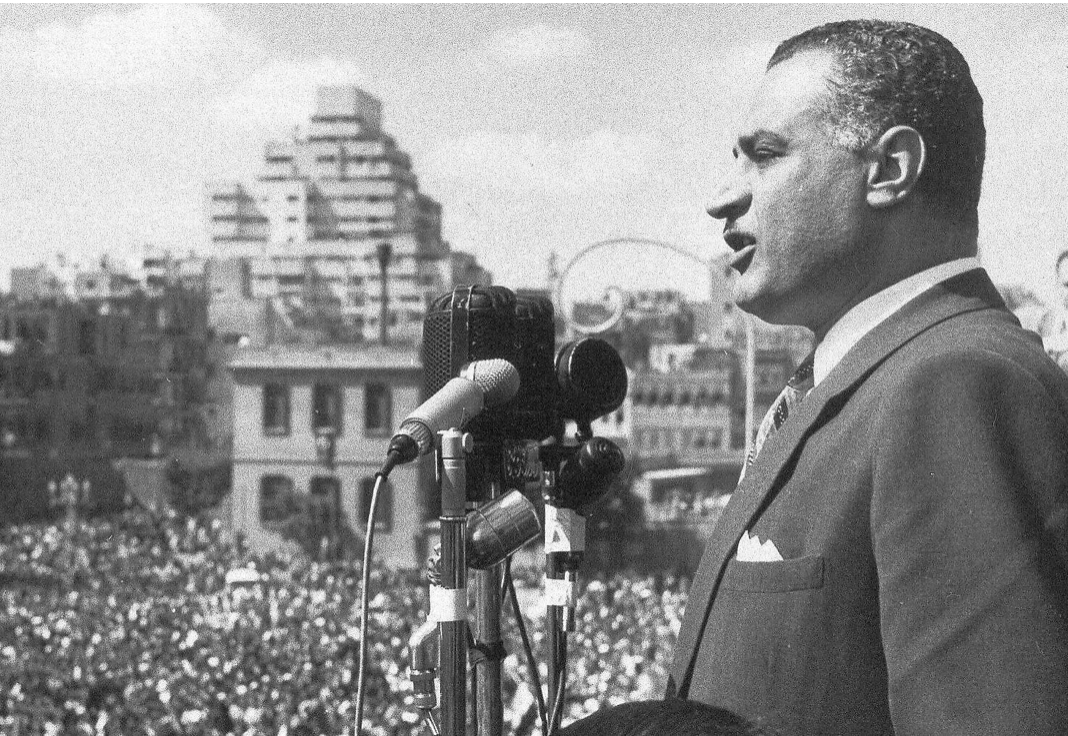
Pan-Arabism came most alive during the regime of Gamal Abdel Nasser Hussein (جمال عبد الناصر حسين), typically referred to by Nasser, one of Egypt’s most notable leaders. He was president from 1954 until his death in 1970, and was highly influential to the development of Egypt and the Middle East. Almost immediately, Nasser began implementing elements of Pan-Arabism. This is very evident in one of his speeches given in 1954:
“[A]ll countries that speak Arabic are our countries, and we must liberate our countries… the Muslims across the world are siblings, and siblings must cooperate in times of hardship… We the East, confronting the greed of the West, are one Nation!… [W]e desire— we the Arabs, we the Muslims, we the people of this East— to become one bloc.” (Nasser 1954)
This idea was hammered into the Arab people over the next few years in a variety of different ways, and they began to get excited. Nasser was so influential that Syria became interested, so interested that they advocated for unity with Egypt, and for a time, there was talk of a combined state— the first step in creating the grand Pan-Arab state. However, even this union was short lived, and “turned into a struggle for dominion… the Egyptians ran Syria like a colony— and a badly run colony at that” (Kramer). So in 1961, the Syrians launched a coup that “ousted Nasser’s viceroy from Damascus and declared the union finished” (Kramer). And ever since this failed union of Egypt and Syria, Pan-Arabism has been withering, backsliding.
Works Cited
Fallatah, Mohammed A. S. The Emergence Of Pan-arabism And Its Impact On Egyptian Foreign Policy: 1945-1981 (Egypt), University of Idaho, Ann Arbor, 1986. ProQuest, https://www.proquest.com/dissertations-theses/emergence-pan-arabism-imp….
Abou-El-Fadl, Reem. “Early Pan-Arabism in Egypt's July Revolution: The Free Officers' Political Formation and Policy-Making, 1946-54.” Nations and Nationalism, vol. 21, no. 2, 2015, pp. 289–308., https://doi.org/10.1111/nana.12122. Accessed 12 Nov. 2021.
Kramer, Martin. “Arab Nationalism: Mistaken Identity.” Arab Awakening and Islamic Revival, 2017, pp. 19–52., https://doi.org/10.4324/9781315082172-3. Accessed 12 Nov. 2021.