

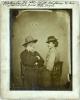
Peter Doyle, born in June of 1843, was an Irish man who moved to the United States with his family in the early years of his life. Although Doyle moved across the world to live the American Dream, he did not live a lavish lifestyle as his father worked in a factory and his mother took care of him and his eight siblings. Doyle received little education before he moved to America and did not attend any educational institutions in the U.S (Murray). Around the same time that Doyle was growing into a young adult, the transcendentalist movement was spreading across the nation. Intrigued by the movement to unify rather than divide, Boyle was drafted into the military where he hoped to learn more about his new found home and advocate self relience. After being wounded in the civil war, Boyle decided to move to Washington D.C where he worked as a conductor for the Washington and Georgetown Railroad Company. It was during his career as a conductor that Boyle met Walt Whitman, infamous American poet and transcendentalist, on a streetcart ride he was conducting across the city. The two began to write to eachother and eventually formed scheduled meeting times each month to catch up with one another. Many of Whitmans infamous poems include quotes and phrases he used to say to Boyle explicitly. Although Boyle was an uneducated "blue collar" man and Whitman was a well kept individual, the two are suspected to have engaged in a sexual relationship for several years until Whitmans stroke in 1871.
Boyle and Whitman are still known today for their relations to the LGBTQI+ community. Although the two never married, they did spend many years together while still taking care of their mothers. As stated, many of the works produces by Whitman were influenced by the relationship Doyle and he had (Kiffer). Whitmans "The Song of Myself", intoduces many aspects of individuallity and pride in being different from others. It is also in this peom that Whitman expresses his transcendentalist mindset by giving gratitude towards the universe for the ability to think for ourselves and love those we choose.
Works Cited
Kiffer, Selby, and Halina Loft. “Literally in Love: The Story of Walt Whitman and Peter Doyle.” Sothebys.Com, Sotheby’s, 25 July 2019, www.sothebys.com/en/articles/literally-in-love-the-story-of-walt-whitma….
Murray, Martin. “Pete the Great: A Biography of Peter Doyle.” Pete the Great: A Biography of Peter Doyle | Whitman Archive, whitmanarchive.org/item/anc.00155. Accessed 24 Apr. 2024.
“Peter Doyle (Transit Worker).” Wikipedia, Wikimedia Foundation, 11 Jan. 2024, en.wikipedia.org/wiki/Peter_Doyle_(transit_worker).
“‘The Song of Myself.’” Covecollection.Org, Accessed 2024.