
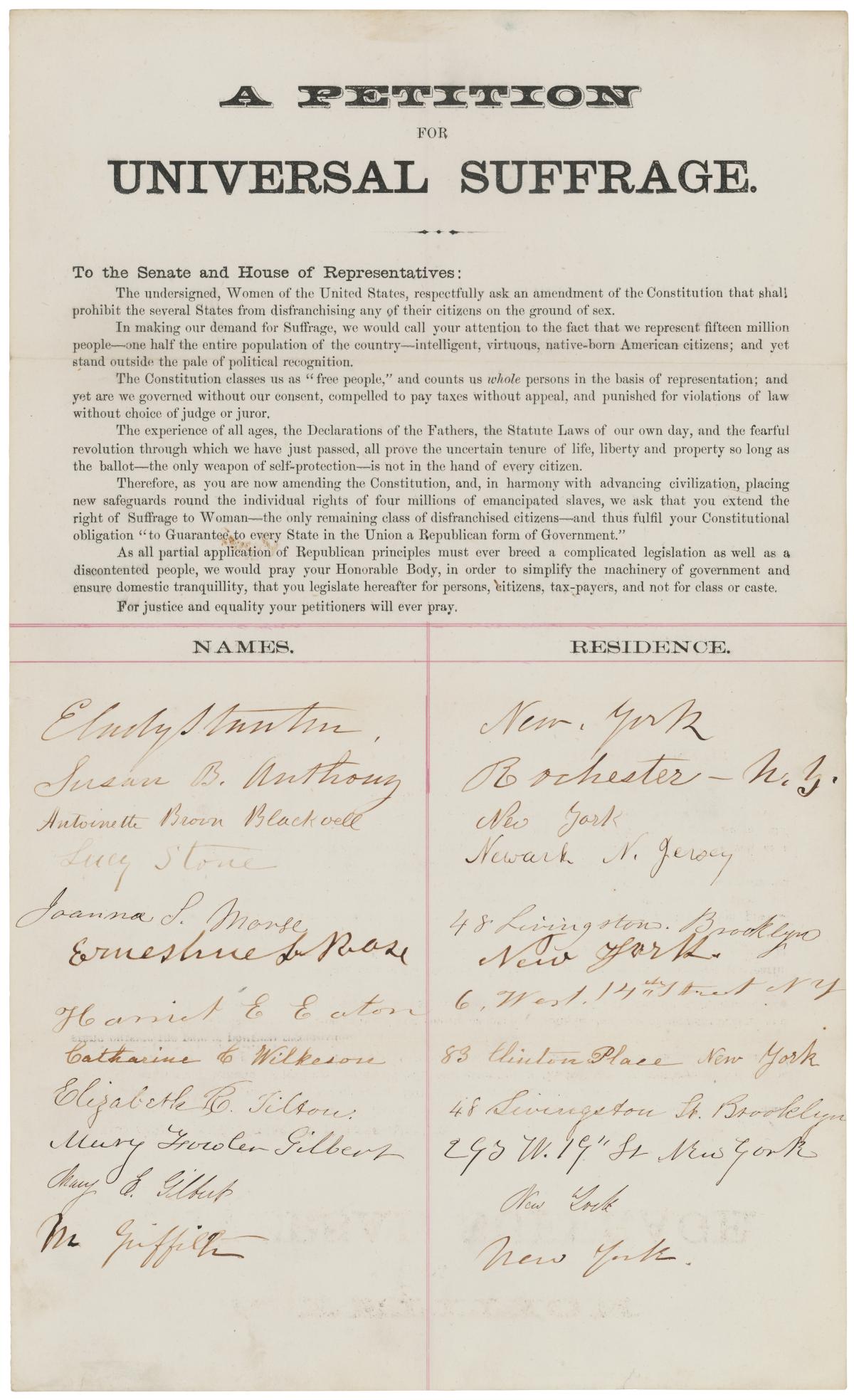
This image shows the Petition for Universal Suffrage. The petition was created following the end of the U.S. Civil War in 1865. When the war ended, many people felt that there were questions that were left answerless. What did the end of the war mean for freed slaves? What will the future look like for freed men and women? Will this affect women's rights as well? The people deserved answers, and that is exactly how this petition came to be. The petition stemmed from the root proposal that a Fourteenth Amendment be added to protect the freed slaves. Elizabeth Cady Stanton and Susan B. Anthony, both influential suffragists during this time, caught wind of this and were set on getting women included in the constitutional changes that could potentially happen. Together, the two assembled a group of women's rights advocates and as a group they began pushing for the idea of 'universal suffrage'. This group was not only fighting for women's rights, but also the rights of everyone regardless of sex or race. Talk of universal suffrage spread very fast and the movement began gaining many followers and also the public's attention.
By the next year, 1866, suffrage petitions began making their way to congress. Thaddeus Stevens, a congressman, presented this specific petition for universal suffrage to congress on January 29, 1866. Some of the most notable suffragists signed the petition, including Elizabeth Cady Stanton, Susan B. Anthony, Ernestine Rose, Lucy Stone, and Antoinette Brown Blackwell. Ultimately, the petition asked, "The undersigned, Women of the United States, respectfully ask an amendment of the Constitution that shall prohibit the several States from disfranchising any of their citizens on the ground of sex". Although this petition did not make the change that many of the abolitionists and suffragists were hoping for, it was still a major milestone for women's rights. It helped gain congressional attention to their cause. It may have taken Congress 42 years to finally come around to their campaign, but the Petition for Universal Suffrage helped set that into motion. Many of the suffragists did not live to see it, but their fight was worth it in the end. Finally, in August 1920, the 19th Amendment was passed and women were guaranteed the right to vote.
Works Cited
'Universal Suffrage." National Archives and Records Administration, 25 July 2019, https://www.archives.gov/legislative/features/suffrage
"Women of the Senate." U.S. Senate: Women of the Senate, 18 Aug. 2020, https://www.senate.gov/artandhistory/history/People/Women/WomanSuffrage…
"Women's Rights Timeline." National Archives and Records Administration, 8 Apr. 2019, https://www.archives.gov/women/timeline#event-/timeline/item/petition-f…