
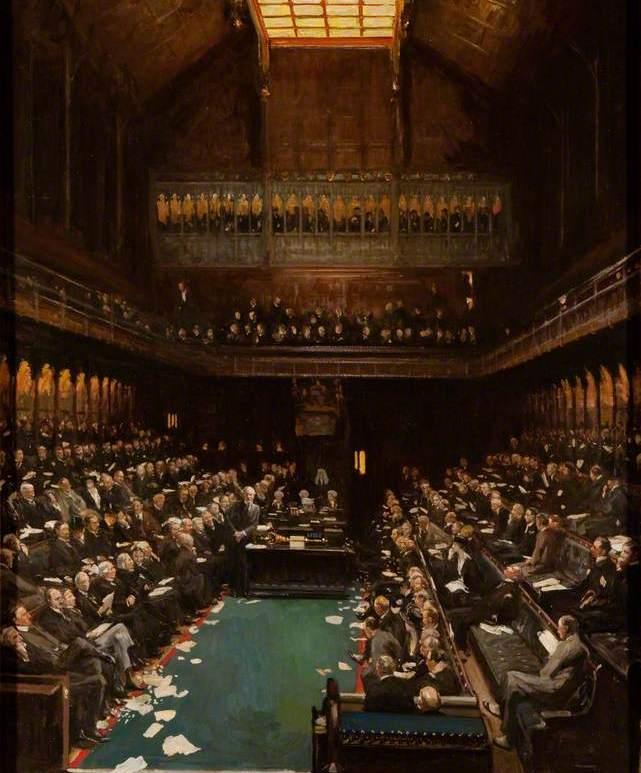
There are a myriad of political events that occurred in England post-1860’s. It was during this era that political parties in parliament saw an increase in “party-loyalty”. Between the 1850’s and 1890’s, parliamentary political parties became much more unified. Parties also went through changes in size. According to researchers, this had an influence on legislative decisions. There were also some changes in the ways voting was conducted. Parliament ensured that the “Ballot Act of 1872” was passed. This act ensured that a citizen’s vote would remain anonymous. It was an attempt by parliament to quell “corruption” in the political process. There was a change made to the amount of representation available in parliament. This was known as the “redistricting of 1885” in British Parliament.
Before the 1860’s, there was a prominence of nationalism and “political radicals”. This remained the case even into the post-1860’s era. Some historians believe that this radicalism has formational roots in the Whig party of the 1600’s. Certain forms of the radicalism were confined to England’s more rural regions. However, in the years leading up to the 1860’s, there was a strong push for class equality. This was likely responsible for inspiring the gender equality push of the post-1860’s era. The fight for gender equality in this era can be seen in the Married Women’s Property Act, the Matrimonial Causes Acts, and the Custody of Infants Act. The continued support for “British Liberalism” led to a prominence of “national pride” and “patriotism”. Liberal politicians used the population’s patriotism to justify British military and economic presence in foreign nations. England had (and still has) one of the most powerful navies in the entire world. This helped them gain footholds in foreign countries for various reasons. When it came to international conflict, the liberals over-exaggerated England’s military leadership. To fit their narrative, they conveniently understated the contributions made by the country’s allies. Among British liberals, there was a sense of aggressive competition towards fellow colonial powers. The British Liberalism of Victorian England is most ideologically equivalent to modern conservatism. It is an ideology based on national pride and reduced taxation. It became quite popular in both Scotland and Wales as well. During the post-1860’s era, there was an increase in satisfaction with the political status-quo. In other words, the anti-establishment narrative was less prevalent. It was a period of extreme urbanization due to rapid population growth. Many workers saw an increase in their wages. Travel by train became more common due to consistent railway construction. This “boom” led to a general increase in the amount of economic legislation that parliament passed.
There was also a rise in pro-labor and socialist political movements. The socialist movement was dependent upon internal chaos. Therefore, “taking-sides” in the American Civil War was considered a dog whistle for supporting chaos or socialism. The labor unions helped to make the working class in England extremely cohesive during this time period. The “pro-worker” movement proceeded to gain formidable political power. Karl Marx stated that England had abundant resources for communist revolution. However, he thought that the British people didn’t have the will-power to carry it out. Although the aforementioned legislation applied to England, this wasn’t always the case for Ireland and Scotland. For example, Ireland passed the Irish Franchise Act in 1850, which edited their legislative process. It was similar to the Reform Act in England, which wasn’t passed until 1867. The Irish nationalist movement took hold in the 1880’s primarily among the middle class “novel” voters. On a lower level, there was also an increase in Irish localism. Immense tension existed between Catholics and Protestants in the country. “Landlords” had gained substantial amounts of political power in Ireland. Unlike England, it was the rural areas of Ireland that held the majority of electoral power. There was an abundance of politically motivated violence in these areas. It was more prevalent in Ireland than in both England and Wales. There was no shortage of financial corruption in the Irish political process. The Church had more political power in Ireland than it did in England. In post 1860’s era, the Tory party in Ireland had more electoral success than the Unionist party. Ironically, they pushed a “pro-British Empire” narrative.
Cox, Gary W. The Efficient Secret: the Cabinet and the Development of Political Parties in Victorian England. CUP, 2005.
Finn, Margot C. After Chartism: Class and Nation in English Radical Politics, 1848-1874. Cambridge Univ. Press, 2003.
Parry, J. P. The Politics of Patriotism: English Liberalism, National Identity and Europe. Cambridge University Press, 2006.
Hoppen, K. Theodore. “The Franchise And Electoral Politics In England And Ireland 1832–1885.” History, vol. 70, no. 229, 1985, pp. 202–217., doi:10.1111/j.1468-229x.1985.tb01434.x.
Guilford Press, Science and Society