
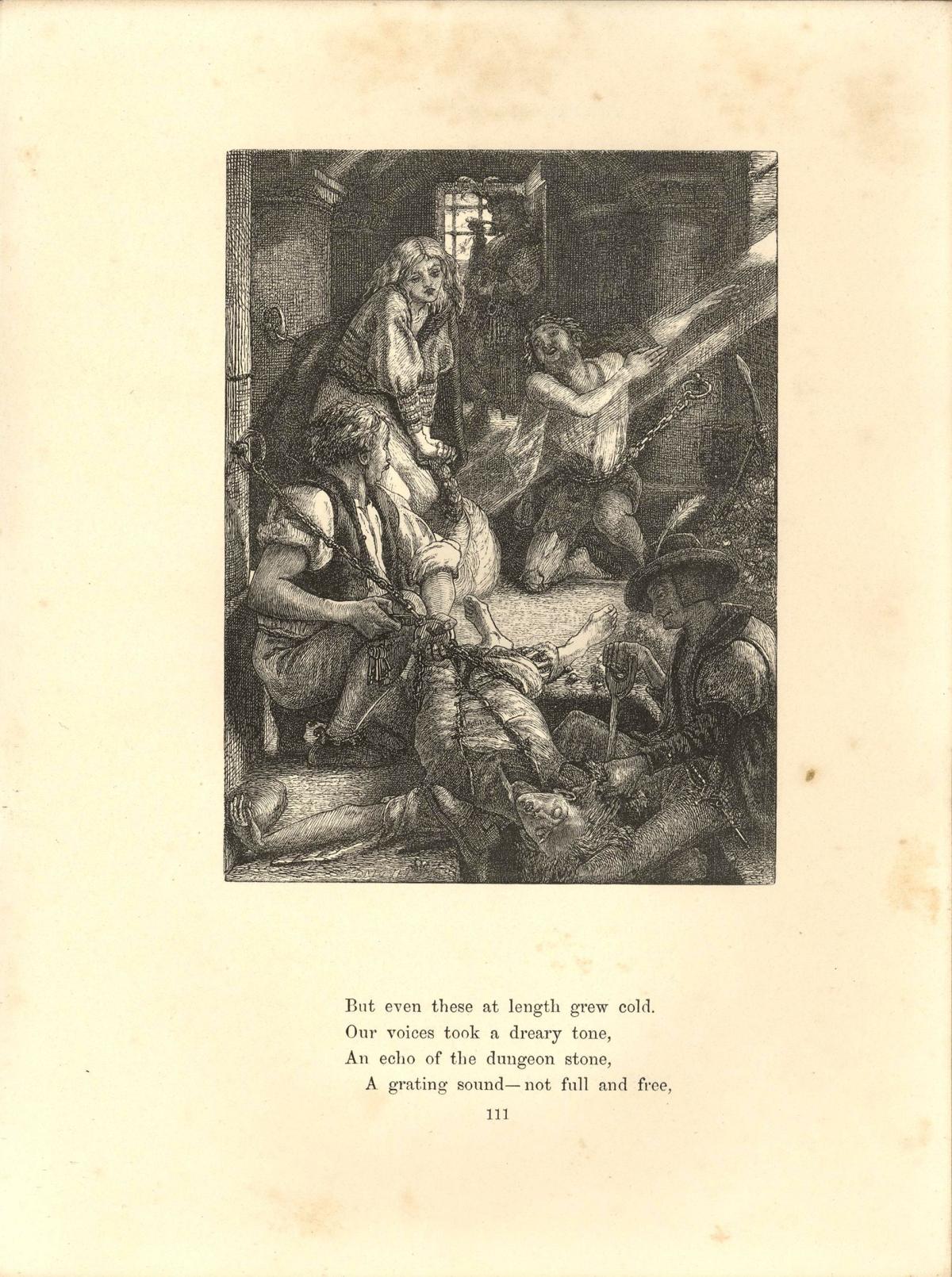
Ford Madox Brown (1821-1893) was one of the Pre-Raphaelite artists commissioned by the Dalziel Brothers to provide illustrations for Poets of the NIneteenth Century (1857), a lavishly illustrated Christmas gift book featuring national poets. As a Pre-Raphaelite artist, Brown followed a "truth to nature" approach to his illustrations, for which he used models. This "realist" approach to illustration was distinct from the caricature style of artists like George Cruikshank, John Leech, and John Tenniel, who did not use models for their drawings. For his illustration for Lord Byron's poem "The Prisoner of Chillon," Brown went to the dissecting room of the University hospital to draw studies of a fresh corpse in its stages of gradual decomposition. As he would for any life model, the artist arranged the position of the cadaver's arms and legs, tying a rope around its collapsed midsection to emulate the contorting effect of chains on the stiffening body. Brown completed the rest of his studies in his studio, where he spent many hours over six weeks creating studies and drafting his composition before sending the final design, drawn on the woodblock. to the Dalziels for engraving. As a relief printing process, wood-engraving allowed imagges to be set up with the letterpress and printed on the same page as the text, as seen in this page from Poets of the Nineteenth Century. Byron's poem is about three brothers cast into a castele's dungeon by a tyrant. The surviving eldest brother narrates the horror of seeing his siblings die in front of him, only to be buried in a shallow grave close to his fettered feet. Presented with this dramatic picture of death in its grimmest aspect, readers of Poets of the Nineteenth Century would take in Byron's poem through the visual lens of Brown's gruesome, anatomically accurate picture. Ford’s realistic rendering of the subject is worthy comparing with Cruickshank’s equally powerful but stylistically different “Fagin in the condemned cell,” for Dickens’s Oliver Twist (1837-38), an etching produced two decades before this wood-engraved illustration for “Prisoner of Chillon” (1857). Ford's empirical style is derived from a Pre-Raphaelite aesthetic and informed by scientific developments, including an interest in skeletal remains fostered by popular science such as Robert Chamber's Vestiges of the Natural History of Creation, and the Anatomy Act., which provided dissecting rooms with the corpses of indigent paupers.
Source: Lorraine Janzen Kooistra, "Science and Art: Vestiges of Corpses in Pre-Raphaelite Illustrations," Reading Victorian Illustration, 1855-1875, edited by Paul Goldman and Simon Cooke