
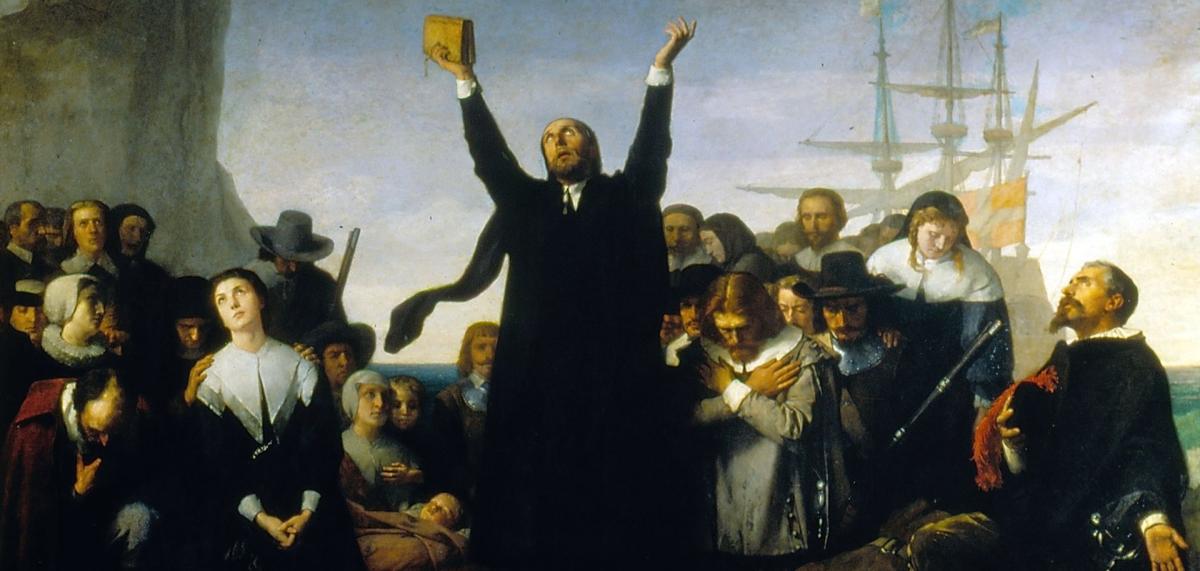

Though American history spans hundreds, if not thousands of years, English American history begins with religious disputes in Europe. Of course, the division between Catholocism and Protestants sparked much of the religious conflict in Europe, but tensions between denominations and religious groups grew until the schism led to the Puritans fleeing Europe for America. The painting "The Arrival of the Pilgrim Fathers," or "Desembarco de los puritanos en América" in its original language, visually depicts the arrival of the Puritans in America. The Puritans believed in ridding England of Roman Catholic practices and becoming even more Protestant in their beliefs and practices. One of these "progressive" ideals that led to the actions they took involved their interpretation of what faith meant to them. Specifically, faith involved the joy and love found in Christ's redeeming power. This emotion within religion set Puritans apart from more traditionalist Protestant ideologies - and even further apart from Roman Catholics.
No literary work presents this progressive Puritan ideology better than Johnathan Edwards's"Sinners in the Hands of an Angry God."
Scholar Rosemary Hearn directly addresses Edwards' contribution in regards to religious emotion in her article "Form as Argument in Edwards' 'Sinners in the Hands of an Angry God.'" She writes, "Historians cite Edwards' delivery of this sermon in July 1741 at Enfield, Connecticut, as his central contribution to the religious revival, especially its emotionalism" (Hearn 452). As Edwards writes, he utilizes vivid, violent imagery of the eternal damnation that awaits the apathetic sinners he addresses. Consider the statement, "natural men are held in the hand of God over the pit of hell; they have deserved the fiery pit, and are already sentenced to it" (Edwards). Phrases like these are used by Edwards to strike fear into his congregation, forcing them to realize where their indifference is leading them.
Compared to the very ritual- and practice-oriented theology of Catholicism, Edwards - representing the progressive Puritan ideals - emphasizes the personal action and responsibility that the individual must take upon themselves to prevent falling into such a fate. He says "let every one that is yet out of Christ and hanging over the pit of hell, whether they be old men and women or middle-aged or young people or little children, now hearken to the loud calls of God’s word and providence" (Edwards). Christians, per Puritan ideals, cannot depend on forgiveness from a clerigal authority or rely on some sort of payment or action to absolve them of their sins; no, the Puritans and all Christians must make the choice to step away from sin and toward faith is they so desire eternal salvation.
And so, if not for this progress in religious ideology, from the long-standing and traditional Catholic principles to the comparitvely radical Puritan sect of Protestantism, the foundation of English American history may not exist as we understand it today.
Works Cited:
Edwards, Johnathan. "Sinners in the Hands of an Angry God." Cove.
Hearn, Rosemary. “FORM AS ARGUMENT IN EDWARDS’ ‘SINNERS IN THE HANDS OF AN ANGRY GOD.’” CLA Journal, vol. 28, no. 4, 1985, pp. 452–59. JSTOR, http://www.jstor.org/stable/44321854. Accessed 18 Mar. 2024.
Gisbert, Antonio. "Desembarco de los puritanos en América." Wikimedia Commons, Wikimedia Foundation, 1883, https://commons.wikimedia.org/wiki/File:Desembarco_de_los_puritanos_en_…. Accessed 1 May 2024.
.jpg)