

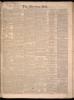
In 19th century Victorian England, women were significantly inferior to men, regardless of their title or occupation; however, there were some occupations held by women deemed more worthy and respectable than the rest. One of these such occupations was the role of a governess. In Charlotte Bronte's 1847 novel, Jane Eyre, the titular character finds employment as a governess at Thornfield Hall under the employment of Edward Rochester, whom she later engages in a romantic relationship. Though the role of a governess was not financially rewarding, it was far less physically strenuous then the work of the lower classes in factories and, therefore, was more respectable; however, this did not make women within higher or lower class households equal to their employers or even treated fairly by them as evidenced by the misadventures of Jane Eyre during her time as a governess. The picture shown, is that of a common advertisement that would have been found in the papers at the time taken out by women looking for employment as a governess within a household, acting as a sort of resume for future employers.
“Governess Advertisements from The Morning Post.” British Library, Sourced from the British Newspaper Archive, https://www.bl.uk/collection-items/governess-advertisements-from-the-morning-post.

Barrett , Kara L. “Victorian Women and Their Working ... - Buffalo State College.” State University of New York College at Buffalo - Buffalo State College Digital Commons at Buffalo State, May 2013, https://digitalcommons.buffalostate.edu/cgi/viewcontent.cgi?article=1009&context=english_theses.

“Historical Context - Meet Jane Eyre.” Google Sites, 2012, https://sites.google.com/site/meetjaneeyre/historical-context.

Hudson, Professor Pat. “History - Women's Work.” BBC, BBC, 29 Mar. 2011, https://www.bbc.co.uk/history/british/victorians/womens_work_01.shtml.