
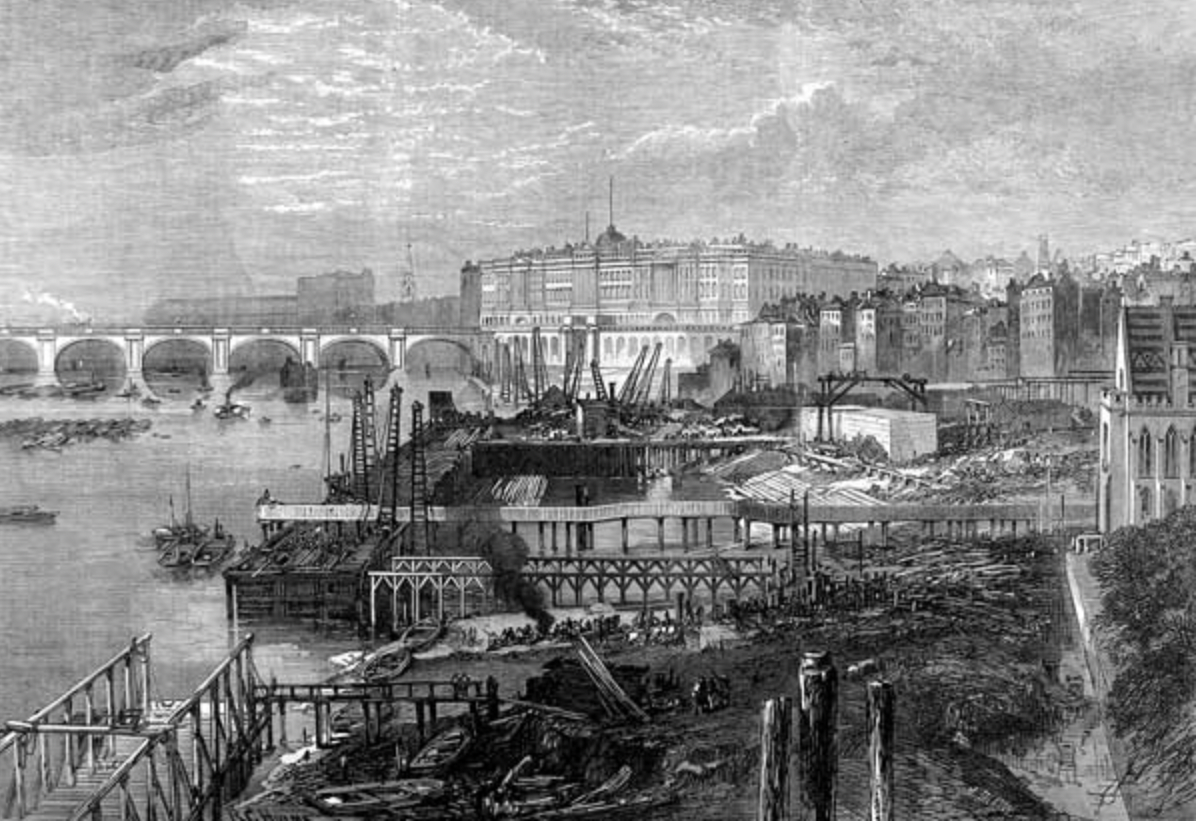
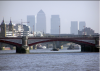

This stop of the map tour will focus on the Thames River, specifically the spot on the river crossed by the Blackfriars Bridge. Dickens does not explicitly name the Thames River in Bleak House, but his use of the word aits (small river islands, especially those found in the Thames) in “Fog up the river, where it flows among green aits and meadows; fog down the river…” (Bleak House, Chapter 1) combined with the proximity of other locations mentioned in the excerpt to the Thames, it can be assumed that is the river mentioned. Even though it was not mentioned in Bleak House I chose to specifically stop at the Blackfriars Bridge because it existed at the time the story was written, and it is close to other locations on the tour.
The first people to build a bridge over the Thames were the Romans. The Romans were the first civilization to build a bridge over the Thames, which they called the Tamesis, meaning "dark", for its incredibly murky water (Messenger). The appearance of the Thames adds to the Gothic attitude of Bleak House. At two hundred and fifteen miles (Thames River Sightseeing), the Thames is England’s longest river and was vital to the establishment of London. After the Romans lost power and left the area, London became a popular trading and shipbuilding hub for Saxons, Normans, and Tudors all because of its location on the Thames. The forty-seven locks along the Thames, some of them dating back four hundred years, are a testament to the river’s place in London’s financial and innovative history.
During Dicken’s lifetime, the Thames River presented a great difficulty for the people of London. The sewage system at the time was inadequate and much of the city’s waste ended up in the Thames. The stench became so bad that in 1858 meetings of Parliament were suspended until the problem could be addressed. In 1869 the first filtration plant for the Thames was created to solve the sewage problem (Messenger). Today, the Port of London Authority oversees the maintenance of the river channels and provides services for shipping.
The specific spot on the Thames included on this tour is the Blackfriars Bridge. Completed in 1769, the Old Blackfriar Bridge was faulty and required constant repairs during throughout the 1830s. Finally, in 1860 the original Blackfriar Bridge was demolished to make way for the Blackfriar Bridge that is seen today. The present Blackfriar Bridge was opened in 1869 by Queen Victoria and has been in use ever since (The History of London). Today, the Blackfriar Bridge carries the north-south Cycle Superhighway 6, something completley unimaginable in Dickens' day (Blackfriars Bridge).
The Thames, with its long and winding history, has been a steadfast feature of British literature for generations- specifically in Charles Dicken’s Bleak House. This is why it is only fitting to include it as a stop on our tour of London.
Works Cited
“AIT.” Wikipedia, Wikimedia Foundation, 29 June 2022, https://en.wikipedia.org/wiki/Ait.
Dickens, Charles. Bleak House. Tauchnitz, 1852.
Doan, Mai-Linh. London from Above . London, England , 2 Oct. 2005.
“Blackfriars Bridge.” Illuminated River, https://illuminatedriver.london/bridges/blackfriars-bridge.
“The History of London.” London's History, https://www.thehistoryoflondon.co.uk/the-original-blackfriars-bridge/ .
Messenger, Paul. “The River Thames: A History.” The River Thames: A History :: West End on the Thames, https://www.westendonthethames.com/home2/blog/2014/01/22/sailing-up-the-thames-the-best-thing-since-sliced-bread/.
Pingstone , Adrian. Blackfriars Bridge, Seen from Waterloo Bridge . London, England , Nov. 2004.
Thames River Sightseeing. “10 Interesting Facts about the River Thames.” Thames River Sightseeing, 18 Mar. 2021, https://www.thamesriversightseeing.com/blog/interesting-facts-about-the-thames.
"The Thames Embankment". The Illustrated London News [London, England] 4 February 1865; p. 112; Issue 1300