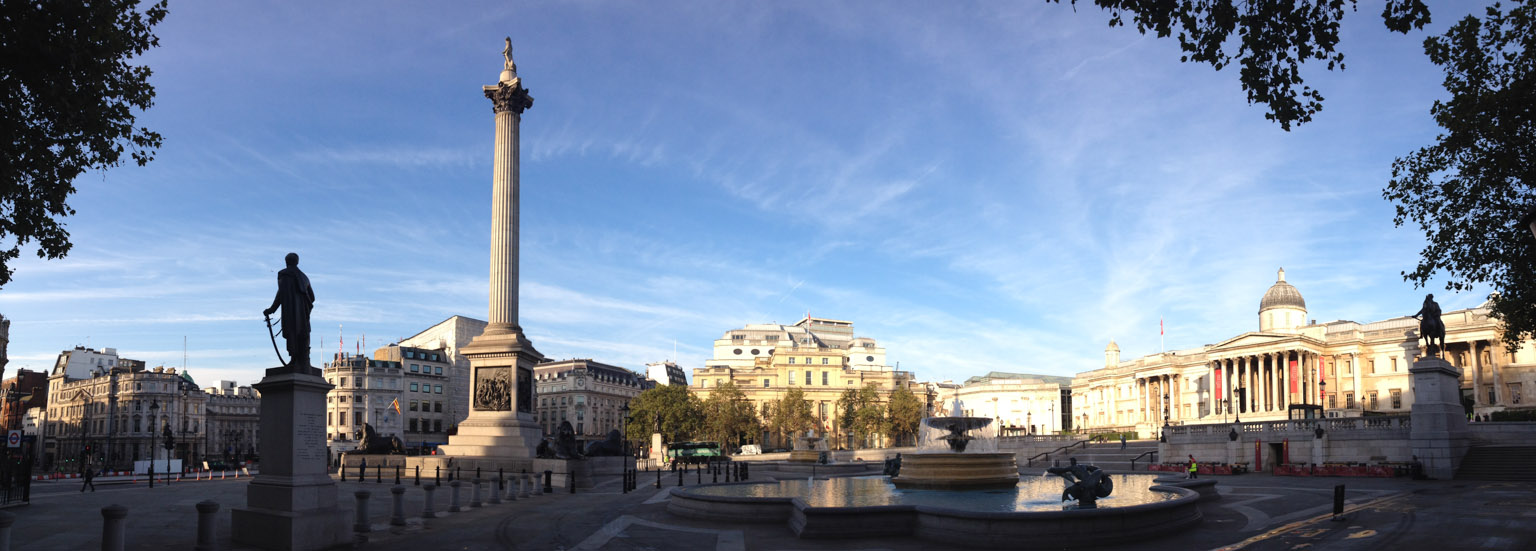
The area Charing Cross feeds into – Trafalgar Square – is one of London’s most famous public common areas lacking a green space. It is a bit redundant, but Trafalgar had historical significance built into it before it was even completed. Throughout the years, people have had many reasons to choose this square as their gathering place.

In the 16th century, the area was previously the Great Mews stabling, serving Whitehall Palace. The fire at the end of the 17th century burned the Palace and forced the residents elsewhere. In the beginning of the 19th century, a famous naval commander – crucial in wars against the French – Viscount Horatio Nelson dies obtaining victory in the Battle of Trafalgar. This 1805 victory helps to establish British naval supremacy for the century. Read between the lines: wealth is power; home is empire.
The square is built as the idea of a public thoroughfare begins. Things shift; people use the space for their own ideas. We see Trafalgar-square mentioned by the Boy Crossing-Sweeper: “But we don’t mind the police much at night-time, because we jumps over the walls round the place at Trafalgar-square, and they don’t like to follow us at that game, and only stands looking at you over the parrypit. There was one tried to jump the wall, but he split his trousers all to bits, and now they’re afraid.” Charing-cross (adjacent to Trafalgar Square) is a central point in the young boy’s life. Trafalgar Square becomes a refuge from the policeman who decide to wage a war against them in their spaces. (Those in poverty interact with the space, too.) The city seems to offer the boy a home; the city gives the poor a place.


Trafalgar Square has since seen many political rallies, traditions, and at times, violence and riots. The area was hit twice with suffragette bombings, in 1913 & 1914 (a list from Wikipedia, citing reputable sources for further research). There is a longstanding tradition of Norway gifting a Christmas tree for the square during the holiday season. It began as a symbol of gratitude for support during WWII, but it has come to symbolize something else in the years of community that have followed. In the early 2000s, animal activists staged a protest after the Mayor banned feeding pigeons in the square (and still has a page with the London government). During May 2007, the square was temporarily covered in turf to promote green spaces for two days. Such a public space is forced to reckon with the boundaries established by the shifting views of its people.


The fourth plinth is a demonstration of Trafalgar Square’s contemporary openness to variation and creativity of the people. The program has invited artists to make sculptures, and has displayed several sculptures that lean more contemporary than traditional (a few past commissions). This – both the plinth and the area – is an intersection of home and city as leaders guide spaces to stay public.