
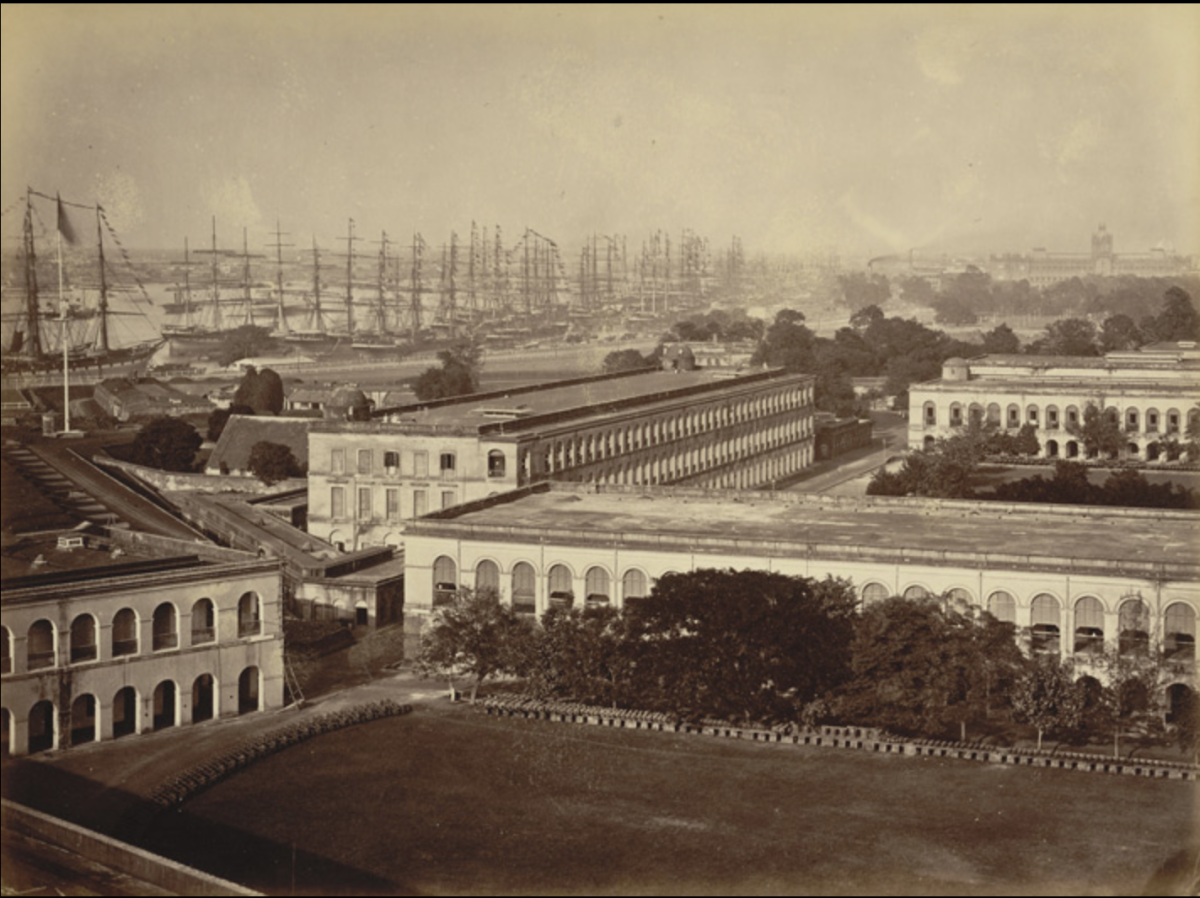
West Bengal was crucial for the British empire due to its richness in resources and its geographical position with access to sea ports. This made it a staging ground for both trade and military operations. Following the Battle of Plassey in 1757, led by British soldier Robert Clive under command of the East India Company, the British granted Clive the title of Mughal emperor. Although the title was largely symbolic, it marked a decisive shift in power in the Bengal region into the hands of the British Empire. In 1858, the British government and crown took direct control of the East India Company’s dealings in India following the Indian Rebellion in 1857. The British Raj was in direct control of Bengal, which was not yet partitioned. Bengal was partitioned in 1905 along religious lines between Hindus and Muslims as an attempt to undermine the growing calls by Hindus for greater representation in government. This marked a period of social and political unrest in the region, as opponents to the partition fiercely held protests and boycotts against the British Empire. Maintaining control of this region was crucial for the British Empire due to its position as a stronghold for British control of the region. West Bengal became heavily influenced by British practices and institutions, while East Bengal received less attention. This “under-governance” became one of the British talking points for partition in 1905.
Sen was born in West Bengal and, in her adulthood, spent many years in Calcutta, the capital of British India. Even prior to the partition, tensions between East and West Bengal as well as with Europeans were prevalent between Indian citizens. As Sen was being escorted by Kalicharan in Mokamah, he was rebuked for leaving her unattended and was called a “bumpkin from east Bengal” (76). He then tells her, “The bastard called me a bumpkin from east Bengal. But what did I see? Why were you hobnobbing with Europeans? My uncle says you are a good girl, that's the only reason I agreed to accompany you.” (76). Thus, while interacting with Europeans was not seen favorably, certain tensions between east and west Bengal existed and were likely exacerbated by the British presence in the region.
Citations:
Marshall, Peter . “BBC - History - British History in Depth: The British Presence in India in the 18th Century.” Www.bbc.co.uk, 17 Feb. 2011, www.bbc.co.uk/history/british/empire_seapower/east_india_01.shtml.
Siddiqui, Dr Habib. “Bengal under English Rule (1757-1905) – Analysis.” Eurasia Review, 19 Mar. 2023, www.eurasiareview.com/20032023-bengal-under-english-rule-1757-1905-analy...
Kaul, Chandrika. “BBC - History - British History in Depth: From Empire to Independence: The British Raj in India 1858-1947.” Bbc.co.uk, 2011, www.bbc.co.uk/history/british/modern/independence1947_01.shtml.