
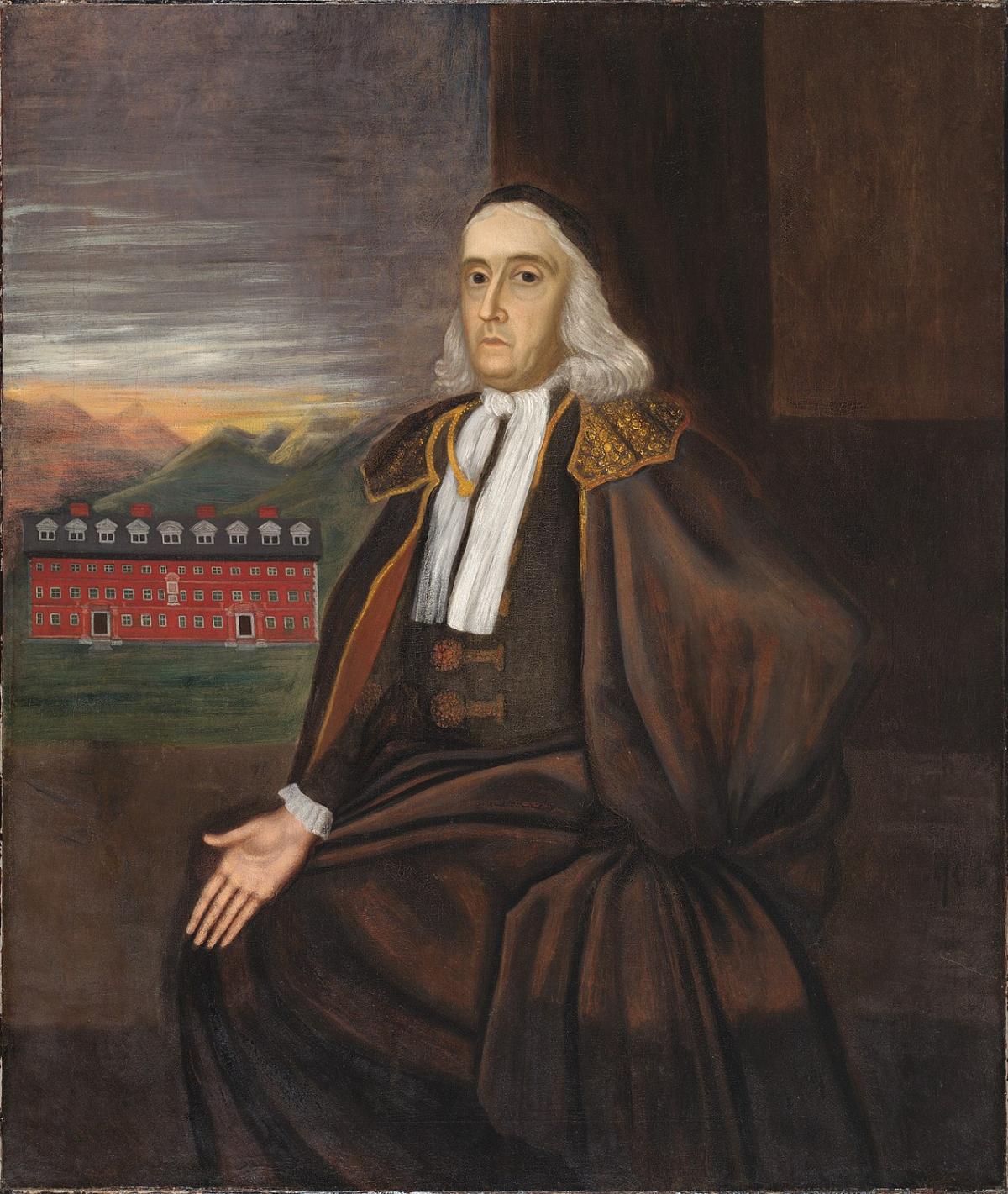

The above image is a portrait of William Stoughton, created around 1700 by an unknown author, the chief of justice in the Salem Witch Trials (“William Stoughton (Judge)”). Stoughton was the main prosecutor of those accused of witchcraft. During the Salem Witch Trials, he frequently imposed injustice on those accused of witchcraft. Similarly to the witch trials, Langston Hughes “Harlem” explores the injustice placed on African Americans during the Harlem Renaissance period, a movement which signified a cultural awakening. In court, “a guilty until proven innocent” method was used; it was nearly impossible to prove one’s innocence due to the afflicted girls’ “fits” which was used as “spectral evidence” (“The University of Chicago Library”). Due to this, injustice was served to all those accused of witchcraft. Hughes mentions “Or fester like a sore – And then run?” (Hughes). Hughes is referring to the African Americans’ dreams of sharing the same privileges as the white males which surround them. During the 20th century, severe injustice was placed on African Americans which can be seen through the tightening of segregation and growing racism (Locke). Likewise, with William Stoughton and the Salem Witch trials, injustice was placed on the accused, restricting them of the right to fight for their innocence.
Hughes also mentions “Or does it explode?” (Hughes). This line signifies the potential for societal unrest due to the African Americans’ deferred dream of being equal. Their issues eventually became known through peaceful protests; however, the trials did not end so peacefully. In the Salem Witch Trials, societal issues were an everyday occurrence, often resulting in another innocent civilian being accused of witchcraft. William Stoughton caused societal unrest as well due to issuing arrest warrants to those accused of witchcraft with minimal evidence supporting the claim. Both of periods of time resulted in a cultural awakening due to societal issues. The Salem Witch Trials, William Stoughton, and “Harlem” by Langston Hughes all show similar themes of injustice and societal unrest which can be brought to light by an examination of systemic injustices across different historical periods.
Hughes, Langston. “Harlem by Langston Hughes.” Poetry Foundation, Poetry Foundation, www.poetryfoundation.org/poems/46548/harlem. Accessed 5 May 2024.
Locke, Alan, et al. “The Civil Rights Act of 1964: A Long Struggle for Freedom the Segregation Era (1900–1939).” Library of Congress, 10 Oct. 2014, www.loc.gov/exhibits/civil-rights-act/segregation-era.html.
“The University of Chicago Library.” The Salem Witch Trials - The University of Chicago Library, 1 Oct. 2020, www.lib.uchicago.edu/collex/exhibits/salem-witch-trials-legal-resources/.
“William Stoughton (Judge).” Wikipedia, Wikimedia Foundation, 30 Apr. 2024, en.wikipedia.org/wiki/William_Stoughton_(judge)#/media/File:WilliamStoughton.jpg.