
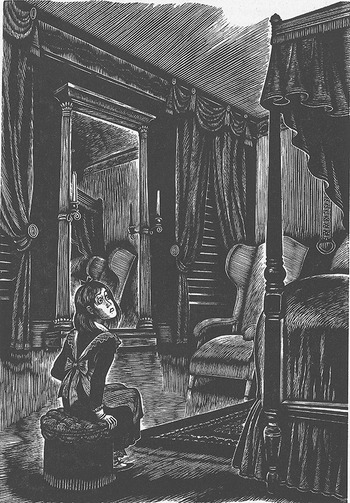
Excluded from her relations and abused by her cousin John Reed, Jane’s resentment and grief causes her to lash out to an extent that, according to the narrator (Jane’s older self), “I was a trifle beside myself.” By this idea, Brontë means to open the reader’s questioning of Jane’s identity: “‘What shocking conduct,’” Miss Abbot scolds, “‘to strike . . . your young master!’” “‘How is he my master?’” Jane retorts. “‘Am I a servant?’” (chap. 2). The question is reasonable, the reader can surmise, given Jane’s orphan status, which her aunt has compounded by exclusion from the family circle.
Behind her aunt’s hostility, however, is an unsettled emotion about Jane’s identity: “‘there is something truly forbidding in a child taking up her elders in that manner,’” Mrs. Reed confesses (chap. 1). Jane seems alien even to the household servants, among whom she is placed: Bessie is “incredulous of [her] sanity” and Miss Abbot regards her as “‘an underhand little thing: I never saw a girl of her age with so much cover’” (chap. 2). These characters are unable to penetrate beyond their limited and prejudiced experience.
Mrs. Reed’s impulse, therefore, is to lock Jane out of sight in the seldom-visited Red Room. There the child experiences emotionally what the older narrator more objectively calls “out of myself.” In a mirror, Jane catches sight of herself as if she were another being: “my fascinated glance . . . explored the depth” that the mirror “revealed,” discovering in its “visionary hollow” a “strange little figure there gazing at me, with a white face and arms specking the gloom” like “a real spirit” come into existence from one of Bessie’s fairy tales. In this revelation, Brontë presents to the reader an experience of selfhood that neither Jane’s elders nor even the child herself can penetrate—the hidden self. Here Brontë draws on a shift in Victorian psychology, which treated the self as hidden in a mental depth, alien perhaps to the ordinary functioning self, and accessible only in moments like Jane’s of disassociation from ordinary reality or by the penetration of skilled mental analysis, which Brontë makes available only to privileged characters in her novels (Shuttleworth 9-10).
In his 1943 woodcut illustration to Jane Eyre, Fritz Eichenberg hides a ghostly face in the armchair as reflected in the mirror. The real Jane looks anxiously away from the mirror, but the viewer apprehends that she will soon turn her “fascinated gaze” into the mirror’s depths and discover this alienated version of herself.
Works Cited
Brontë, Charlotte [Currer Bell]. Jane Eyre: An Autobiography. Smith, Elder and Co., 1847. Cove Collective, Southeastern Louisiana University.
Eichenberg, Fritz. “Daylight began to forsake the red-room,” woodcut illustration, in Charlotte Brontë, Jane Eyre. Random House, 1943.
Shuttleworth, Sally. Charlotte Brontë and Victorian Psychology. Cambridge UP, 1996. eBook Collection, EBSCOHost.