
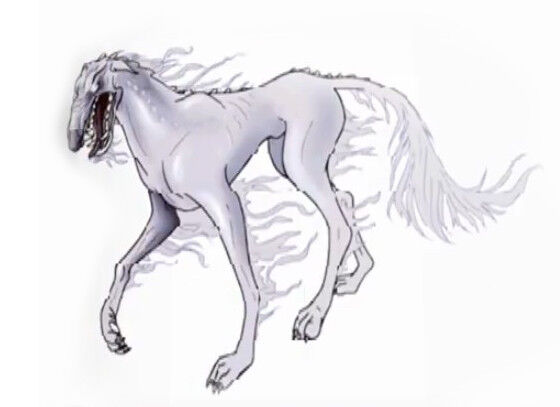
When Jane first encounters Rochester on the road (“It was very near . . .”), Brontë sets the moment in a world shaped by folklore and Romantic imagination. As Jane sees a dark figure approaching, her mind jumps to the Gytrash, a northern English spirit said to appear as a horse, mule, or dog and to mislead travelers on lonely paths. The Wikipedia article describes the Gytrash as “a spectral black dog,” and Branwell Brontë’s own account paints it as a large, shadowy creature that startles wanderers before vanishing into the moors. It’s exactly the kind of superstition that would surface in Jane’s imagination during a solitary walk on a winter evening.
By invoking this legend, Brontë briefly pulls the reader into the Romantic fascination with folk tales—the same cultural interest that inspired the Grimm brothers, Walter Scott, and Andersen. The quiet road, the dim light, and the sudden appearance of a “great dog” all create a moment that feels eerie and otherworldly, as if Jane has stepped into a story shaped by superstition.
But Brontë doesn’t let that mood linger. She quickly snaps the scene back to reality. The Gytrash dissolves into an ordinary dog, and the mysterious horseman becomes a very human man who has slipped on the ice and is clearly irritated about it. Rochester’s entrance is almost anticlimactic: he curses, he struggles to stand, and he speaks sharply. The supernatural atmosphere evaporates in an instant.
This shift matters. Brontë refuses to let Rochester appear as a Romantic hero who magically expands Jane’s horizon or rescues her from her limitations. If she allowed the Gytrash-like fantasy to continue, Rochester would become just another conventional “solution” for a woman’s restricted world. Instead, Brontë introduces him as flawed, grounded, and unmistakably human. By playing down the Romantic atmosphere, she makes it clear that Jane’s yearning to “overpass [the] limit” of her horizon won’t be answered by a mythical figure or a sweeping romance, but by something far more complex.
Works Cited
“Gytrash.” Wikipedia, Wikimedia Foundation, https://en.wikipedia.org/wiki/Gytrash.
Katchmar, Colin. "Gytrash." Cove Collective, 19 January 2022, https://editions.covecollective.org/index.php/content/gytrash.