
The "male gaze" as it is known is a term that is very much synonymous these days with conversations locked within feminism and gender roles, and one which tends towards modernity at least insofar as common use of it is concerned, yet with roots which run far deeper than that which tends to be expected for the conversation. However, where it applies to Jane Eyre is in the way it pervades Jane's life, inspecting her and forcing her to live within the confines of what men want from her, and especially how they are affected by her and her work. As seen within Chapter 13, Mr. Rochester himself very much dominates the interactions with the women he is with, whether from his icy, statuesque nature, to the manner in which he rather brutally talks Jane down and constantly leaves her to defend herself during their interactions. However despite that, Jane herself actively manages to combat the expectations forced upon her by Rochester, defying the norm by having not copied from a master for her pieces, but rather doing it on her own and allowing her own creative vision to bloom and paint the vivid scenes she impresses Rochester with.
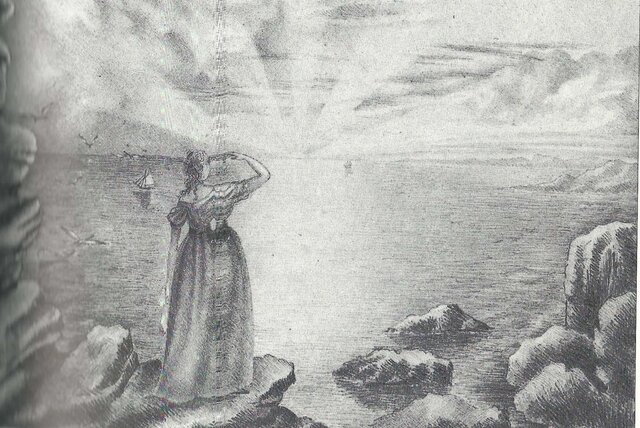
Fittingly, then, it only makes sense to inspect Anne Brontë's art in relation to the theme of the male gaze, more specifically how it inverts what is expected to allow a woman to wield the power of gazing upon something, and admiring it with her own eyes. The image in question is untitled, but known as Sunrise over Sea for the purposes of describing the image and titling it for viewers unfamiliar with Anne's work. The image itself shows a woman gazing upon the sea from a craggy cliffside, staring out into the rising sun in the horizon as jagged rocks, birds, and a singular boat can be seen. The isolation within the image is palpable, being the only human displayed upon the piece, yet one which is important considering the fact she is standing tall, alone, in the foreground while admiring the view. Jane herself does this as well within Chapter 12, where she describes the experience from atop Thornfield as, "...that then I longed for a power of vision which might overpass that limit..." This sort of ambition and admiration for the world around her is something which similarly reflects the theme of gazing, where she is admiring the world and taking it in while also realizing she herself wishes she could, as opposed to Mr. Rochester seeing her an attempting to confine her into what he expects of a woman. This innocent admiration for the world can be understood then, as the feminine gaze, and one which Anne's piece embodies, allowing a woman to stare much like Jane from the roof, and admire the early morning sun (again much like Jane had in the bildungsroman) without worry for what a man might think of her for doing so. And indeed, she does actively do so, instead lamenting the fact she does not have much experience with other women, and a want for worldliness that only men during this time could very easily have (Chapter 12 Paragraph 3).
To tie such a theme to Jane's images that impressed Mr. Rochester so, the use of gaze within her images is present only within the final two, the first of both detailing a woman blending into the starry night as she stares at the viewer, almost evoking that sense of the male gaze and showing how a woman herself can embody such, strikingly detailing her "eyes shone dark and wild" alongside "the hair streamed shadowy, like a beamless cloud..." (ch 13) both of which offer a very cold, steely sort of picture which likely mirrors the cold gaze she herself wore when depicted by Jane. And finally, the visage of Death itself- as suggested by the quotes by Milton's Paradise Lost of "the likeness of a kingly crown" and "the shape which shape had none"- staring off towards an iceberg during the northern lights, which in and of itself mirrors the first image and Anne's drawing which similarly have a figure staring off towards the horizon, admiring the view, which in a manner could suggest that the overall theme of gazing with the third painting. That being that it is simply to show the very human nature of admiring a view and the sense of aspiration for worldliness, no matter who is doing it, and showing that while ultimately a gaze might be able to oppress, affect, and even beat down upon others, that a person can similarly intend to use it as a manner to admire the world around them, and experience the world as they wish to, rather than as they are told to by others, a core part of Jane's overall character, and her very unique manner of choosing her own fate rather than letting it come to her.
Works Cited
Brontë, Anne. Untitled [Sunrise over Sea]. Pencil, 1839, Brontë Parsonage Museum. In Beverly Taylor, "Becoming Acton Bell," Journal of Juvenilia Studies, vol. 5, no. 1, Feb. 2023. Research Gate, https://www.researchgate.net/publication/368679311_Becoming_Acton_Bell.
Brontë, Charlotte [Currer Bell]. Jane Eyre: An Autobiography. Smith, Elder and Co., 1847. Cove Collective, Southeastern Louisiana University.