
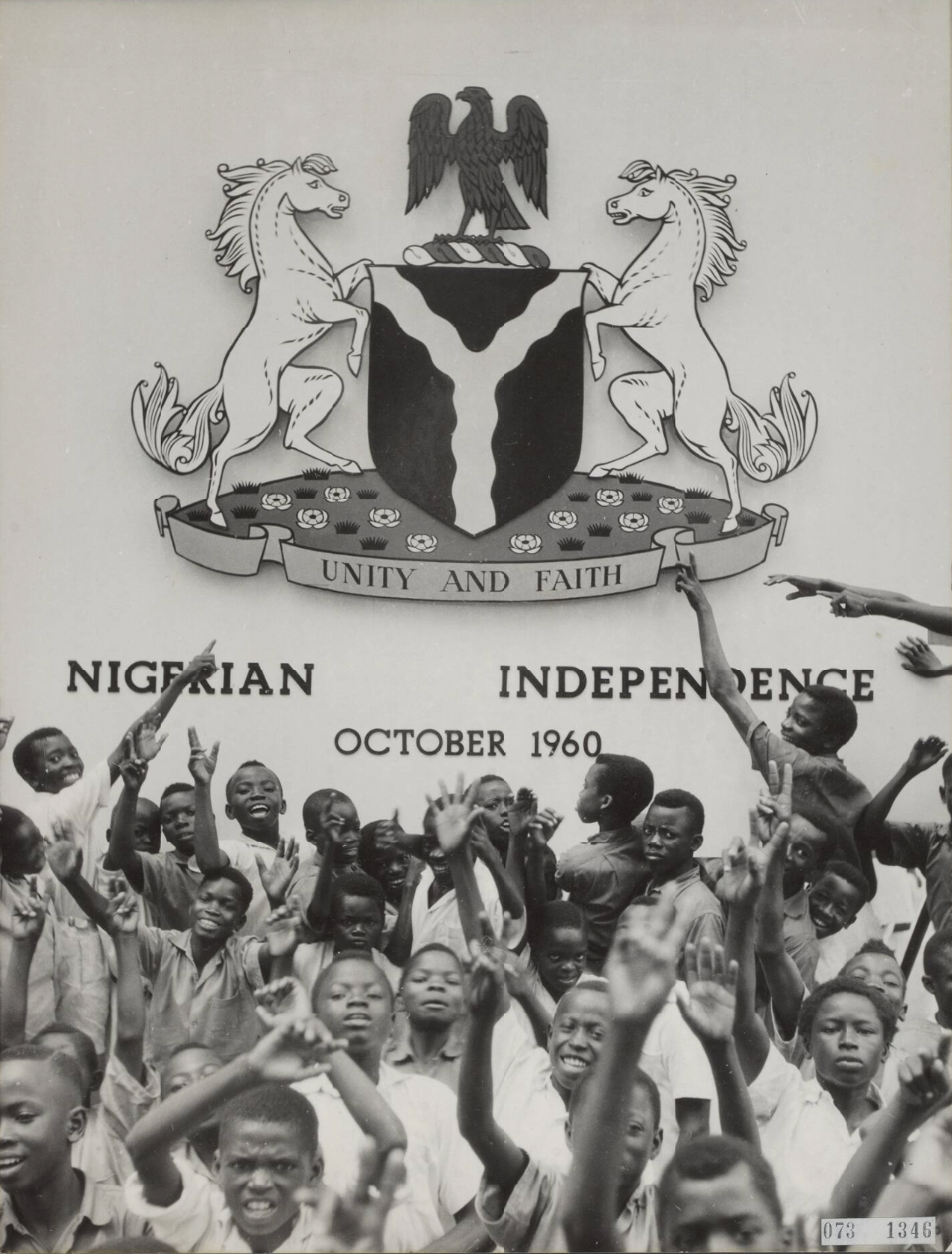
On October 1st, 1960, Nigeria was granted independence from Great Britain after nearly a hundred years of colonial rule (Udo). For decades, British rulers exploited the labor of Nigerians, interfered in their long-held traditions, and limited their ability to participate in politics. Repeated non-violent protests led by Nigerian citizens pressured the British government into granting the nation independence. Newspapers like The Lagos Weekly Record and The West African Pilot played a significant role in voicing the opinions of Nigerians. Some of the most pivotal movements during Nigeria’s struggle for independence include the Nigerian Union of Railwaymen protest, the General Strike of 1945, and the Egba Women’s Revolt (Vincent-Anene).
While Nigerian citizens celebrated their long-awaited separation from the empire, the conflict was far from over. When England took control of Northern and Southern Nigeria, they failed to recognize the many differences between Nigeria’s ethnic groups, forcing British education and religion onto its diverse population. The British government’s widespread influence caused tensions to rise between Nigeria’s ethnic groups in the decades prior to its independence, eventually resulting in the Nigerian Civil War of 1967 (Lee). There is still significant division between Nigeria’s religious groups today, demonstrating the longstanding impact colonialism can have on a nation.
In Akata Witch, a novel set almost eighty years after Nigeria gained independence, we can still see the impacts of British colonialism in Sunny’s everyday life. Sunny remarks that the Power Holding Company of Nigeria (PHC) cannot keep the electricity on through the night, an experience that she is still not used to after leaving the United States (Okorafor 1). This detail is indicative of Nigeria’s lagging infrastructure; because of Nigeria’s long struggle for order since gaining independence, important systems are developing at a slower rate than other independent nations.
Works Cited
Lee, Alexandria. “British Colonization in Nigeria: Past and Present Impact.” The Organization for World Peace, 4 Aug. 2025, theowp.org/reports/british-colonization-in-nigeria-past-and-present-impact/
Udo, Reuben Kenrick. “Independent Nigeria.” Britannica, 19 Apr. 2026, www.britannica.com/place/Nigeria/Independent-Nigeria.
Vincent-Anene, Prince. “The Nigerian Struggle for Independence.” The Nonviolence Project, University of Wisconsin-Madison, 9 Oct. 2022, thenonviolenceproject.wisc.edu/2022/07/11/the-nigerian-struggle-for-independence/.
Young kids support Nigerian independence in 1960. National Archives of the Netherlands, Wikimedia, Oct. 1960. https://commons.wikimedia.org/wiki/File:Young_kids_celebrate_Nigeria%27s_independence_in_1960.png