
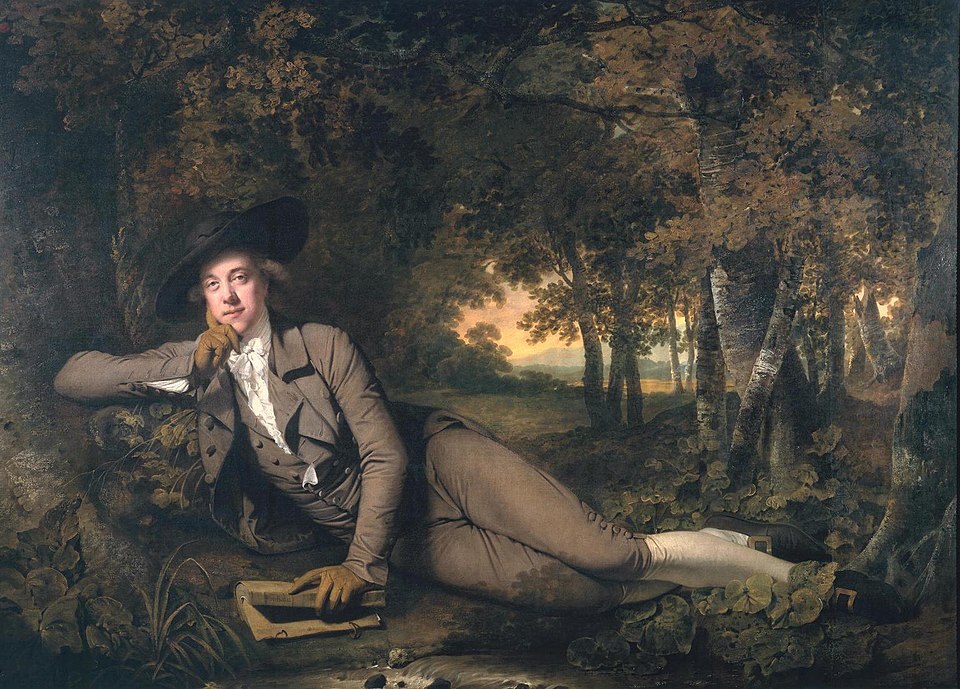
Joseph Wright of Derby (1734-1797), Sir Brooke Boothby (oil paint on canvas, 1781; Tate); Tate Museum
Boothby was a follower of Rousseau and embraced the values of the cult of sensibility.
The composition of this painting is a marked departure from the constrained portraiture of previous eras; note its emphasis on contemplation (via Boothby's relaxed, reclining, cross-legged posture as well as the relaxed color palette), emotion (via Boothby's gentle, melancholic expression), and nature (via the detailed, picturesque forest scenery), which are three crucial, often intersecting, themes explored in the literature of this period.
By the middle of the eighteenth century, the cult of sensibility contributed to an increased demand for tales that explored moments of misery and misfortune in their protagonists (Todd 88-89). Through such moments, these books could arouse feelings of grief and sympathy. The heroes and heroines populating these stories, the men and women feeling, although unrealistic in their passive, unchanging character, appealed to the emotional imagination of the reader as sensitive sufferers that maintained their humility and purity in a seemingly cruel and unforgiving world. While both are compassionate amidst tragedy, expressing "qualities considered feminine in the sexual psychology of the time" (Todd 110), the way each sex was to express these sensibilities differed due to contemporary expectations.
The man of feeling, as exemplified in characters such as Harley from Henry Mackenzie's The Man of Feeling, Laurence Sterne's Yorick from A Sentimental Journey, or the titular hero of Adventures of David Simple by Sarah Fielding (Todd 88), is of a Quixotic, submissive temperament, not too unlike the Rousseauean bon savage untamed by the logical niceties of society. Though expressing feminine sensibilities, the man of feeling is also a paradox. He is tender, helpless, passive, and susceptible, yet, even though he could meet his demise "in a welcomed death" (Todd 89), as was the case of Harley, he was never vulnerable to abandonment or rape (Todd 89-90). Though impotent, chaste, and helpless, being a man, he could never be reductively denigrated to the level of "womanhood." The man of feeling, in accordance with views on masculinity at the time, was to maintain his male agency without being consumed by his femininity.
The woman of feeling, on the other hand, though similar in spirit to her male counterpart, remained unashamedly feminine. Whereas "most sentimental novels with heroes insist[ed] on their instructional nature" (Todd 91), the woman of feeling was seen as an idealized "moral splendor" (Todd 110). She was to be the vulnerable, pitied target of male advances and power, with her splendor and virtue showcased in the characterization of the glory of her bodily authenticity - her emotional reactions through her "ready use of tears, blushes, palpitations, hysteria and even death" (Todd 110) - in the face of passive yet redemptive sexual suffering, as can be seen with one of her codifiers, the titular tragic virgin of Samuel Richardson's Clarissa (Todd 112-114). The woman of feeling was also expected to act within the idealized modes of "the faithful wife . . . the mother . . . the benevolent and sensitive virgin" (Todd 111), or, in the manner of Rousseau's La Nouvelle Héloïse, "the chaste, susceptible and unwilling wife" (Todd 111). Later woman writers of the period, however, such as Elizabeth Helme in her St Margaret's Cave or Charlotte Smith's Emmeline, resisted these conventions, exploring more worldly powerful and spiritually proactive heroines (Todd 112-115). These writers were especially focused on motherhood, since it entailed the exaltation of female agency and virtues (Todd 112) even as their heroines passively operated within the constraints of unhappy or abusive marriages, rape, or death. The woman of feeling and her development, thus, reflect both the traditional and emergent views concerning womanhood in the eighteenth century.
Works Cited
“‘Sir Brooke Boothby’, Joseph Wright of Derby, 1781.” Tate, www.tate.org.uk/art/artworks/wright-sir-brooke-boothby-n04132.
Todd, Janet. “Fiction: The Man of Feeling.” Sensibility: An Introduction, Taylor and Francis, 1986, pp. 88–109.
Todd, Janet. “Fiction: The Woman of Feeling.” Sensibility: An Introduction, Taylor and Francis, 1986, pp. 110-116.