A timeline of British literature and culture studied in ENGL 3030, Fall 2026.
Timeline
Table of Events
| Date | Event | Created by |
|---|---|---|
| 1633 | Court Patronage of the Arts, Renaissance and Seventeenth CenturyAnthony Van Dyck, Charles I (1600-1649) with M. de St Antoine (oil on canvas, 12.1 ft x 8.8 ft, 1633; Royal Collection, Windsor Castle); Wikimedia. The Stuart king Charles I (1600-1649) represented a pinnacle of cultural patronage centered on the royal court. Charles assembled one of the largest and finest art collections in Britain and Europe, derived from Continental artists on the assumption that the English court displayed its prestige largely by importing the arts rather than by patronizing native talent. In literature, Charles favored the flattery of the English Cavalier poets, while the poet and polemicist John Milton (1608-74) led the growing republican and Protestant opposition to Charles's assumption of the "divine right" of absolute monarchy and to his connections with Continental Roman Catholicism. Milton's influential works include the Protestant epic, Paradise Lost (1667, 1674), and his essay arguing for freedom of expression and independence of the press, Areopagitica (1644). Resistance by the English Parliament to Charles's absolutist rule erupted into the English Civil War, resulting in Charles's capture, trial, and beheading. Subsequent Parliamentary rule fell part, however, succumbing to the Restoration of the Stuart king Charles II until 1688, when the Glorious Revolution finally deposed the Stuart reign of Charles's brother, James II. In the eighteenth century, the modern British constitutional monarchy developed under the Protestant royal House of Hanover imported from Germany -- the Georges I, II, and III. The reign by George III (1738-1820) and, from 1811, by his son George IV acting as Regent coincides with the period with which our class begins -- the Revolutionary period dominated by revolutions in America and France. Anthony Van Dyck (1599-1641) was a Flemish artist, appointed by Charles I as painter to the English court in 1632. Along with another celebrated Flemish artist of the period, Peter Paul Rubens (1577-1640), Van Dyck typified the Continental artists favored by the Stuart court. Van Dyck is especially known for the Grand Style portrait, in this example also an equestrian portrait. The huge canvas depicts Charles in military armor, astride a noble steed and riding through a triumphal arch. The architecture alludes to the triumphal arches of the ancient Roman Empire, which were erected for powerful generals and emperors returning from a great military victory. The symbolism enforces Charles's absolute power; and since he is accompanied only by his riding master, M. de St Antoine, instead of surrounded by cheering crowds, the symbolism also enforces his "Personal Rule" — referring to his decade of ruling without Parliament, an absolutism he believed justified by Divine Right. The portrait was originally hung at the end of the Long Gallery in Hampton Court Palace (below), creating an illusion of the king entering the palace in a blaze of power (Strong 14, 20-25). Work Cited |
David Hanson |
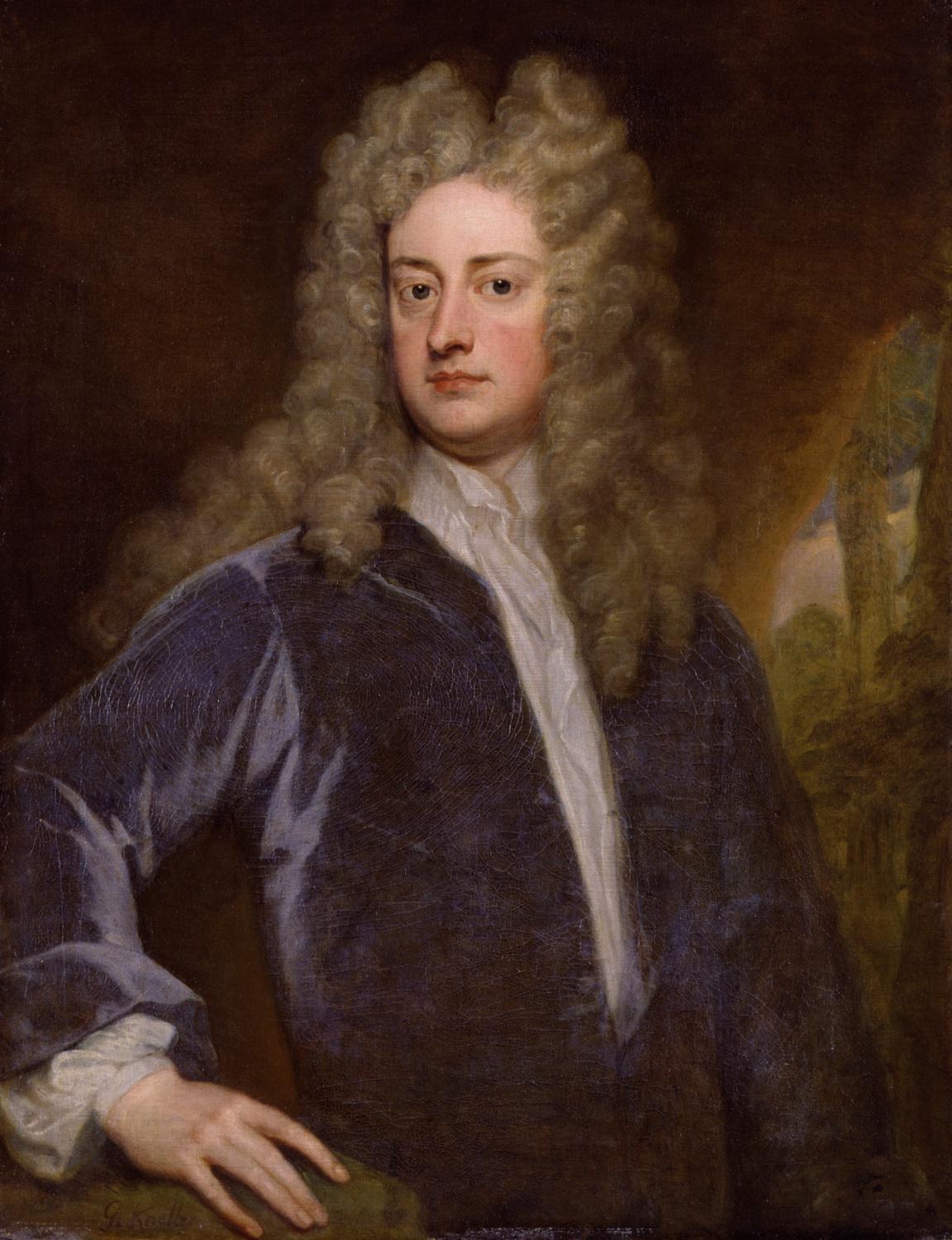
| 1711 | From Court to City: The Coffee House as Cultural Hub in the Eighteenth CenturyThomas Rowlandson (1757-1827), The Coffee House (pencil, pen, and watercolor on paper, 1790; Aberdeen Art Gallery); Art UK. Starting in the Restoration and increasing throughout the eighteenth century, the patronage of literature and the arts shifted from the royal court to the city of London, from court-appointed dependents to a public marketplace of ideas. The earliest hub of this activity was the coffee house. Serving coffee, chocolate drink, wine, brandy, and punch, the coffee house preceded the modern office, not just as a convivial space for conversation and news, but as a busy center for invention and creation, deal-making, and finance among middle-class merchants as well as gentry (Brewer 35). Specific professions gravitated to favored houses -- artists at Old Slaughter's, literati at Will's. Often the houses were located in associated sectors of the city: dancers and opera singers gathered at the Orange, near Covent Garden Theater; booksellers met at the Chapter in Paternoster Row, where printers had set up shop since the early Renaissance. Even today, Lloyd's of London, the insurance marketplace, survives from its inception in a coffee house, Lloyd's, in the 1690s, located in Lombard Street, the center of what became the financial district. Coffee-house culture spawned a literary form of its own, the daily periodical. In 1711, Joseph Addison (1672-1719) and Richard Steele (1671-1729) founded The Spectator, "ambitious to have it said" that, whereas Socrates "brought Philosophy down from Heaven, to inhabit among men," they would bring "Philosophy out of Closets and Libraries, Schools and Colleges, to dwell in Clubs and Assemblies, at Tea-Tables and in Coffee Houses" (Addison 117). At a time when newspapers were expected to be politically partisan, the Whig Addison and the Tory Steele came together to craft a new, nonpartisan genre, the belletristic essay, which explored a wide range of topics through a lens of disinterested, civil observation. Commentary was attributed to fictional characters, "Mr. Spectator" and his fellow members of the Spectator Club who convened their meetings in a coffee house. This fictional device is credited as a progenitor of another new genre -- the English novel, which first emerged later in the eighteenth century in a similarly serialized, epistolary form (Benedict 6-7). The royal court recognized coffee house culture as competing with its dominance. During the Restoration, Charles II attempted to close the coffee houses, suspecting them of harboring "seditious" conversations among the people of mixed ranks who were freely admitted; however, the king's opposition was stymied by his own cronies who habituated the scene (Brewer 36-38). The shift in cultural patronage from court to city was most powerfully represented by the Kit-Cat Club, named after mutton pies, called Kit-Cats, baked by their host Christopher Cat. The club effectively operated as impresarios, sponsoring production of plays and operas, and supporting writers. One member, the publisher-bookseller Jacob Tonson (1655-1736), influenced the consolidation of a national British literature. As a supporter of the Copyright Act of 1709-10, he not only stabilized careers of modern writers such as the poets John Dryden (1631-1700) and Alexander Pope (1688-1744) but also cemented a literary heritage by acquiring the copyrights to Shakespeare and Milton (Brewer 40-43). As a symbol of the shift in power and patronage from the court to city club, a distinctive style of portraiture was developed for the Kit-Cats by the painter Godfrey Kneller (1646-1723). Unlike the 12-feet tall grand style portraits devised by Van Dyck for Charles I at Hampton Court Palace, Kit-Cat portraits were held to 3 by 2 feet to be accommodated within the modest rooms of Tonson's house. Yet, while Kneller maintained a dignified pose for the members, he brought the figure forward in space, closing in on a three-quarter body length that emphasized the expressiveness of face and hands. Dignified yet intimate, Kneller's portrait of Addison (below) suggests a figure engaged in polite conversation with the spectator, like one of his essays for The Spectator (Brewer 41-42; Vaughan 72). Works Cited Addison, Joseph. Spectator no. 10. In Selections from The Tatler and The Spectator, edited by Robert J. Allen, 2d ed. Holt, Rinehart and Winston, 1970, pp. 116-19. Benedict, Barbara M. "Joseph Addison." The Oxford Encyclopedia of British Literature, edited by David Scott Kastan, Oxford UP, 2006, vol. 1, 6-10. Brewer, John. The Pleasures of the Imagination: English Culture in the Eighteenth Century, Farrar Straus Giroux, 1997. Vaughan, William. British Painting: The Golden Age from Hogarth to Turner. Thames and Hudson, 1999.
|
David Hanson |
| 1784 | The Picturesque TourCharacteristics of the Picturesque Tour The Picturesque Tour (1760-1800), a tourism and artistic movement across Britain in the late 18th century, arose as an alternative to international landscape tourism as the country’s borders closed from war with France. During this period, poets and visual artists alike aimed to describe natural landscapes as if they were pictures, focusing more on imaginative details and composition as opposed to associating them with classical tropes. Specific words in poems and artistic techniques in paintings were chosen to describe or illustrate the landscape as a whole composition of parts instead of a mere piece of land. Furthermore, poetry and paintings idealized the pastoral way of life and viewed it as an escape from typical courtly responsibilities. These tourists, most of whom were coming from the city, viewed the rural landscape as a “Golden Age” in which man and nature lived in harmony. The Picturesque Tour was also an attempt at establishing British culture as its own; artists slowly moved from incorporating Roman figures and myths in their works as a connection to “high” art to simply illustrating the landscape’s composition for beauty’s sake. Once again, both poets and painters became highly influenced by memory, imagination, and associations between the stunning natural landscapes they were viewing and their feelings during the experience. The Wye River Tour The image of the exterior of Tintern Abbey (above) was painted by artist J. M. W. Turner (1775-1851) and is currently housed in the British Museum. The Wye River served as one of the main attractions for the Picturesque Tour. Along the river was Tintern Abbey, which was a great source of awe and inspiration for each artist that traveled past it. William Gilpin (1724-1804), author of several picturesque guidebooks, initiated this Picturesque tourism movement throughout Britain with his work Observations on the River Wye…Made in the Summer of the Year 1770 (1782). In his book, he instructed his readers on how to view certain landscapes and scenery as pictures; thus, poets and painters alike could capture a particular moment in time and adequately translate it to their particular medium. Works Cited Andrews, Malcolm. The Search for the Picturesque: Landscape Aesthetics and Tourism in Britain, 1760-1800. Scolar, 1989. Hussey, Christopher. The Picturesque: Studies in a Point of View. Routledge, 2020.
|
Ella Lawrence |
| 1786 | Sensibility: The Man and Woman of FeelingJoseph Wright of Derby (1734-1797), Sir Brooke Boothby (oil paint on canvas, 1781; Tate); Tate Museum Boothby was a follower of Rousseau and embraced the values of the cult of sensibility. The composition of this painting is a marked departure from the constrained portraiture of previous eras; note its emphasis on contemplation (via Boothby's relaxed, reclining, cross-legged posture as well as the relaxed color palette), emotion (via Boothby's gentle, melancholic expression), and nature (via the detailed, picturesque forest scenery), which are three crucial, often intersecting, themes explored in the literature of this period. By the middle of the eighteenth century, the cult of sensibility contributed to an increased demand for tales that explored moments of misery and misfortune in their protagonists (Todd 88-89). Through such moments, these books could arouse feelings of grief and sympathy. The heroes and heroines populating these stories, the men and women feeling, although unrealistic in their passive, unchanging character, appealed to the emotional imagination of the reader as sensitive sufferers that maintained their humility and purity in a seemingly cruel and unforgiving world. While both are compassionate amidst tragedy, expressing "qualities considered feminine in the sexual psychology of the time" (Todd 110), the way each sex was to express these sensibilities differed due to contemporary expectations. The man of feeling, as exemplified in characters such as Harley from Henry Mackenzie's The Man of Feeling, Laurence Sterne's Yorick from A Sentimental Journey, or the titular hero of Adventures of David Simple by Sarah Fielding (Todd 88), is of a Quixotic, submissive temperament, not too unlike the Rousseauean bon savage untamed by the logical niceties of society. Though expressing feminine sensibilities, the man of feeling is also a paradox. He is tender, helpless, passive, and susceptible, yet, even though he could meet his demise "in a welcomed death" (Todd 89), as was the case of Harley, he was never vulnerable to abandonment or rape (Todd 89-90). Though impotent, chaste, and helpless, being a man, he could never be reductively denigrated to the level of "womanhood." The man of feeling, in accordance with views on masculinity at the time, was to maintain his male agency without being consumed by his femininity. The woman of feeling, on the other hand, though similar in spirit to her male counterpart, remained unashamedly feminine. Whereas "most sentimental novels with heroes insist[ed] on their instructional nature" (Todd 91), the woman of feeling was seen as an idealized "moral splendor" (Todd 110). She was to be the vulnerable, pitied target of male advances and power, with her splendor and virtue showcased in the characterization of the glory of her bodily authenticity - her emotional reactions through her "ready use of tears, blushes, palpitations, hysteria and even death" (Todd 110) - in the face of passive yet redemptive sexual suffering, as can be seen with one of her codifiers, the titular tragic virgin of Samuel Richardson's Clarissa (Todd 112-114). The woman of feeling was also expected to act within the idealized modes of "the faithful wife . . . the mother . . . the benevolent and sensitive virgin" (Todd 111), or, in the manner of Rousseau's La Nouvelle Héloïse, "the chaste, susceptible and unwilling wife" (Todd 111). Later woman writers of the period, however, such as Elizabeth Helme in her St Margaret's Cave or Charlotte Smith's Emmeline, resisted these conventions, exploring more worldly powerful and spiritually proactive heroines (Todd 112-115). These writers were especially focused on motherhood, since it entailed the exaltation of female agency and virtues (Todd 112) even as their heroines passively operated within the constraints of unhappy or abusive marriages, rape, or death. The woman of feeling and her development, thus, reflect both the traditional and emergent views concerning womanhood in the eighteenth century.
Works Cited “‘Sir Brooke Boothby’, Joseph Wright of Derby, 1781.” Tate, www.tate.org.uk/art/artworks/wright-sir-brooke-boothby-n04132. Todd, Janet. “Fiction: The Man of Feeling.” Sensibility: An Introduction, Taylor and Francis, 1986, pp. 88–109. Todd, Janet. “Fiction: The Woman of Feeling.” Sensibility: An Introduction, Taylor and Francis, 1986, pp. 110-116. |
Morgan Martinez |