
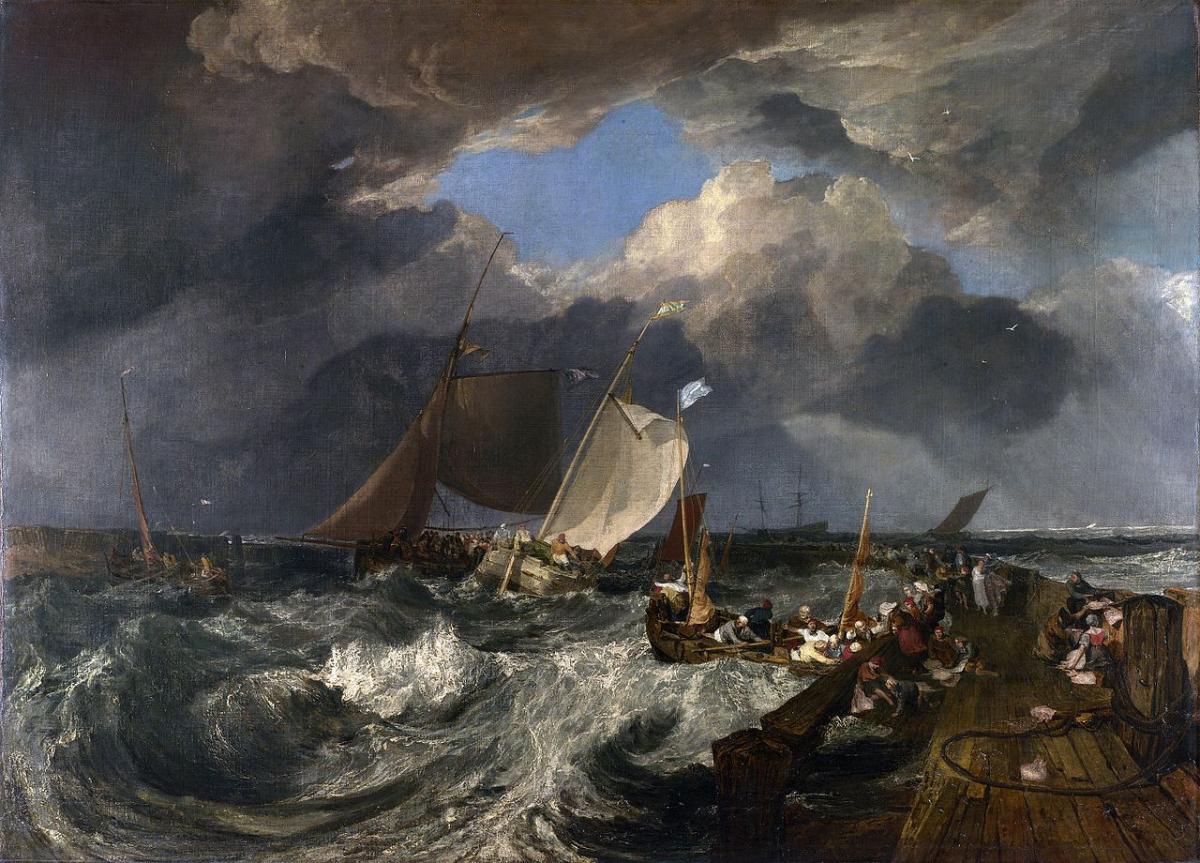
Joseph Mallord William Turner is known for his expressive and emotional paintings. He was a master of British landscape, known for his iconic, theatrical, and tumultuous scenes of nature. The Calais port sits on the north-west side of France at the English Channel's narrowest point and was used to cross over to England. Turner took this route a few times, and this painting is based on a time when he attempted to cross during a great storm. The strong winds come from the North Sea and the Atlantic Ocean, creating this uneasy scene next to the pier.
Turner was very interested in encompassing great emotion as he captured moments in history in the nature around him. This painting was not very well received when it was first showcased, but bow is highly regarded among his critics for its depiction of the Calais scene. The fact that this painting accomplished his goal to paint common things also relates to the relationship between England and France at the time. Perhaps Turner chose to depict the Calais Port during the time of the storm to represent much of the tumult that was caused by the two countries by themselves as well as the effects of their relationship.
This painting also has to do with the emphasis on the emotional and individualism. Turner was a great part in exploring the ideals of the emotional and what it means to be human. A very common thread of thinking throughout the romantic era was that using human emotion over reason was necessary to understanding the world around them, which is a radical change from the Renaissance period which focused on reason. The art in the Renaissance and the Neoclassical period both focused on composed human figures, showing their excessive control over their human emotion, and depicted tragic scenes in a serene way. Turner flips this on its head by not only using his trademark light and color techniques to express the grandeur of nature but also how humans relate to it. He also explores several Greek myths in some of his largest and most well known paintings, combining traditionally opposing Grecian ideals and emotional turmoil. Looking at this depiction of the Calais Pier, it is clear that the water is violent and the subsequent rigidity is visible in the people who cling to one another. However, the highest point of tension is in the ship that sits towards the front of the painting, closest to the pier. It’s position is frozen in time and is almost about to sway and fall in the water and humans would be powerless against the force of the storm. The blue in the background of the painting suggests that the storm may be passing soon, or has only just begun. All of these dynamic elements contribute to the overall emotion of the painting. Turner has successfully created a seascape simultaneously wrought with fear, hope, and showcases the delicate nature of being human while relating to larger themes present during the romantic era.
Works Cited:
Shanes, Eric. The Life and Masterworks of J.M.W. Turner. Parkstone International, 2012. EBSCOhost, search-ebscohost-com.ezproxy.uvu.edu/login.aspx?direct=true&db=e025xna&AN=455962&site=eds-live.
Turner, Joseph Mallord William. “Calais Pier.” Joseph Mallord William Turner | Calais Pier | NG472 | National Gallery, London, 1 Jan. 1970, https://www.nationalgallery.org.uk/paintings/joseph-mallord-william-tur….