
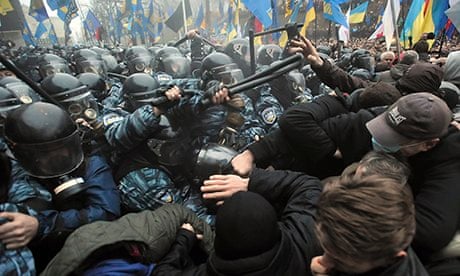
When Viktor Yanukovych was elected as President of the Ukraine in 2010, he likely did not expect that just three years later, in 2013, demonstrations and protests by the Ukrainian people would call for his removal. In 2013, many Ukrainians were excited and ready for a transition away from Russia and the East. This transition, as they understood, would come in November of 2013 when President Yanukovych signed the Ukraine’s Association Agreement with the European Union. Nadia Diuk’s “Euromaidan: Ukraine’s Self-Organizing Revolution” emphasizes this idea when the following is explained: “For Ukraine, signing the Association Agreement would have marked a decisive step away from centuries-long orientation toward Russia and the east” (10). While many awaited the signing, it never came. President Yanukovych took a more authoritarian approach to leading and governing and decided not to sign the Association Agreement. This change in decision, as almost all Ukrainian citizens understood and saw it, was influenced by Yanukovych’s relationship and connections to Vladimir Putin and Russia. The New York Times emphasizes this truth by stating, “The Kremilin, which has supported Mr. Yanukovych as a geographical ally for years…used aggressive pressure to persuade him not to sign the accords” (6). This apparent influence from Russian relations sparked outrage amongst Ukrainian citizens, especially individuals of younger generations who desired to move toward European ideals to better their futures. This outrage quickly turned into action, and Euromaidan began.
November and December of 2013 in Ukraine saw protests and demonstrations calling for President Yanukovych’s removal. The people were speaking, and they did not want to be placed back under Russian control or influence in any way. Most large protests took place in Kyiv, Ukraine’s capital city. More specifically, these took place in Independence Square which is often referred to as Maiden Nezalezhnosti. This place of protest and the desire for a closer relationship to Europe brought about the name Euromaidan. While these protests were peaceful on behalf of the Ukrainian citizens, the government was not as peaceful. There were several instances where protests and demonstrations turned violent. One incident took place on November 30 when there was a “brutal…beating of students in an attempt to clear the Maiden” (Diuk, 86). While the Yanukovych hoped and believed this act would discourage protestors, his violence only encouraged the call for his removal. After months of tension and conflict, the Ukrainian voices were heard, and in February of 2014, Yanukovych was removed from office. Euromaidan is an exceptional example of Ukraine’s desire for independence from Russia and the east. In fact, this event, according to Nadia Diuk’s “Euromaidan: Ukraine’s Self-Organizing Revolution,” “…marked a new stage in the evolution of Ukraine as an independent and sovereign state” (10). Today especially, we still see Ukraine struggle to remove itself from Russia’s grasp. One thing sustaining Ukraine is their solidarity and pride for their country. This pride stems from years of abuse and control at the hands of Russia, and, specifically today, Vladimir Putin. The Maiden and Beyond: Finding Ukraine” by Nadia Diuk emphasizes that during Euromaidan, “…Vladimir Putin, in trying to destabilize Ukraine, has increased Ukrainians’ sense of national solidarity” (88). Today, the same statement can be made as Russia is, once again, trying to control Ukraine and its people.
Works Cited
David. “Thousands Demand Resignation of Ukraine Leader.” The New York Times, The New York Times, 1 Dec. 2013, https://www.nytimes.com/2013/12/02/world/europe/thousands-of-protesters…;
Diuk, Nadia. “EUROMAIDAN: Ukraine’s Self-Organizing Revolution.” World Affairs, vol. 176, no. 6, 2014, pp. 9–16, http://www.jstor.org/stable/43555086. Accessed 27 Apr. 2022.
Diuk, Nadia. "The Maidan and Beyond: Finding Ukraine." Journal of Democracy, vol. 25 no. 3, 2014, p. 83-89. Project MUSE, doi:10.1353/jod.2014.0041. Accessed 27 Apr. 2022
Furman, Alexey. “Ukrainian Protesters Clash with Riot Police near the Cabinet Building in Kiev.” TheGuardian.com, Kyiv2, 24 Nov. 2013, https://i.guim.co.uk/img/static/sys-images/Guardian/Pix/pictures/2013/1…. Accessed 30 Apr. 2022.

Related Link
https://editions.covecollective.org/chronologies/crimean-war-1853-1856
Matthew's entry on the Crimean War directly relates to conflict within the region of conflict now between Ukraine and Russia.
https://editions.covecollective.org/chronologies/russian-invasion-ukraine
Truitt's entry on the most recent Russian invasion of Ukraine is a climactic event resulting from events and ideaologies such as the ones mentioned in this entry.