
The Prince With The Nine Sorrows - Laurence Housman.
The House of Joy (1895) is a collection of adult fairy tales written and illustrated by Laurence Housman. His sister, Clemence Housman, a talented writer and wood engraver provided the engravings for the illustrations.
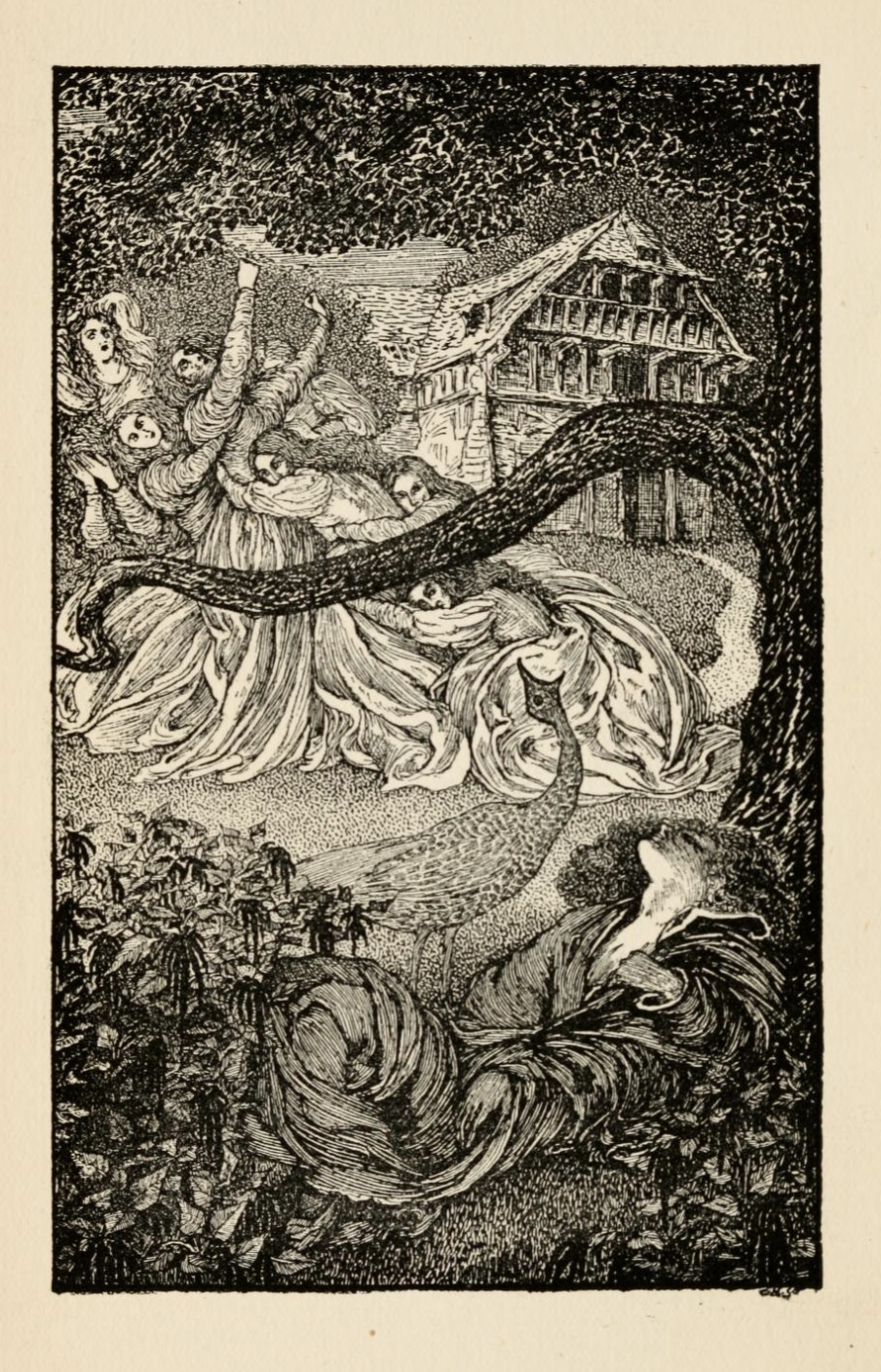
This front piece illustration appears on page sixteen beside the first page of The Prince With The Nine Sorrows. The tale follows the story of a cursed young prince, who is fated to die in his twentieth year at the hands of his foster sister. The Queen, who favours her son, allows her 9 daughters to be annually taken away by a witch and transformed into birds to prevent the curse. Overwhelmed by the guilt and sorrow of losing his sisters, the prince sets off in his twentieth year to find his foster sisters, willing to sacrifice his life for his siblings to return to their human form.
This illustration is proleptic meaning it anticipates a later scene in the tale. In this scene which occurs at the end of the story, the prince lies dead after sacrificing his heart to his youngest sister, who is the hovering bird. After the youngest sister pecks out his heart, the eight other sisters transform back to their human bodies and can be seen in the background of the image. However, we know that the prince comes back to life moments after the events of this illustration, resolving the story to a happy ending.
When looking at this illustration remember that author and illustrator Laurence Housman was a part of the Aesthetic Movement which placed emphasis on aesthetics and design values more than social-political representations in art.
My question is as follows:
Consider the background of Laurence Housman and the shift of gender norms at the end of the 19th century.
In what ways does this tale and illustration depart from the traditional (and often gendered) fairy-tale conventions of the time? Do you think Laurence Housman intended to create relevant socio-cultural meaning in this illustration or is it simply just an aesthetically pleasing image?