

Display Explanation:
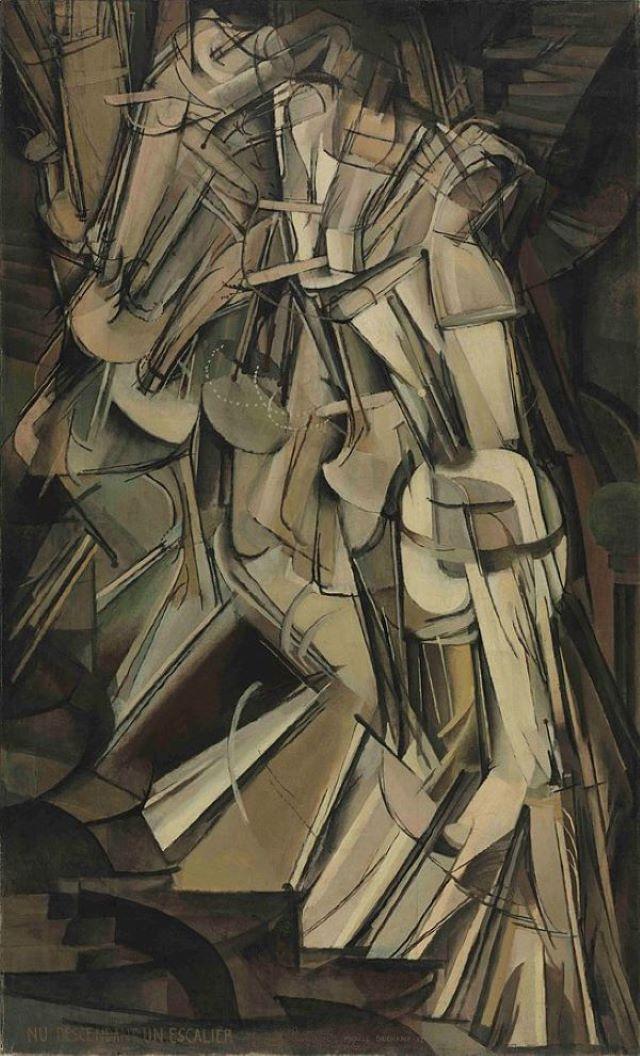
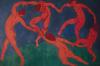
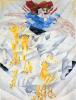
The installation lies at the end of a nondescript hallway of approximately 20 feet in length. This hallway, like the exhibit itself, has neutral-colored walls of a forgettable beige. The hallway is devoid of artworks. The exhibit itself is a circular room at the end of this hallway, approximately 20 feet in diameter. There is a pillar 5 feet wide in the center of the room. No door separates the hallway and the exhibit, and Matisse’s The Dance stands directly across from the entrance. It, like Nude Descending a Staircase and Dynamism of a Dancer, is suspended via horizonal struts from the wall, the supports hidden from view by the canvas. The paintings, hung this way, look almost as if frozen in time as they fall to the ground. The Dance, the largest painting of the exhibit, would dominate the view from the entrance if not for the pillar in the center of the room, blocking the visitor’s perspective from the entrance. The other two paintings are placed at areas 60° around the room, an equilateral distance apart from each other. This way, at least one painting will be hidden from the visitor’s view at any given moment. Nude Descending a Staircase is placed to the right of the entrance, Dynamism of a Dancer to the left. Upon crossing the threshold into the exhibit, visitors will notice the most startling aspect of the room: the circular floor is constantly rotating in a counterclockwise direction at a rate of 2.5 feet per second at the outermost edge (caution signs regarding this feature in the preceding hallway are permitted if legal codes require such). Visitors who step into the room are immediately thrust into a tour of the paintings, beginning with Nude Descending, proceeding to The Dance, and concluding with Dynamism. No explicit instructions are given as to how they may proceed with this, though they are welcome to let the floor guide them, walk against it to linger at a painting or advance backward, or move with the direction of the movement at an accelerated pace.
The central theme of my installation is a contemplation of what is sacrificed in artistic depictions of motion. I elaborate on this below in my analysis of the paintings, but my installation seeks to reinforce this theme through a few strategies. Most noticeably, the rotating floor prevents the visitors from completely focusing on any particular painting. Viewers can stop walking to look, losing the perception of detail in their perpetual motion, or they can move against the floor’s rotation to remain still relative to the painting. While this second option allows the painting to look still, it requires motion of the visitor that distracts from the experience of appreciating the art. Something—the painting or the viewer—is always in motion, and something is always lost. Similarly, the pillar in the center of the room serves to obstruct The Dance from the stationary entryway. The Dance, as the most conventional depiction of motion, seemingly sacrifices the least of the paintings to its medium of depiction. As I point out in my analysis, though, this is not the case, and the installation reflects such. Even from the entryway, the point of solace against the constant motion of the floor, the viewer cannot ever fully appreciate The Dance because of the obstructing pillar at the room’s center. The stillness of the entryway may reflect both the conventional method of viewing art and the more conventional depiction of motion of Matisse’s work, but the creation of motion always costs something.
Installation Note:
I want my installation to focus on sexuality and motion, and how different artists from the early 20th century integrate movement into their paintings. The first years of the 1900s are ones of speed. There is movement, of course, in the motion picture, an invention that Duchamp draws explicit inspiration from for Nude Descending a Staircase. There is also the popularization of the automobile and the airplane, as well as a more intangible motion as society grows interconnected and information travels faster than ever through telegraph, and then radio. Sexual and gender norms are also in flux, changing faster in these few years than in the prior few centuries. These paintings are all, in some ways, responses to this unceasing acceleration. Specifically, Duchamp, Matisse, and Severini depict motion in the still medium of paint, but they draw attention to the sacrifices one must make to accomplish this paradoxical task.
Notably, Nude Descending and Dynamism of a Dancer accomplish the sensation of motion through the excision of detail. Duchamp shows a naked woman walking down a staircase in the way a motion picture might: through a series of successive still frames. Perhaps as a nod to this inspiration, Duchamp’s color palette mirrors the muted beiges of early film. Duchamp, rather than showing each frame successively as a film reel does, bleeds each image together. The image’s nude subject achieves motion, but she is deprived of all detail and color, drained of the sexuality of the conventional nude. Severini similarly accomplishes motion through the kaleidoscopic blending of frames, though Dynamism does not blend these images together but rather seems to convey the frenetic energy of the dancer’s movements as if refracted through a prism or a shard of broken glass. Her movements are not melded as much as refracted. Unlike Duchamp’s subject, Severini’s dancer is painted in vibrant color: the bright yellow, blue, and red of her attire scattered throughout her movements. There is a life and sensuality to the dancer, but the scattering of her movements deprives the audience of the chance to know her and to fully appreciate her dance. Severini’s paints convey a greater vibrancy than Duchamp’s, but the audience is just as shut out by both pictures.
Contrastingly, Matisse represents the motion of his dancers in a decidedly different way than either Duchamp or Severini. While the latter artists utilize the more abstract stylings of modernism and Italian Futurism, Matisse depicts his dancers in a more traditionally representative (though certainly still innovative) manner. Matisse’s motion comes primarily from the careful arrangement of his figures and their postures. The dancers contort their bodies into strange shapes—one figure’s back is twisted into a curve, another’s head pointed at their navel, one other entirely suspended in air. These positions could not be achieved by a stationary individual, we understand, so they must be in motion for the composition to make sense.
Like Duchamp’s nude woman and Severini’s dancer, Matisse’s dancers convey an aspect of sexuality in their motion. They are free of clothes, men and women dancing together, unbounded by societal norms of dress and gender. Much like Severini’s Dynamism, there is a sort of freedom and aliveness to the subject’s movements. There is an imperfection to this reading, however. There exists a gap in the circle where one figure’s hand fails to reach another’s. With this, the circle threatens to fall apart after a moment as the unsupported dancer falls through the air. We never see that fall, though. The painting captures a singular moment of motion, preserving this beautiful celebration before it may ever collapse. Yet, this preservation in time also sacrifices the joy of continuing the dance, or of the audience seeing it in its entirety. While The Dance promises sexual and physical freedom for its subjects, they are ultimately constrained by the stillness of the painting. As in Nude Descending and Dynamism, motion extracts a cost.
These common themes converge to that the early 20th century may have accelerated in numerous domains of sexuality, artistry, and technology, but at what cost does that speed come? Shortly after these paintings were created, Western society sped toward the most devastating war the world had ever known, followed by the movement and vibrancy of the Jazz Age while debt, depression, and fascism boiled beneath the surface. Motion, in life and in art, extracts a cost. Duchamp, Matisse, and Severini show that motion may necessitate the loss of understanding, freedom, and the intimacy of really seeing another.
Duchamp, Marcel. Nude Descending a Staircase, No. 2. 1912. Philadelphia Museum of Art.
https://en.wikipedia.org/wiki/Nude_Descending_a_Staircase,_No._2#/media/File:Duchamp_-_Nude_Descending_a_Staircase.jpg. Accessed 16 Feb. 2023.

Matisse, Henri. La Danse (second version). 1910. Hermitage Museum, St. Petersburg,
Russia. https://en.wikipedia.org/wiki/Henri_Matisse#/media/File:Matissedance.jpg. Accessed 16 Feb. 2023.

Severini, Gino. Dynamism of a Dancer. 1912. Pinacoteca di Brera, Milan, Italy.
https://upload.wikimedia.org/wikipedia/en/4/45/Gino_Severini%2C_1912%2C_Dynamism_of_a_Dancer%2C_oil_on_canvas%2C_60_x_45_cm%2C_Jucker_Collection%2C_Pinacoteca_di_Brera%2C_Milan.jpg. Accessed 16 Feb. 2023.
