
The Corpse Crisis in the City of London and the Birth of Garden Cemeteries
During the time period that Oliver Twist was written and the setting of the book itself, there were many major problems that plagued England during the time period including but not limited to poverty, child labor, sickness, and death. The funeral business was rather busy as we have seen in the book Oliver Twist (in the first half of it alone) and as young Oliver Twist apprenticed for Mr. Sowerberry, the undertaker. There is no doubt that there was a filth problem in London during the 19th century, so author Lee Jackson chose to investigate, write, and publish his findings in his 2014 book titled “Dirty Old London: The Victorian Fight Against Filth”. Just as Charles Dickens decided to bring to light the conditions of child labor and how poverty leads to crime, Jackson too wanted to draw attention to another problem that affected everyone in London throughout the 1800s. There were several sanitary problems in London, one major one being associated with the human corpse.
In the 1830s, bodies were piling up at an immense rate given London’s conditions. Cremation was a new and a foreign custom many were not acquainted with and chose not to understand (Jackson). Every typical burial place was running out of room to bury the bodies even while stacking them on top of each other as mentioned in Chapter 5 of Oliver Twist: “It was no very difficult task, for the grave was so full, that the uppermost coffin was within a few feet of the surface” (Dickens p. 46) Grave diggers resulted to some gruesome tactics when it came to removing bodies in order to make room for new ones. Some bodies dug up were dumped at the Liverpool docks. Yet there was still not enough room in small church yards and burial grounds. The stench of the rotting bodies would be a topic of discussion for years to come as many debate whether or not it is linked to the spread of diseases like cholera, the creation of new illnesses, and if it can affect the health and well-being of the grave diggers handling the bodies and everyday citizens.
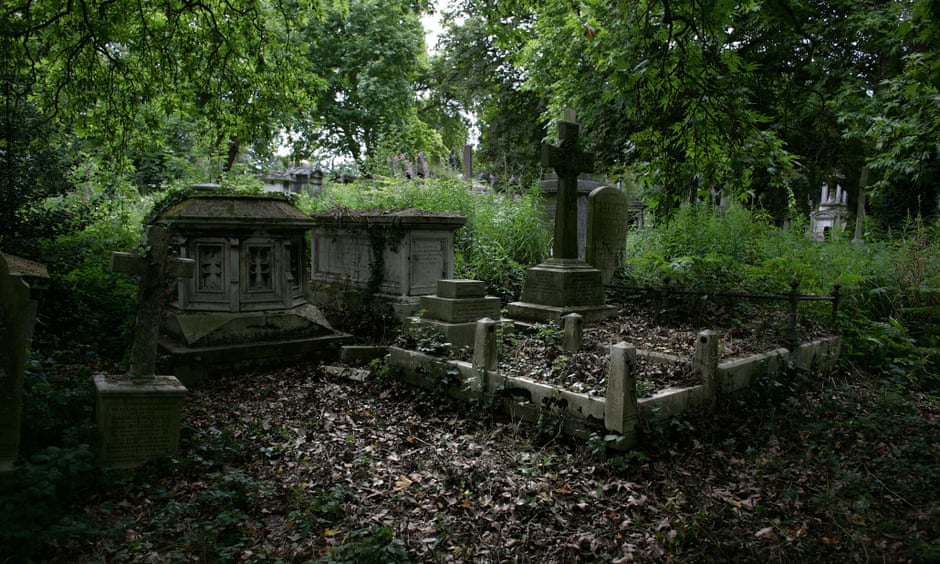
Some citizens decided to take matters into their own hands. Starting in the 1830s, garden cemeteries became the new places to bury deceased for all that could afford it. As Jackson states in his article, “For the middle- and upper-classes, one answer was to remove their dead to commercial “garden cemeteries”, spacious parks built in the semi-rural suburbs, such as Kensal Green (opened in 1832) and Highgate (1839). Such places, however, were well beyond the means of the urban poor” (Jackson). The divide between the rich and poor continued even into death through the treatment of corpses, burials, and burial locations. By the 1860s, these garden cemeteries would surround the metropolis on all sides, both commercial and parochial. Many of the old, disused private burial grounds would also eventually become garden cemeteries, of a sort (Jackson). Despite the passing of time and vandalism to garden cemeteries like Highgate Cemetery, Victorian garden cemeteries have survived even to this day.
Works Cited
Dickens, Charles. Oliver Twist. Amazon Classics, 2017.
Godwin, Martin. Garden Cemeteries. Kensel Green, London.
Jackson, Lee. “Death in the City: the Grisly Secrets of Dealing with Victorian London's Dead.” The Guardian, Guardian News and Media, 22 Jan. 2015, www.theguardian.com/cities/2015/jan/22/death-city-grisly-secrets-victori....