
Created by Tessa Bigelow on Tue, 11/11/2025 - 18:09


Description:
Phillipa Levine opens her essay "So Few Prizes and So Many Blanks" with the statement that “Marriage, for the nineteenth-century woman, was perhaps the single most profound and far-reaching institution that would affect the course of her life” (Levine 1). That is to say, women’s future is resolved by the prospect of their marriage. This concept brings in the question of what happens to women who have made a misguided decision, or have decided not to marry at all? Levine answers this by saying, “Women who did not marry--those whom the Victorians, with characteristic linguistic inelegance, dubbed "surplus women" — were seen as doomed to an unhappily penniless and lonely existence, unenriched by the social cachet and putative material comforts of the marital state” (Levine 151). Marriage was a pivotal point in the lives of women in the nineteenth century: It determined the outcome of their lives and the success of their family for generations to come. I find this information important when reading Jane Austen's Pride and Prejudice (1813), particularly because of Lydia Bennet's (almost) fall from grace. For my COVE project I chose to recreate the rushed letter Jane Bennet writes to her sister Elizabeth Bennet in Pride and Prejudice to inform her of Lydia’s disappearance with Mr. Wickham. This is a pivotal moment in the novel because the implications of the disappearance could taint the future of all the Bennet sisters. This moment brings light to the importance of public opinion and of marriage in the Regency period. If Lydia is not married to Mr. Wickham, this will cause a scandal and will discourage other suitors from pursuing the Bennet daughters. Finally, this moment showcases the economical side of marriage as Elizabeth’s aunt comments on Wickham’s reason for not proposing because of a lack of economic benefit. To support this claim, I will discuss the presence of a dowry in Regency marriages and how these acted as a marital "economical contract" and discuss the observations Lydia's cousin Mr. Collins makes regarding the disgrace of their disappearance and his wishing to keep the matter "hushed." Public scrutiny and wealth determined the reputation of families— in particular, women. This project will explore how Lydia almost ruined the Bennet family name for generations to come.
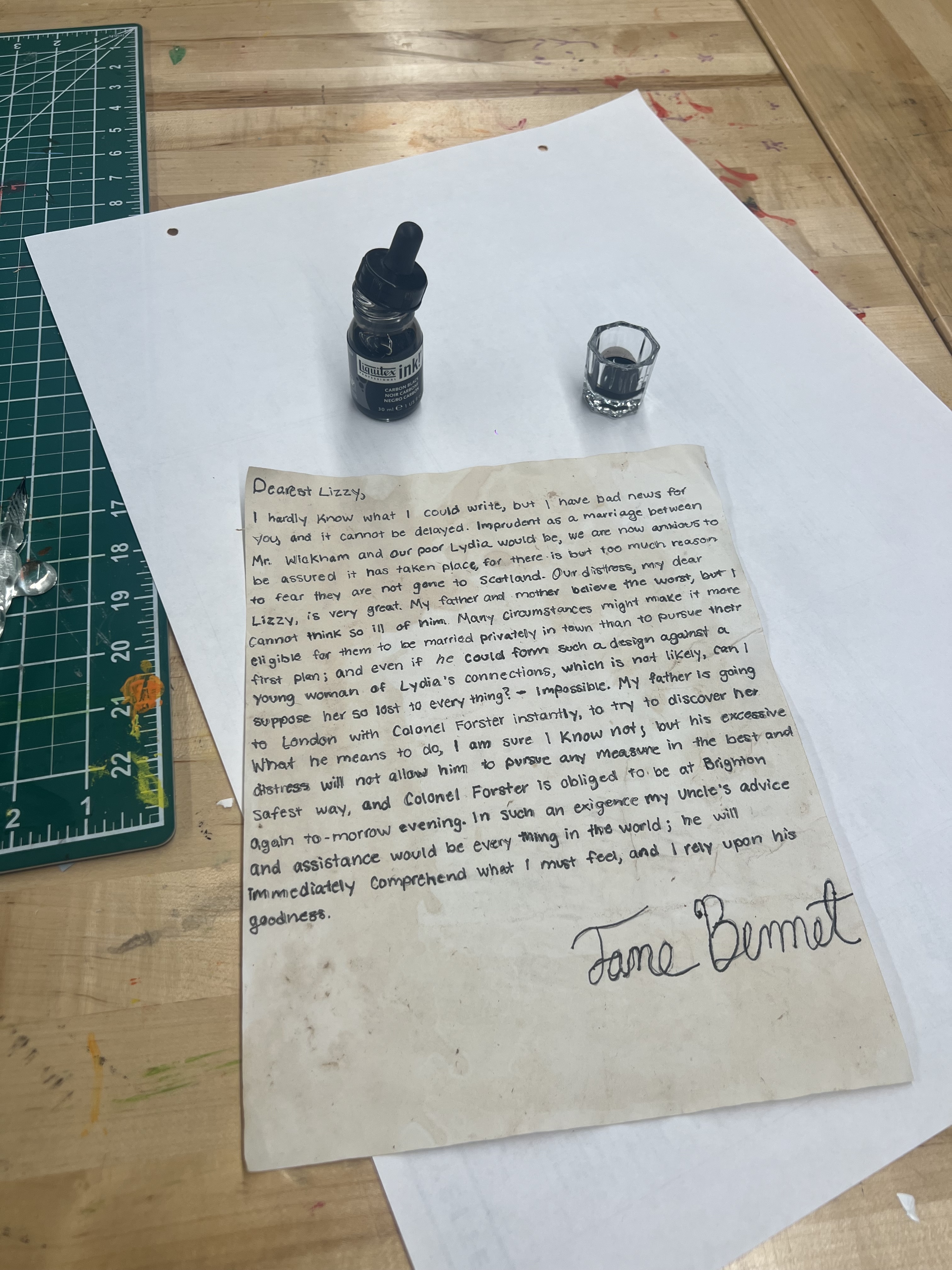
The Process of Creating my Regency Letter, Photo by Tessa Bigelow, 2025. I decided to make tea-stained paper by hand, which was an incredibly enjoyable and rewarding part of this project. I began by brewing a pot of Yorkshire tea and pouring it on a baking sheet. I then took a white piece of paper and crumpled it into a ball a few times to give it a more used and hurried appearance. I put the paper into the baking sheet with the bewed tea and let it sit for about five minutes. From there, I placed the paper in the oven at a low heat for ten minutes to speed up the drying process. Next, I brought my tea-stained paper to class to begin recreating Jane's letter using black ink and quill. Prior to this activity in class, I had never writen using ink before, so I made sure to practice on a different sheet of paper before using my own. Once I felt comfortable enough, I copied Jane's letter onto my tea-stained paper. I thoroughly enjoyed this part of the project as I felt as though I was fully emersing myself in Regency times. Upon working on this project, I was shocked by how difficult it can be to write a letter in the hurried fashion that Jane writes. To write an abbreviated version of the letter took me 30 minutes, and I cannot imagine how Jane must have felt delivering such intense news to Elizabeth.
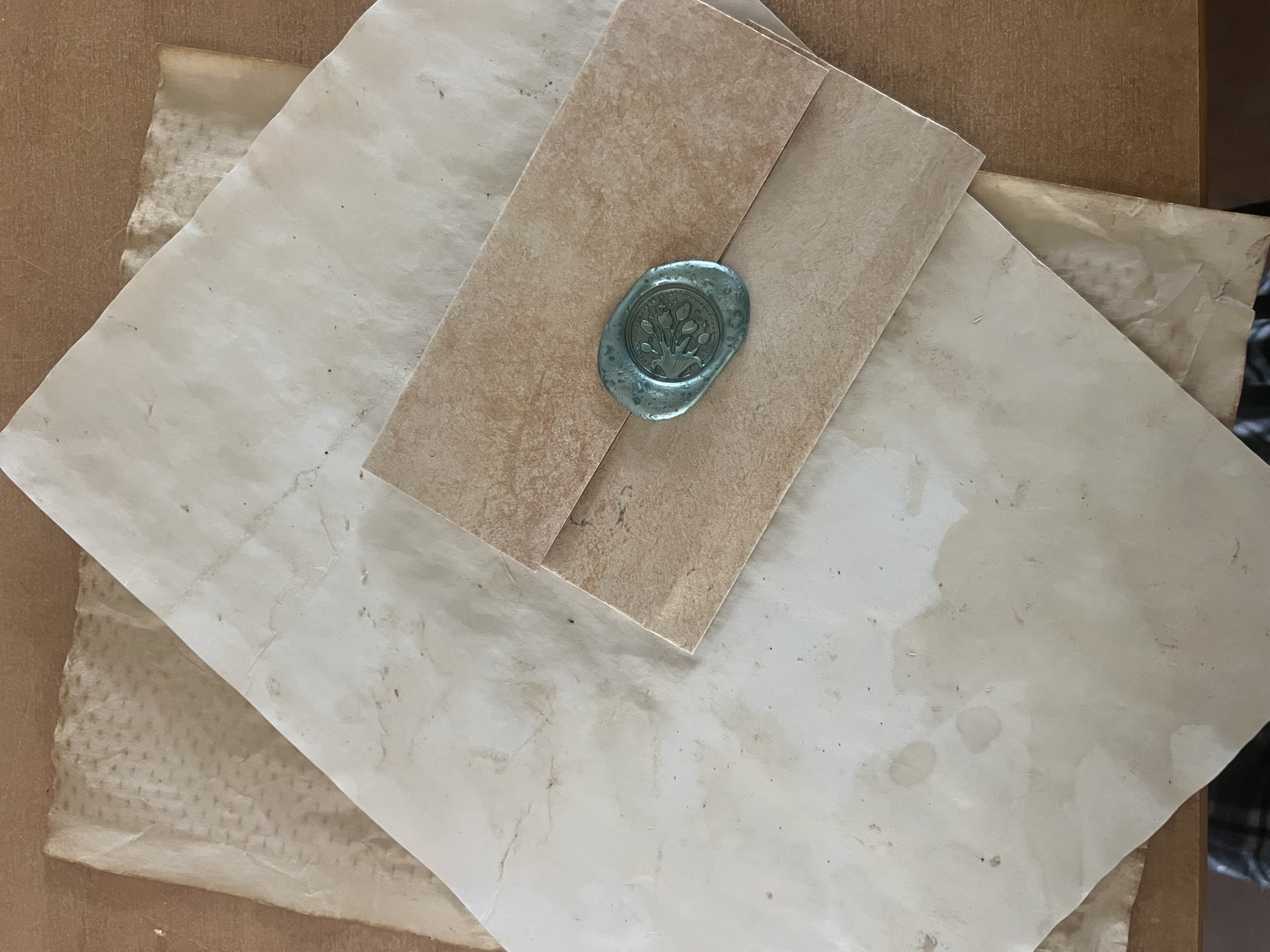
Recreated Regency letter of Jane Bennet Writing to Elizabeth, Sealed and Ready to be Opened in Class, by Tessa Bigelow, 2025. Jane Bennet's letter to her sister Elizabeth is to deliver the news of their younger sister Lydia's disappearance with Mr. Wickham. Not only does this moment increase the momentum of the novel by finally uniting Elizabeth and Mr. Darcy, but it also demonstrates the urgency of marriage, wealth, and reputation in the Regency period. Although the Bennets are not poor, their dowry— the economic transaction of a marriage between the father of the bride and the husband— could never be enough to convince Wickham to agree to marry Lydia. Yet the main cause of Jane's urgency is because of the severity of her disappearance and how it could be interpreted within Regency society. The letter that I have written is abbreviated, and mentions the most important moments that Jane writes. The most striking line reads, "can I suppose her so lost to everything?" which implies that this indiscretion could determine Lydia's reputation within society for the rest of her life. If Lydia becomes a "fallen woman," she will be seen as a scorned choice. She will find that there will be no suitors to call on her because of the permanent stain of scandal to her name. However, Lydia's scandal could determine the fate of her sisters, too, making them unsuitable for marriage in the future. As Elizabeth is aware of Mr. Wickham's previous history with scheming for more money in matrimony, her distress is felt more greatly, as she feels as though this is her fault for not warning her family of Wickham's previous behavior. Similarly, Mr. Darcy feels an equal amount of responsibility, causing him to pay Lydia's dowry and ensure her marriage.
My Classmates and I Holding our Regency Letters!, Photo by Catherine J. Golden, 2025. The third illustration shows my classmates and I holding our Regency letters after freshly sealing them. I enjoyed deciding which wax colors I would like to use and picking out a stamp to seal the wax with. I chose to go for Regency blue and gold as I took inspiration by how Jane was depicted in the 2005 version of Pride and Prejudice directed by Joe Wright. Jane Bennet is seen with golden blonde hair and often wearing a Regency blue dress. I chose a wax seal with a bouquet of flowers as there are flowers in Jane's hair at one of the balls in the 2005 Pride and Prejudice.
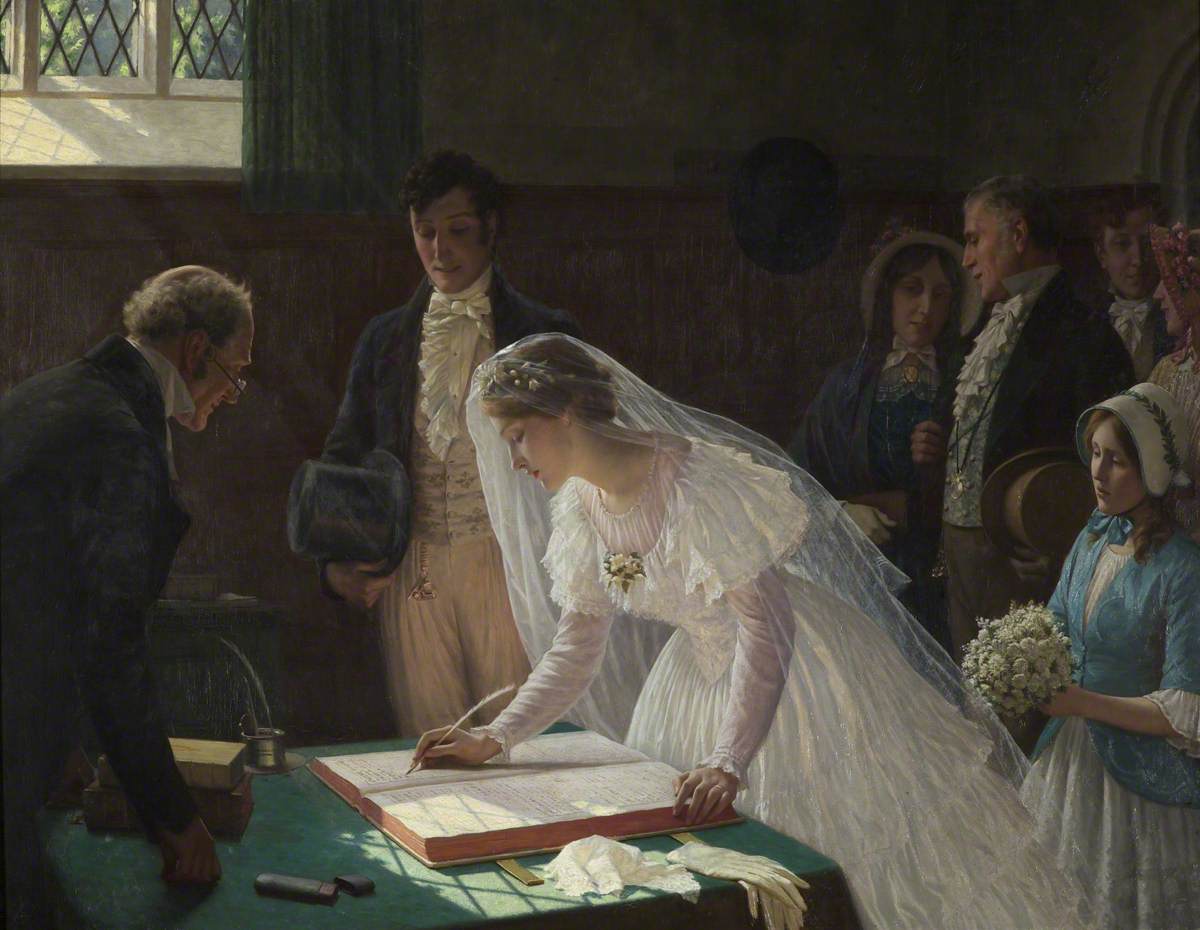
Edmund Blair Leighton, The Wedding Register, 1920, Artchive, 2025. I have included Edmund Blair Leighton’s The Wedding Register, a painting which features a bride signing the marriage register, which symbolizes the social “contract” of marriage. I chose this image because I believe that this gives perspective to the harsh reality of the marital decision for women. In reality, marriage was negotiated through a dowry, which is to be paid by the father of the bride. Relating this to Pride and Prejudice, Elizabeth’s uncle comments that Mr. Wickham would choose to not marry Lydia for lack of economical benefits. On page 346, he says “Wickham would never marry a woman without some money. He cannot afford it,” which highlights the significance and relevance of monetary status in marriage and society.
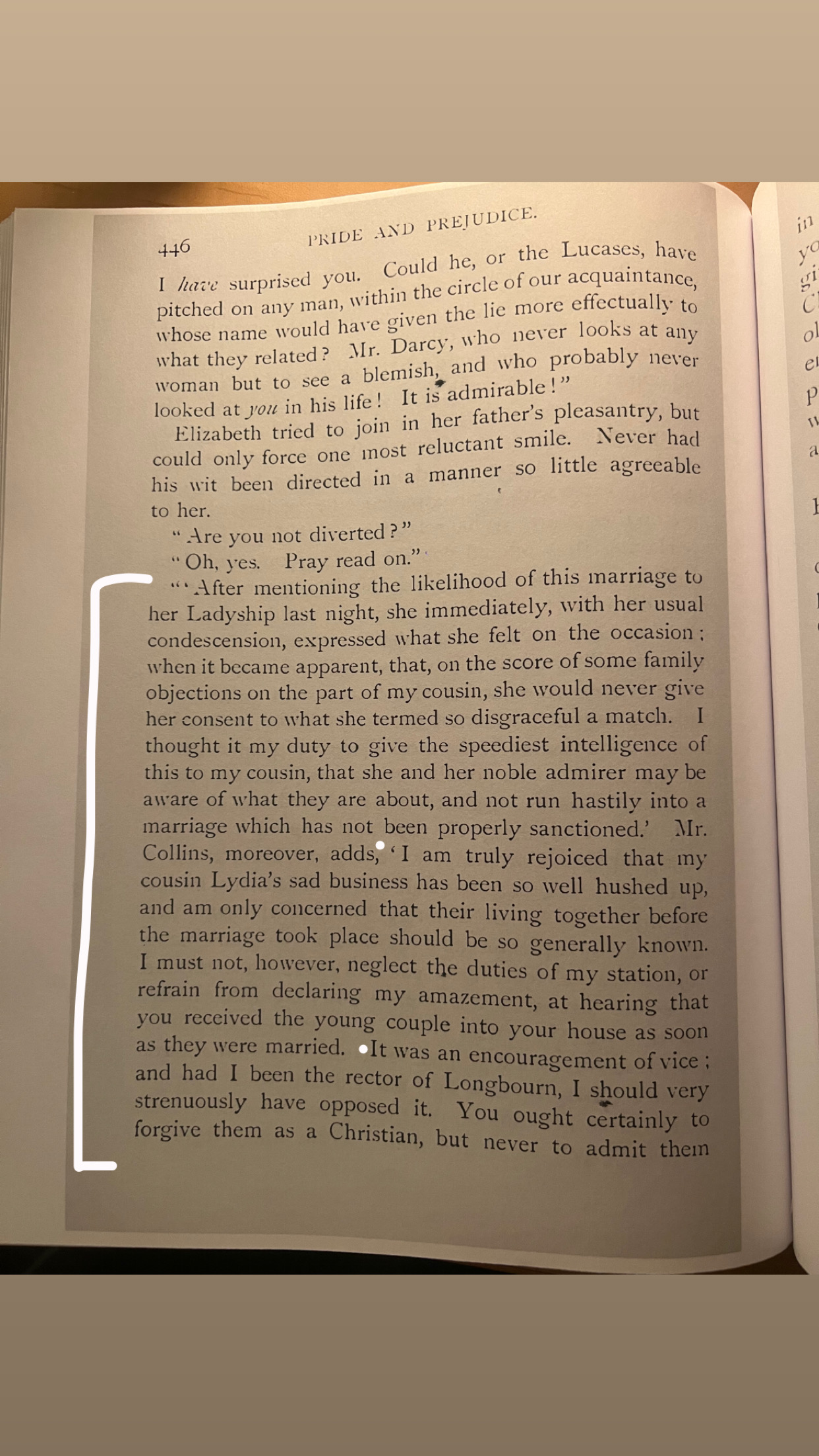
Letter From Mr. Collins in Pride and Prejudice (1813) by Jane Austen, Photocopy of Volume 3, Chapter 13. I have included a copy of Mr. Collins’s letter to Mr. Bennet where he praises the family’s ability to keep Lydia’s situation “hushed,” that is to say, to avoid public scrutiny. In the letter, Mr. Collins expresses concern of knowledge of their union prior to their marriage becoming public information. This comment demonstrates the extent to which Regency society cares about public opinion and how serious Lydia's indiscretion is for the entire reputation of the Bennet family. In this letter, Mr. Collins further questions the Bennets for even accepting the couple into their home, which also highlights how purity is expected in Regency women, or else they are exiled from society's unforgiving public opinion. Mr. Collins advises that the Bennets "ought certainly to forgive them as a Christian, but never to admit them in your sight, or allow their names to be mentioned in your hearing" (446). Within this small phrase, Mr. Collins reveals how Lydia and the rest of the Bennets would have been treated within society if Lydia's situation were revealed or Darcy had not married her.