
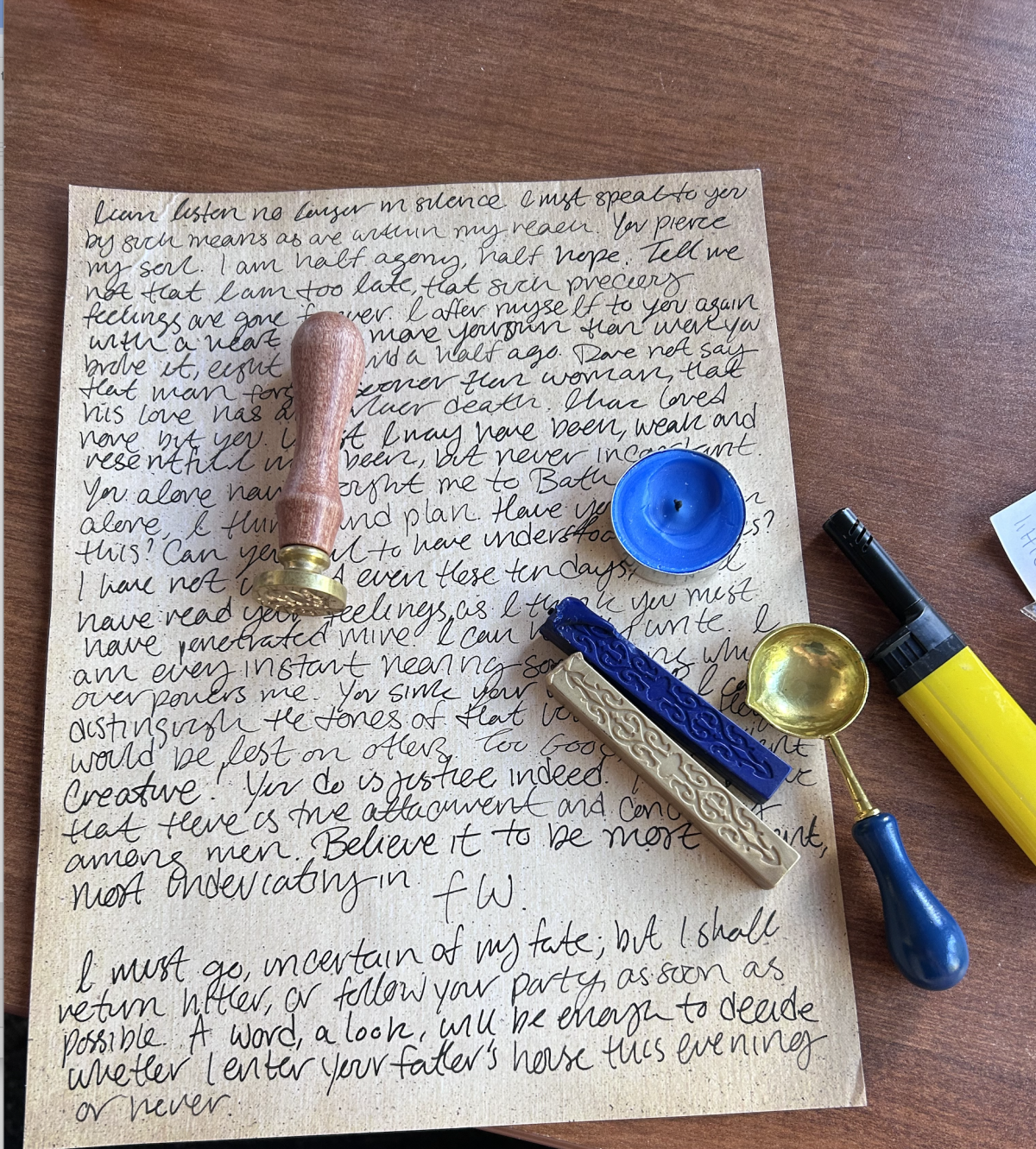
I chose to recreate the letter that Captain Wentworth gives to Anne Elliot in Persuasion (1818). The text was handwritten with a dip pen and black ink on weathered paper. I decided to recreate this letter because of the high importance it holds to the narrative arc of Persuasion as the act that finally brings Wentworth and Anne together, as well as just how beautiful and romantic it is. Love confessions in Austen's work are more times than not quite beautiful-- Knightley's "If I loved you less, I might be able to talk about it more" immediately comes to mind-- but hardly anything can beat "I offer myself to you again with a heart even more your own than when you almost broke it, eight and a half years ago" (1202). This quote refers to the inciting incident of Persuasion, the very mistake that gave the book its name. Anne Elliott, despite being "...deeply in love..." (1087) with Captain Wentworth, is persuaded from marrying him on the grounds that he has no fortune to speak of whatsoever, regardless of his (correct) conviction that he would gain a large one soon enough. She gives in to this persuasion due to her age and-- to borrow a modern phrase-- people-pleaser tendencies, but when she is older and receives this letter, she has gained a maturity of mind that could stand up against any persuasion.
In this Cove Gallery Post, I hope to illuminate some connections that Persuasion-- and specifically this letter-- has to Jane Austen's life, as well as demonstrate the process of sealing a letter using a candle and wax.
Recreated Letter from Captain Wentworth to Anne Elliot in Persuasion, by Simon Stephenson, October 2025.
As my cursive handwriting is not the best, here is the letter's text, in full:
"I can listen no longer in silence. I must speak to you by such means as are within my reach. You pierce my soul. I am half agony, half hope. Tell me not that I am too late, that such precious feelings are gone for ever. I offer myself to you again with a heart even more your own than when you almost broke it, eight years and a half ago. Dare not say that man forgets sooner than woman, that his love has an earlier death. I have loved none but you. Unjust I may have been, weak and resentful I have been, but never inconstant. You alone have brought me to Bath. For you alone, I think and plan. Have you not seen this? Can you fail to have understood my wishes? I had not waited even these ten days, could I have read your feelings, as I think you must have penetrated mine. I can hardly write. I am every instant hearing something which overpowers me. You sink your voice, but I can distinguish the tones of that voice when they would be lost on others. Too good, too excellent creature! You do us justice, indeed. You do believe that there is true attachment and constancy among men. Believe it to be most fervent, most undeviating, in F. W.
I must go, uncertain of my fate; but I shall return hither, or follow your party, as soon as possible. A word, a look, will be enough to decide whether I enter your father’s house this evening or never."
The letter, like most in Austen's work, is a pivotal moment of change for the narrative and for the readers' perceptions. The main question throughout the novel is whether Frederick Wentworth still loves Anne Elliot or not and if he will forgive her for her original mistake of giving in to persuasion. At the beginning, Wentworth seems like he is completely disconnected from their old romance and even seems to be pursuing other women. He is even actively cruel to Anne in speaking to others, even calling her "Altered beyond his knowledge" (1106) behind her back! Wentworth addresses this in the letter, admitting that he has been "unjust" and "resentful" of her-- but he has always loved her throughout it all. He assures her that she has been the only one on his mind, that he has only considered her as a possible romantic match. This is, ultimately, what allows for their conversation on the gravel walk, where they finally come back together and decide to be married.
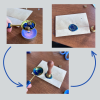
Process of Creating the Letter from Captain Wentworth to Anne Elliot, Photographs by Simon Stephenson, October 2025. For the letter, my penmanship is not nearly as neat or perfect as I'd imagine Captain Wentworth's to be, but I hope that my sealing expertise more than makes up for it! I chose to do the seal at my apartment so that I could use a candle, as the characters of Austen's novel would have done. For the wax, I chose blue and gold for their noble look, and for their color associations with the British Navy to which Wentworth belongs. No relevance rests in the raven design of the wax seal; it was simply the nicest and prettiest one I had to do the sealing. If I had access to it, I would've given him a simple "W" wax seal; he seems like the kind of man who would appreciate simple aesthetic choices.
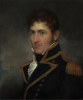
Painting of Captain Charles Austen by Robert Field, 1810. Captain Charles Austen, the sixth and youngest son of the Austen family, served in both the French Revolutionary and Napoleonic Wars. He eventually would rise through the ranks to rear-admiral. Fun fact: He may have offered naval vocabulary to help Jane revise the second edition of Mansfield Park! He was not the only resource that Jane would've had at her disposal, as Francis Austen was also a navyman. Francis rose even higher through the ranks than his younger brother, becoming a full admiral who served as the Commander in Chief of the North American and West Indian fleet. I selected this image of Charles as a Captain to show the blue-and-gold uniform that inspired the wax seal's color, the same uniform that Frederick Wentworth would be wearing.
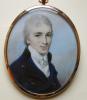
Portrait Miniature of Tom Lefroy, 1798. Jane Austen never married, despite her dedication to writing some of the most well-loved and admired romance novels ever published. Part of this was her dedication to love in marriage; she was almost married to Harris Bigg-Wither in 1802, but broke off the engagement because she did not truly love him. Her life, however, was not entirely without romantic love. In 1795, when she was younger, she met someone-- but, just like our heroine in Persuasion, the young love would be thwarted. This was Tom Lefroy, an Irish law student who was visiting his aunt and uncle in Ashe, near Steventon. Not much is known about their courtship, and he is only mentioned in two surviving letters from Austen. But from what is known, they met at a ball and courted for weeks with multiple dances. However, as Tom was the first son of a (in comparison to the Austens) wealthy family, he was expected to marry higher than Jane, and he returned to London to continue his studies. Later on in life, Tom would admit to his nephew that he did indeed love Jane, but it was a "boyish love." This romance is one of the reasons that Persuasion can be considered Austen's most self-indulgent work with regards to romance; are Anne Elliot and Captain Wentworth manifestations of that long-lost love? Was Jane writing the very letter she wished to receive?