
Discovery of Aspirin
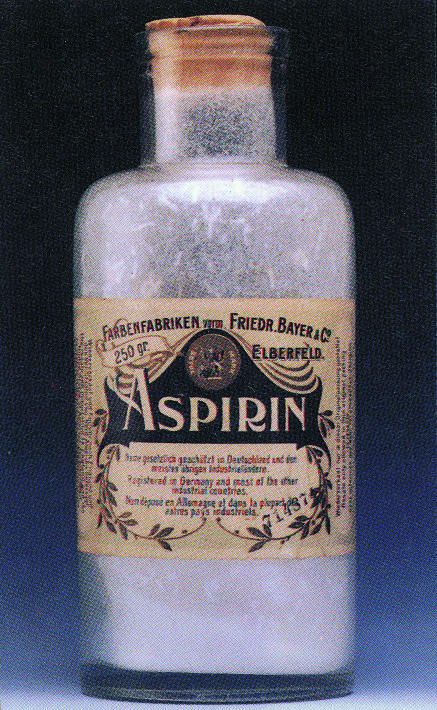
Aspirin is one of the most commonly used drugs in the world and is considered one of the biggest success stories of pharmaceuticals in the last century. Aspirin is a synthetic compound that is based on salicin which is found in willow bark. Willow bark was used as a fever reducer and pain reliever in many cultures for much of human history. The active ingredient in willow bark, Salicin, was discovered in 1828 by Johann Buchner. The process of refining Salicin into a usable pharmaceutical was further developed and its effectiveness was tested, but it was not widely used due to unpleasant side effects.
In 1897, Arthur Eichengrün, Felix Hoffman, and Heinrich Dreser found acetylsalicylic acid which was a form of Salicin that was stable and did not cause the unpleasant side effects of the previous versions. This became known as aspirin after undergoing clinical trials and was released to the market in 1899. Within 3 years of the release of aspirin, it was widely used throughout the world and was seen as a potential replacement for opium which was incredibly addictive.
There is no direct reference to aspirin or other painkillers in Sen’s work, she likely used opium quite liberally to treat her patients. The invention and widespread popularization of aspirin had a huge impact on the medical field as a whole, likely affecting Sen’s medical career to some degree.
SOURCES:
https://www.ncbi.nlm.nih.gov/pmc/articles/PMC1119266/
https://www.ncbi.nlm.nih.gov/pmc/articles/PMC1894700/#:~:text=In%201897%2C%20Felix%20Hoffman%2C%20a,1).&text=Subsequently%2C%20aspirin%20was%20found%20to,the%20stomach%20than%20salicylic%20acid.