
Travel and Truth to Nature in the Grand Style: Hunt's The Scapegoat
The Grand Tour in the 1700s was a popular form of travel that resulted in a new form of artwork, topographical painting. These watercolors were often created by noblemen who were encouraged to paint from their experiences while traveling. Topographical art accurately portrayed natural scenes in extensive detail. It was less concerned with higher meanings and more concerned with simply recording one’s travels in a factually sound way.
In the next century, John Ruskin (1819–1900) and the Pre-Raphaelite Brotherhood (PRB) also advocated the accurate representation of nature in art, though they argued that an accurate portrayal of nature is necessary not only in topograpical painting but also in oil paintings in the Grand Style. Notably, Ruskin and the PRB were not interested in reviving the topographical tradition and did not see themselves as connected with that tradition; rather, they aimed for authenticity in their attempt to achieve a high art. In their search for authenticity, the PRB began to paint “en plein air,” braving distressing weather conditions in order to depict a scene as it actually appeared.
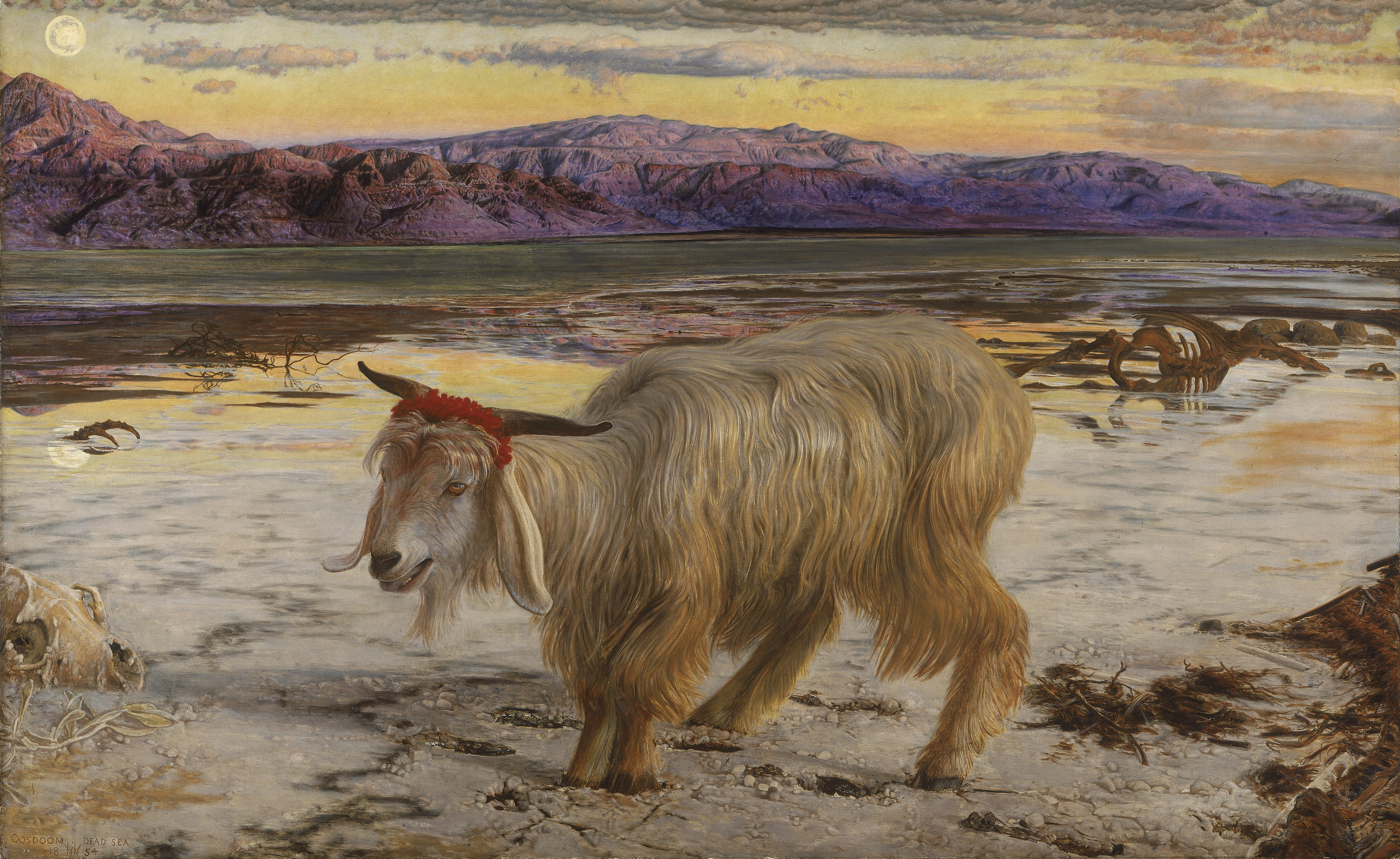
This need for accuracy led some in the Brotherhood to travel so that they could depict foreign landscapes from their personal observations. A particularly attractive destination was the Holy Land. William Holman Hunt (1827–1910), a member of the PRB, is especially known for his religious paintings. His fixation on portraying the life of Jesus led him to the Holy Land, where he created several paintings, one of which is The Scapegoat (1854-56). This painting features typological symbolism, which is “a key method of biblical interpretation … where biblical events and individuals were understood as prefiguring future and more important events in the scriptures” (Barringer 140). The Scapegoat is a painting of a goat clearly in distress, as it seems to be stuck in the middle of nowhere, with the head of a (presumably) dead goat in the far left of the painting and other bones scattered throughout the rest of the scene. The goat seems weighed down and wears a red crown.
On one level, this painting “refers to the Jewish ritual of atonement for the sins of the people described in the book of Leviticus” (Barringer 140). According to the ritual, one goat is killed in the temple as a sacrifice. Another goat, the scapegoat, is left alive to reconcile with the Lord and will then bear the sins of the people and be released into the wilderness, where it will find a deserted place to bring the sins. Before it was set to wander, the scapegoat’s horns were adorned with a red piece of cloth. If the goat was later found with a white cloth, the people believed that God had accepted the reparations. Literally and realistically, the painting portrays the scapegoat from the Jewish ritual. In Hunt’s eyes, however, the story of the scapegoat is “a symbolic prefiguration of Christ’s passion” (Barringer 140).
So how does Hunt manage to portray a literal goat and Christ at the same time? One way he does this is with the placement and vibrancy of the red cloth adorning the goat’s horns. There are several ways in which a cloth can be attached to a goat’s horns, yet Hunt chose to paint the cloth in the place where a crown would sit, symbolizing Jesus’s crown of thorns. The cloth/crown is the only place in the painting where that vibrant shade of red is used, so it immediately catches the viewer’s eye and reminds the reader of the blood spilled from Jesus’s crown of thorns.
In terms of setting, the aim of his travel, Hunt chose the site of “the rocks of Usdum on the Dead Sea” because of its history of destruction and its overall feeling of bleakness (Barringer 142). This is a place Hunt traveled to and painted while he was in the Holy Land, so he was able to accurately portray the landscape. The painting is very detailed; the viewer can nearly feel the texture of the white sand and can appreciate the stark beauty of the barren space.
For his typological program as well as truth to nature, Hunt took inspiration from Ruskin’s writings. In Modern Painters III (1856), Ruskin writes that in the Grand Style “we find its whole power to consist in the clear expression of what is singular and particular” (28). Unlike Reynolds, Ruskin believes that including more details makes something more poetic/artistic. For example, the beautiful, pinkish purple, rocky mountains in the background of The Scapegoat are painted according to their particular nature and therefore do not resemble the idealized mountains one would find in traditional Grand Style paintings (i.e., mountains one would find in Europe). This lends authenticity to the painting. Though the exact scene being depicted is invented, the painting portrays exactly what it would look like if a scapegoat wandered to that part of the Dead Sea.
As Ruskin furthers his argument, he reasons that perhaps more than simply adding or subtracting details contributes to a piece of art being considered poetic or historical. He states: “There must be something either in the nature of the details themselves, or the method of using them, which invests them with poetical power or historical propriety” (Ruskin 29). In other words, to qualify for the Grand Style, the particular details in a piece of art must contribute meaning in some way, whether that is simply by their nature or the way in which they are used. For example, Hunt’s positioning of the red cloth/crown in The Scapegoat is a meaningful detail in its nature and its usage, as explained above.
To conclude his argument, Ruskin arrives at the following assertion: poetry is “‘the suggestion, by the imagination, of noble grounds for the noble emotions’” (30). Hunt’s painting, as mentioned above, accurately portrays the particular landscape of that area along the Dead Sea, though he used his imagination to create the scene he depicts. This mixture of imagination and authentic representation of the Holy Land and religious meaning present a noble ground for the noble emotion of “veneration” (Ruskin, 30).
Though The Scapegoat is not a topographical painting and does not depict a scene that Hunt could actually have observed, it contains such detail as to have fallen under the topographical category if it had been painted in the previous century. The viewer gains an accurate understanding of what that area along the Dead Sea truly looks like. This authenticity and attention to detail do more than teach the viewer, however; the details contribute to the spiritual meaning of the painting, which is exactly what the Pre-Raphaelites and Ruskin hoped to achieve in their creation of a new Grand Style.