
Above The Working Class
Created by Phoebe Fisher on Tue, 04/08/2025 - 13:47
This timeline provides a sociohistorical context for Lucian Freud's 1995 Benefits Supervisor Sleeping.
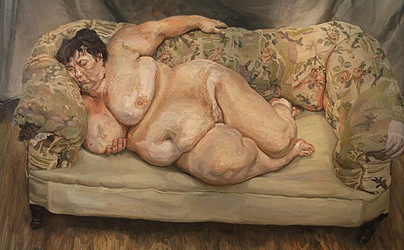
Freud, Lucian. Benefits Supervisor Sleeping. 1995.
https://en.wikipedia.org/wiki/Lucian_Freud#/media/File:Benefit
s_Supervisor_Sleeping.jpg.
Lucian Freud's Benefits Supervisor Sleeping is more than just a nude portrait-it is a profound reflection of his shift toward psychological realism, a meditation on the life in his subject Sue Tilley, and a quiet critique of class and dignity in late 20th-century Britain. Freud's transition from traditional portraiture to more raw style allowed him to explore the complexities of real people, rather than idealized figures. Tilley, a benefits supervisor, defied conventional standards of beauty and status, embodying a working-class presence rarely seen in high art. Her slumbering,unapolagetically large figure captured in intimate detail, confronts viewers with the humanity of someone often overlooked in both society and art history. Working in Britain's evolving and often criticized welfare state, the painting becomes a subtle political statement-elevating the dignity of everyday people during a time where their value was publicly questioned. The story explains not just the painting's context, but to show how Freud's art challenges assumptions made about class, body image, and who deserves to be seen.
Timeline
Chronological table
| Date | Event | Created by | Associated Places | |
|---|---|---|---|---|
| 1940 to 1950 |
The British Welfare State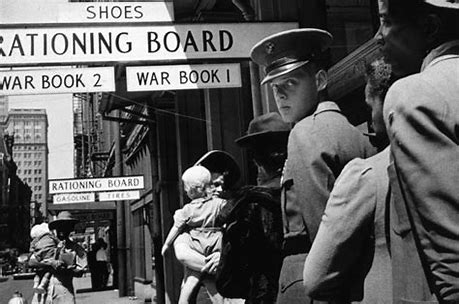 The Welfare State of Britain After WWII The period following World War II in Britain was marked by significant social and economic changes, including the rise of the welfare state. The subject in Benefits Supervisor Sleeping works within this system, which was a part of a broader shift towards increased state involvement in citizens’ lives through benefits and social support. The connection to the image is the subject’s role as a benefits supervisor can be seen as a symbol of the evolving relationship between individuals and the state in post-war Britain. The unidealized portrayal of this woman can be interpreted as a critique of the welfare system, but also as an acknowledgement of the hard work required to support others in times of social need. The painting does not romanticize her role but instead presents it in a way that suggests the complexities of modern social systems, where individuals are caught between personal struggles and their societal obligations. “How WW2 Drove Social Change | Royal British Legion.” The Royal British Legion, 24 Feb. 2020, www.britishlegion.org.uk/get-involved/remembrance/stories/how-ww2-drove-social-change. “IILJ History and Theory in International Law Workshop: The Emergence of the Concept of a ‘Welfare State’ in British Political Discourse, 1940-1950 - Institute for International Law and Justice.” Institute for International Law and Justice, 2016, www.iilj.org/events/historyandtheoryworkshop/. Accessed 8 Apr. 2025. |
Phoebe Fisher | ||
| 1952 to 1953 |
Transitioning Away from Normalcy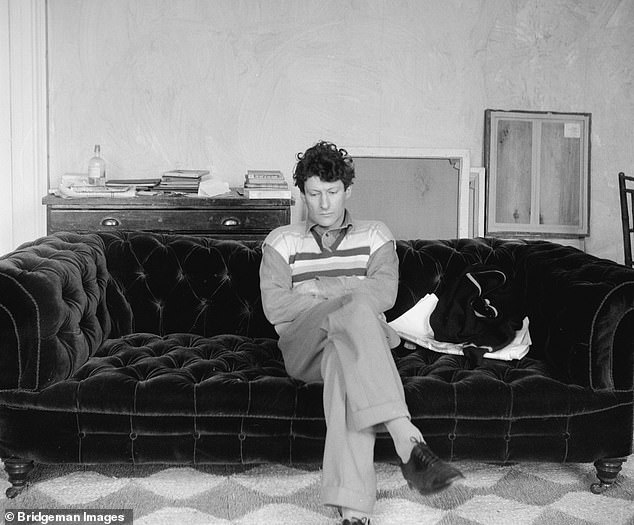 Lucian Freud in his London Studio One key event in Freud’s life that is crucial for understanding Benefits Supervisor Sleeping is his decision to move away from traditional paintings and embrace a raw, psychological realism. Freud’s early exposure to art, combined with his personal life experiences, influenced his move toward depicting not just the physical form but the emotional and psychological depths of his subjects. He rejected idealized representations and instead focused on the complexities and imperfections of the human body. This shift was shaped by his studies at the Norwich School of Art and later his time working in London, where he developed an intense observational style and keen interest in psychological depth. The connection to the image is the raw portrayal of the woman’s form, with no attempt to beautify or idealize her form. This portrayal is a manifestation of Freud’s exploration of the human psyche and his interest in showing people as they truly are. The unflattering perspective of the woman’s body speaks to Freud’s goal of revealing the internal life of his subjects, exposing not just their physicality but their emotional states. Stuff, Art Movements. “Lucian Freud’s Legacy: Revolutionizing Modern Art & Humanity - Art Movements - a Brief History.” Art Movements - a Brief History, 26 Apr. 2024, artmovements.net/lucian-freuds-legacy-revolutionizing-modern-art-humanity. Accessed 23 Mar. 2025. “Website Filtered.” Dailymail.co.uk, 2025, www.dailymail.co.uk/home/books/article-7483083/Freuds-sexual-code-conduc.... Accessed 8 Apr. 2025. |
Phoebe Fisher | ||
| 2012 |
Tilley, An Underappreciated Subject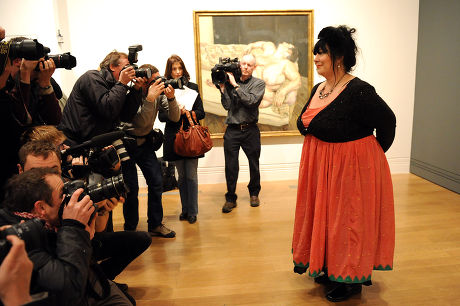 Tilley Posing in Front of Freud's Painting The subject of Benefits Supervisor Sleeping, a woman who worked as a benefits supervisor, represented the working class in 20th century London. Freud was known for his choice of models from diverse social backgrounds including those who lived outside the societal elite. The connection of the image is understanding the subject’s working-class involvement provides context for interpreting the painting. Her portrayal is not one of glamor of privilege, but of realism-showing a body that is weary and unposed, a symbol of the often-overlooked labor and lives of helping the working-class individuals. The image of her sprawled out, resting, is seen as a commentary on the physical and mental exhaustion that comes with the kind of work she did. It speaks to her daily life and the toll that work, and life take on the body, making the image a reflection of her experience as a woman in a working-class environment. “Lucian Freud and ‘Big Sue’ : The Story of an Unlikely Muse.” Https://Www.theyouthtimes.com/, 2018, www.theyouthtimes.com/news-details/931/Lucian-Freud-And-%C3%A2%E2%82%AC%CB%9CBig-Sue%C3%A2%E2%82%AC%E2%84%A2-:-The-Story-Of-An-Unlikely-Muse Telegraph Reporters. “Escenic.” The Telegraph, 8 Feb. 2012, www.telegraph.co.uk/culture/culturepicturegalleries/9068675/Lucian-Freud.... Accessed 8 Apr. 2025. |
Phoebe Fisher |