
Arthur's Seat
Appearance in Frankenstein: Arthur's Seat appears in Chapter 2, Volume 3, when Victor and Clerval visit Edinburgh. Victor describes viewing the city "with languid eyes and mind," while Clerval finds the "beauty and regularity of the new town of Edinburgh, its romantic castle and its environs" delightful. Arthur's Seat, along with St. Bernard's Well and the Pentland Hills, "compensated him for the change and filled him with cheerfulness and admiration." Victor, however, remains "impatient to arrive at the termination of my journey."
Historical Context: Arthur's Seat is an ancient volcanic formation and the main peak in Holyrood Park, rising 822 feet above Edinburgh. By Shelley's time, it was already a celebrated tourist destination and an essential stop on any visit to Scotland's capital. The dramatic geological feature, with its rugged cliffs and panoramic views, embodied the Romantic ideal of the sublime in nature. The name itself (possibly derived from Arthurian legends, though more likely from Gaelic origins) added mythic and historical resonance. For British tourists in the 1810s-1830s, Arthur's Seat represented Scotland's wild natural beauty and ancient power - a stark contrast to England's increasingly industrialized landscape.
Literary Significance: The mention of Arthur's Seat reveals the profound difference between Victor and Clerval's responses to nature. Clerval exhibits the proper Romantic sensibility - he finds joy, admiration, and spiritual restoration in sublime natural landscapes. Victor, corrupted by his obsession, remains emotionally dead to nature's healing power. This is particularly significant because Romantic philosophy held that nature could restore the troubled soul. Victor's inability to respond to Arthur's Seat shows how completely his transgression has alienated him from natural human feeling. The volcanic formation itself subtly echoes the destructive, ancient forces Victor has unleashed through his creation.
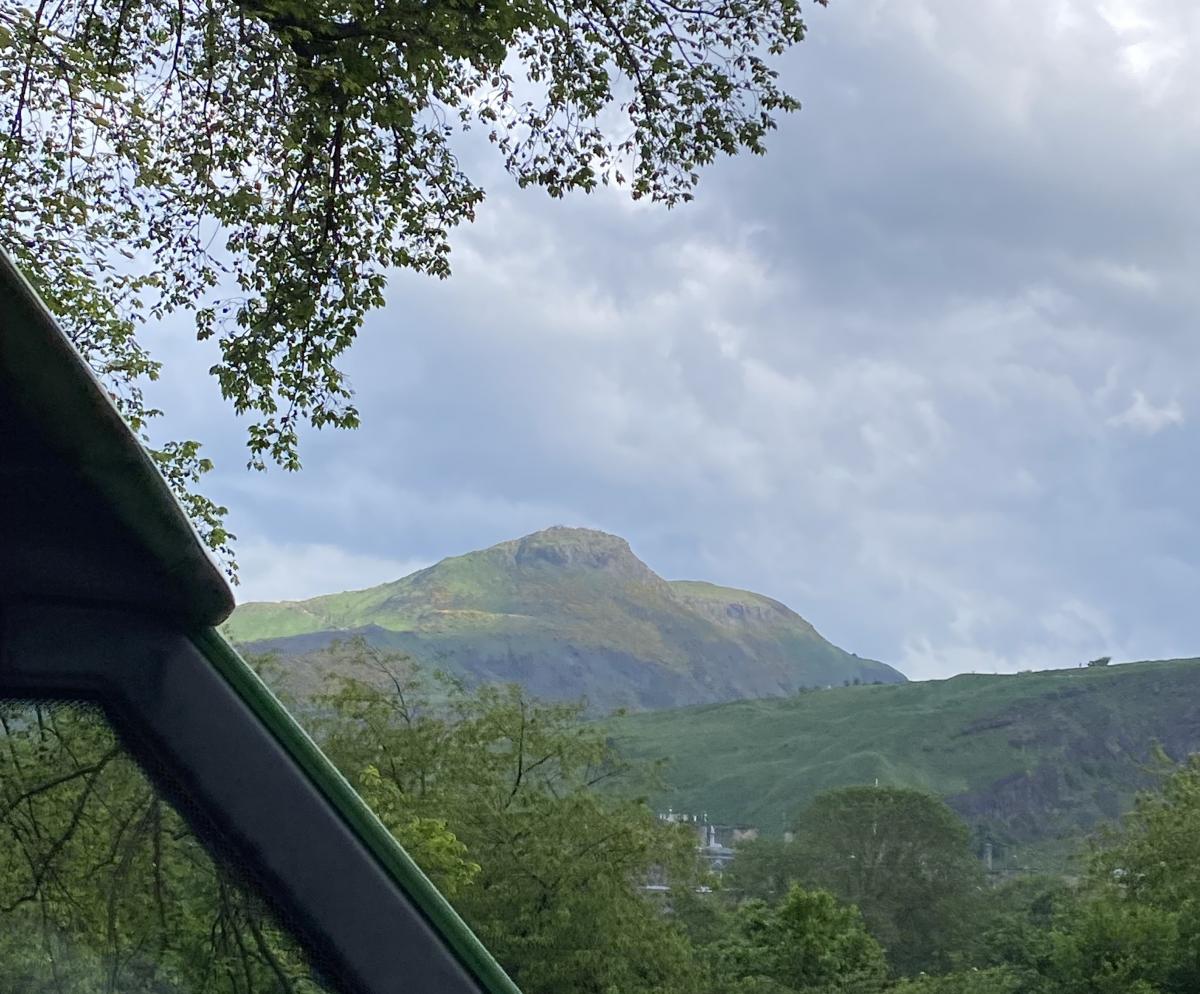
Image: Testerman, Grace. Arthur's Seat. May 25, 2024. Edinburgh, Scotland, UK.
Garry, James. “Why Is It Called Arthur’s Seat? - the Cockburn Association.” The Cockburn Association, 5 July 2024, www.cockburnassociation.org.uk/history-blogs/why-is-it-called-arthurs-seat/.
Parent Map
Coordinates
Longitude: -3.161832400000