
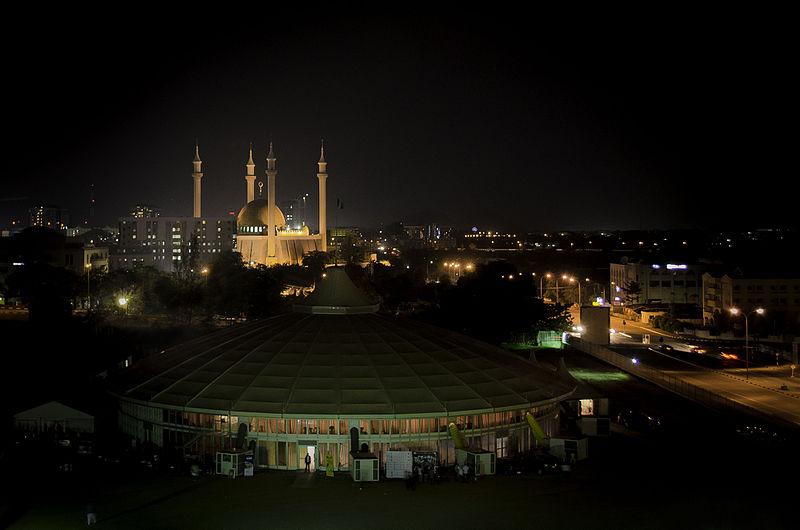
Abuja officially replaced Lagos as the capital city of Nigeria on December 12th, 1991. As the nation’s first planned city, it was purposefully built within the Federal Capital Territory, an area considered neutral ground by Nigeria’s ethnic and religious groups. Additionally, Abuja is in the middle of Nigeria, making it an especially accessible location to citizens across the country. General Mohammed explained this desire for unity while announcing the plan: “We believe that a new federal capital created on such a virgin land, will be for all Nigerians a symbol of their oneness and unity. The Federal Territory will belong to all Nigerians” (Oloworekende).
Today, Abuja is central to Nigeria’s politics and community. There are many governmental offices in Abuja, such as the city hall and national cultural institutes. Religious meeting places like the National Mosque and the National Christian Center also reside in the city. Abuja supports the national economy with its shopping centers, international airport, and the National Stadium (“Abuja”).
In Akata Witch, the main characters travel to Abuja from their village to participate in the Zuma Festival: an annual meeting of Leopard People held at Zuma Ajasco, the Abuja Leopard headquarters. When Sunny asks why Leopard Knocks is still the West African headquarters, Anatov explains that “The scholars of Zuma Ajasco think that Abuja should also become the Leopard central headquarters of West Africa instead of Leopard Knocks [...]. Bullsh—nonsense. Leopard Knocks has been Leopard Knocks for over a millennium. To move it would dislocate all that we hold dear” (223). This passage implies the existence of an ongoing argument between Leopard People. While Zuma Ajasco’s scholars want to make similar decisions to Nigeria’s government, others are fearful that such a change will be detrimental to the lives and traditions of all Leopard People.
Works Cited
“Abuja.” Britannica, 19 Apr. 2026, https://www.britannica.com/place/Abuja-national-capital-Nigeria
Kingabizzy. Night Life Across The Beautiful Central mosque. Wikimedia Commons, 2016, https://commons.wikimedia.org/wiki/File:Abuja_Nightlife.jpg
Oloworekende, Wale. “How Abuja Became Nigeria’s Capital.” Culture Custodian, 2020, https://culturecustodian.com/how-abuja-became-nigerias-capital/