
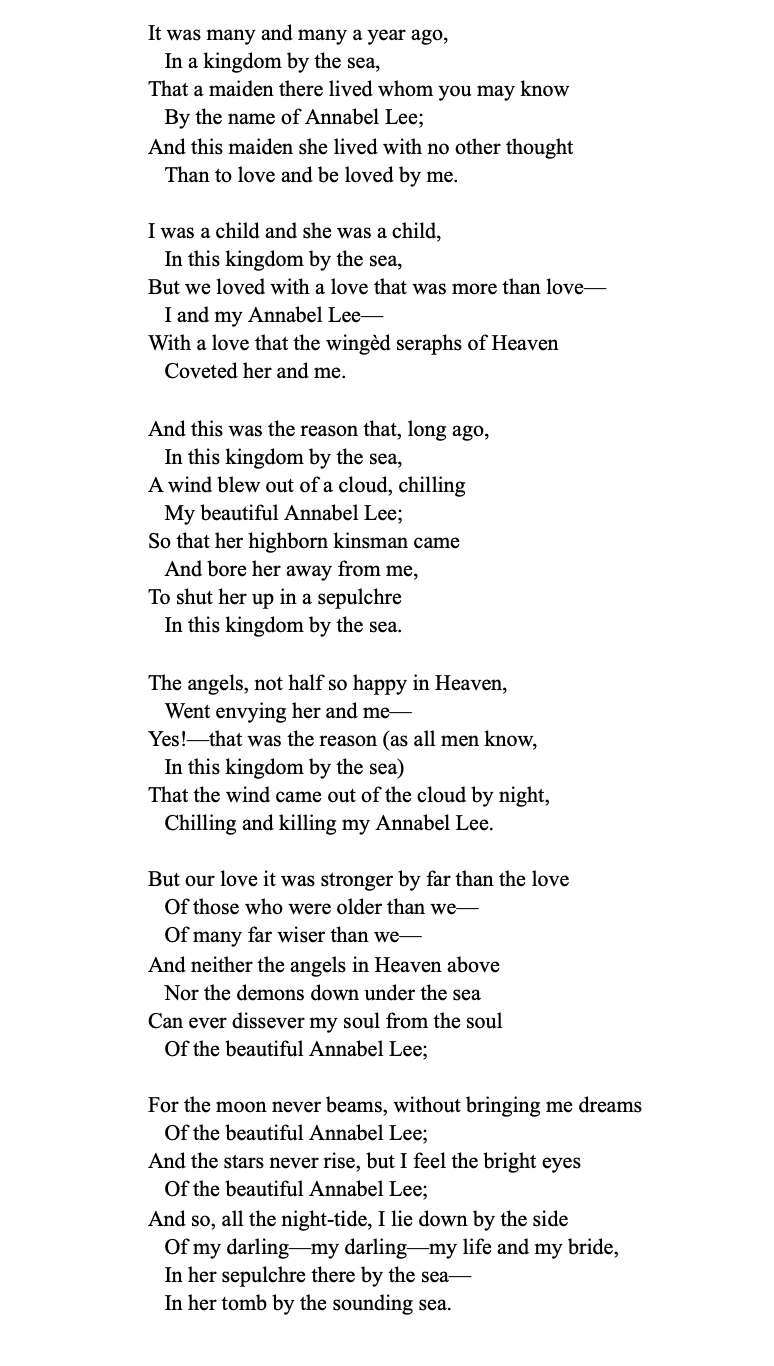
I found this poem in the newspaper today and I was reminded of my best friend whom we laid to rest and was overwhelmed with grief. Alison was such an incredible person and she did not deserve to die in the way that she did. That terrible sickness snuck up on her and sucked the life right out of her. I blame that horrible Dr. Dunlop and that wretched girl he dragged into his and Alison's relationship. There was always something wrong with that girl, I knew it from the moment I saw her face down in that hospital bed. And Dr. Dunlop, he should be punished for what he did to my friend, using her like that. Destroying her, killing her, all to be with another woman. If he would not have done that, Alison would have never felt the need to be at the bedside of patient 27, allowing herself to be infected with that terrible sickness. How I wish I could have warned Alison, told her to stay away from that girl. At least I was able to be there in her final days, by her bedside helping her to stay strong. Oh my how I miss her so much already, I have no idea how I shall live without her presence. As the poem says “I was a child and she was a child” when we first and we have been together ever since, until “her highborn kinsmen came/And bore her away from me,/To shut her up in a sepulchre/In this kingdom by the sea.” I shall retire now and dream of days when it was me and my Alison Lee.
Editor Commentary: The author’s choice of Edgar Allen Poe’s “Annabel Lee” reveals a great deal about her. This choice develops the connection between the author and Alison. It hints at underlying romantic feelings between the two. This is furthered by the author’s negative commentary about Dr. Dunlop who appears to be in a relationship with Alison. During the Victorian era, society would have greatly disapproved of a homosexual relationship between two women. Women were viewed as for males, those who could tend to the household while the men worked and did whatever they pleased.
The author comments about what has happened between Alison, Dr. Dunlop, and the girl, patient 27. She indicates that Dr. Dunlop was unfaithful, “ killing her all to be with another woman”. It is odd that the author would have so much knowledge about the inner workings of Alison and Dr. Dunlop’s relationship as that kind of information was not widely shared with the public back during the Victorian era. This would indicate that Alison and the author were far closer than most women during the Victorian Era. Furthermore, the author’s tone regarding Dr. Dunlop and his affair is uncommon for the Victorian era as well. During this time period, most men had multiple affairs while their wife sat idly by and did or said nothing about the affair; either out of fear to look insufficient for their husband or to avoid upsetting their husband.
Although the author never specifies what illness Alison dies from it appears to be tuberculosis, more commonly known as consumption at the time. This would be the most likely illness that could have been caught just by being around an infected person. It would appear that Alison found out about her husband’s affair and felt bad for the girl because she was sick; yet Alison ended up infecting herself as well and eventually died from it.
Citation:
Dixon, Ella Hepworth. The Story of a Modern Woman. 1894. COVE, 2020.
Poe, Edgar Allan. “Annabel Lee by Edgar Allan Poe.” Poetry Foundation, Poetry Foundation, www.poetryfoundation.org/poems/44885/annabel-lee.