
Display Explanation:
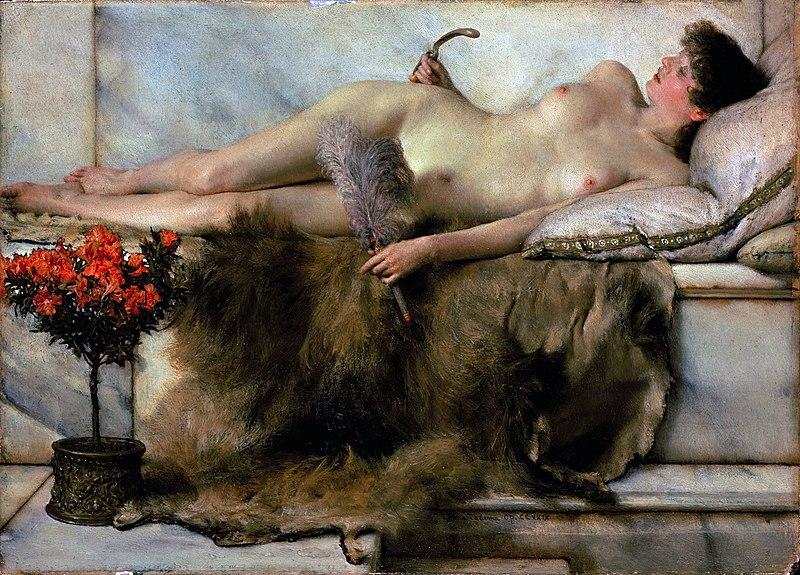
For the display of these art pieces in a museum room, I would place all three paintings on a white art easel with a light on the top so the light will illuminate the pictures. The room would be a well-lit room with a large ceiling light above the heads of the viewers. The room would be small so the only things inside the room are the art easels and one large black leather bench that stretches all the way across the entire room in the back of the room facing the paintings. The room would be painted a cream color, and the first art easel, to the left of the entrance, would be inverted facing towards the entrance in the middle of the room. The easel on the left would have The Tepidarium on display. The middle easel, directly facing the entrance of the room, would have Woman in a Bath Sponging Her Leg on display. The third and final easel, inverted to face the entrance of the room from the right side, would have Dolce far Niente on display. The cream-colored bright room would also feature birds chirping as ambiance sounds from a speaker. The birds will create a scene of tranquility, nature, light, and peace. The birds will help the viewers imagine what the backgrounds of the paintings would sound like. The chirping birds will help put the viewers inside the painting, and the art will be much more memorable if done this way. The installation is promoting peace and cleansing of the soul. Bird sounds are viewed as peaceful, and that is very important to convey. Additionally, I would have the door to the entrance of the room light green and painted with vines, grape vines, flowers, and birds. The door is the first thing the viewers will see; it is crucial that the door also helps promote the peace and the cleansing of the soul idea. The green colored door will have an intricate design that makes the installation much more memorable. The door will have two long thin open slits that reach to the bottom so the viewers can barely see through. The door will look like a painting itself. Once the viewers open the door, there will be a short hallway leading into the installation room. The ceiling in the room will have a design as well. The ceiling will have white painted clouds with a baby blue sky. The colors will not be bright, they will be faded and will appear “old” or “vintage”. The faded colors won’t distract the viewers from the installation, but it will add to the peace and the “freedom of the soul” aura of the room. The nature look, bright lights, and the birds chirping ambiance will easily promote a room of peace. The viewers will look at the paintings and they will be able to imagine themselves there, in that moment, bathing and entering a state of relaxation. The installation is intricately thought out to attract viewers, but also to easily convey the entire idea of the installation itself. The theme of all three images should be obvious and easily identified.
Installation Note:
My first installation piece, The Tepidarium, shows a nude woman resting on animal fur, blankets, and pillows. She holds a strigil in her right hand; a tool used for cleaning dirt and grime off the skin that was often used by the Greeks and the Romans. A tepedarium is a bathhouse with a curved dome above the water that traps in the heat and humidity of the bathhouse. This piece shows a woman peacefully enjoying her time alone in the bathhouse. I notice the bright lighting of the scene; I assume there is sunlight coming in through windows or holes in the walls. There is a flowerpot at the woman’s feet, and the woman’s eyes are closed. She appears to be sleeping. She looks at ease and her body looks relaxed. Her left arm is at her side and her body curves down from gravity due to her relaxed state. She is holding a feather in her left hand. She could have used this to fan herself or run feathers along her skin. It is a comforting feeling, and she is comfortable laying nude in this bathhouse by how relaxed her body looks. The woman is cleansing herself physically, but she is also cleansing herself internally. She is finding peace and relaxation, which is very good for the soul. She can distract herself from the stresses of external life.
Installation Note:
My second installation piece, Woman in a Bath Sponging Her Leg, by Edgar Degas, is similar to the first piece mentioned above. It shows a woman seated in a bathtub washing herself with a sponge. She is not as explicitly nude as the first image I chose, but she is still nude, nonetheless. The painting is bright in color, coming from the left of the frame. It appears to be sunlight seeping into the room. The woman is alone. She appears to be enjoying her bath by placing her left leg on the rim of the tub so she can sponge herself off. There is no sign in her body language that she is uncomfortable or worried. If the image was in motion, I can imagine her doing this process slowly and steadily. She would take her time with the peace she has found. Similarily, she is also cleasing the inside of her soul as well. Peace and self-care often lead to happiness, and I believe she has found that. However, instead of a bathhouse, she is in a room. This could imply that she would be uncomfortable in a bathhouse, since that is more public, but it is hard to tell. My installation theme is “cleansing of the soul” as portrayed by nude women. Women have always been more peaceful than men, so it makes sense to include women in my installation as they are prettier to look at, and overall, just more peaceful.
Installation Note:
My third installation is Dolce Far Niente, which translated means “the sweetness of doing nothing.” Yet again, we see my common theme of resting and “cleansing of the soul.” However, this time, the woman laying down is in a bathhouse, but fully clothed. She is surrounded by flowers and pigeons and is holding peacock feathers in her right hand. She is awake and glancing at the pigeons. She looks to be resting comfortably as she is placing her head on her left hand for stability, and her right arm is draped to her side. Gravity has placed her side in curves and her feet are stacked upon each other. She seems to be in a state of peace. She is, after all, surrounded by beautiful things. I can also make note of the light in this painting. It is very clear that light is coming into the bathhouse because those areas hit by light are bright white in color. There are pigeons surrounding the woman, so they have found a way to get in and out of the bathhouse. As previously mentioned, the woman looks relaxed and at ease. She is also providing for herself by finding a state of peace.
All three images above represent a theme of peace and cleansing. Internally, the women are finding relaxation within their surroundings by bathing. Scientifically, it is proven that bathing, smelling good, and cleaning oneself is good for you psychologically. It boosts self-esteem, endorphins, and lowers depression. Another important factor to note in my installation is the physical representation of sexuality. The women are comfortable with their nakedness. They are not seen to be hiding themselves from their nakedness. They are comfortable bathing, and this expresses their sexuality. If they were to have sex with another person, they would express themselves fully and would not be ashamed of their body. They would embrace their nude and feel comfortable in their skin.
Alma-Tadema, Lawrence. The Tepidarium. 1881. Lady Lever Art Gallery. Lawrence Alma-Tadema - Wikipedia. Accessed 17 Feb 2023.
.jpg)
Degas, Edgar. Woman in a Bath Sponging Her Leg. 1883. Wikimedia Commons. File:Edgar Degas, Femme dans son bain s'épongeant la jambe.jpg - Wikimedia Commons. Accessed 17 Feb 2023.

Waterhouse, John William. Dolce Far Niente. 1880. Wikipedia. https://en.wikipedia.org/wiki/John_William_Waterhouse#/media/File:John_William_Waterhouse_-_Dolce_Far_Niente_(1880).jpg. Accessed 17 Feb 2023.
.jpg)