
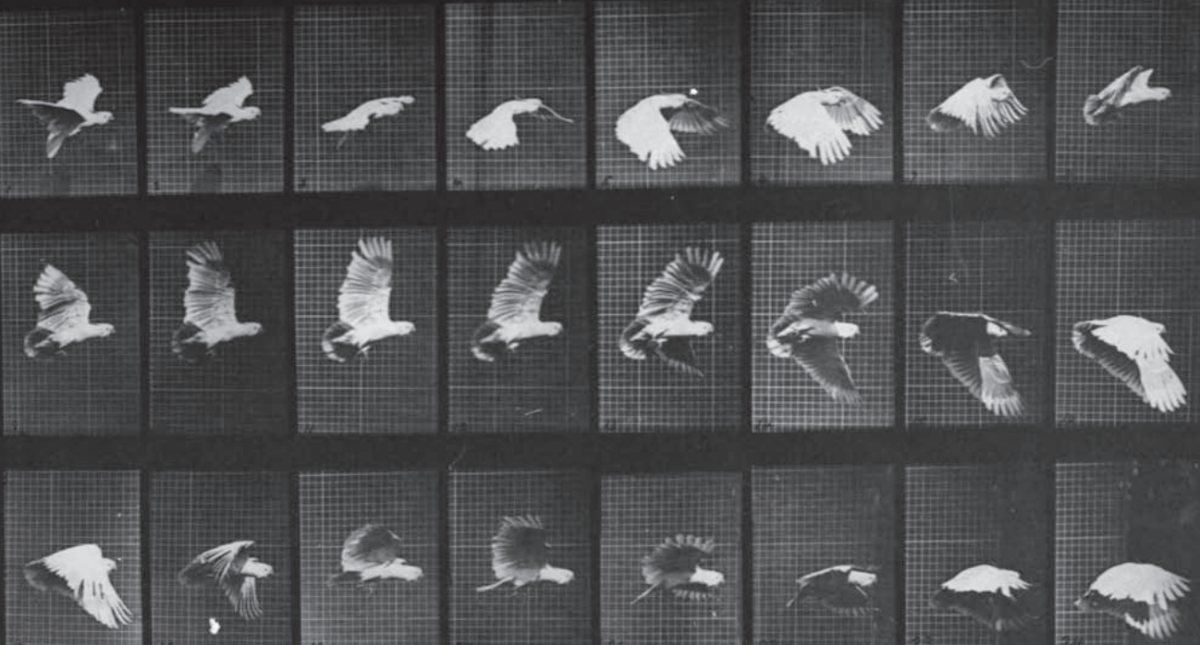
Eadweard Muybridge’s photo of a cockatoo in motion from 1887. Considering the Victorian focus on birds and flying machines, the combination of technology and flight is notable for the period. While the image itself does not focus on prosthetics, the idea of flying in relation to mobility is what ties this to The Lame Little Prince.
An article featuring this image looks at how aerial imagery/surveying has changed our perception of flying as a whole. They discuss how aerial surveying was a practice conducted through several different processes, even before cameras were commonplace. These processes include aerial archaeology (which was thought to be tied to cartography, especially through Flemish art + Mercator projection) (Wickstead, et al. 72), vision itself and camera photography.
This relates to The Little Lame Prince, as it is through his acquiring of the cloak that Prince Dolor is not only able to leave the tower, but he can explore the world beyond it. To the Prince, “...seeing all sorts of wonderful things—or they seemed wonderful to him, who had hitherto seen nothing at all.” (Craik Chapter V) The prince is able to use his prosthetic(s) to understand the world from an aerial point of view. Being able to use the cloak as a mobility aid allows him to view things without having to worry about his legs.
Source:
Wickstead, Helen, et al. “A Spectacular History of Survey by Flying Machine!” Cambridge Archaeological Journal, vol. 22, no. 1, 2012, pp. 71-88. https://doi-org.ledproxy2.uwindsor.ca/10.1017/S0959774312000054
Image citation:
Muybridge, Eadweard. Cockatoo in Flight. 1887, Kingston Museum and Heritage Service. Kingston upon Thames, UK.